Last updated: August 2026
Two things go wrong in Oakland apartment moves, and neither one is about furniture.
The first happens at the loading dock at 8:30 in the morning, when a building manager looks at a certificate of insurance, sees the property management company listed but not the ownership entity that actually owns the building, and declines to release the freight elevator. The crew is on the clock. The truck is double parked. Nothing moves until somebody’s insurance agent picks up the phone.
The second happens about five weeks later, when an itemized statement arrives listing deductions for cleaning and wall repair that the tenant had no idea were coming, and no photographs to argue with.
Both are preventable, and both are prevented in the same 30 day window between the day you give notice and the day you hand over the keys. This is that window, week by week, from a crew that does apartment moving in Oakland every week of the year.
A note on scope. This article covers moving logistics and general information about California and Oakland move-out rules as of this writing. It is not legal advice. For questions about your specific tenancy, the City of Oakland’s Rent Adjustment Program provides free counseling to both tenants and property owners, and rules can change.
Days 30 to 25: Give notice, then get the building’s real requirements
Most Oakland tenancies require 30 days of written notice to vacate. Give it in writing even if your manager says a text is fine, keep a copy, and note the date you sent it. That date starts every other clock in this article.
Then send a second message the same day, because this is the one almost nobody sends. Ask your property manager, in writing, for the building’s move-out requirements. Not “do you have any rules,” which produces a shrug. Ask these specific questions:
- What does the certificate of insurance need to say? You need the exact legal entity names to list as additional insured, the required coverage limits, and whether the building wants a waiver of subrogation. Ask for the building’s standard COI requirements document or lease rider.
- How many business days before the move do you need the COI in hand? Three to five is common. Some buildings want a week.
- How do I reserve the freight elevator, and what are the available windows? Ask how long a window is. A four hour window and a seven hour move is a problem you want to discover now.
- What days and hours are moves allowed? Many Oakland high rises restrict moves to weekday business hours and prohibit them on Sundays and holidays.
- Is there a move-out fee or elevator deposit, and how is it paid? This is a real line item in newer Uptown, Downtown, and Brooklyn Basin buildings, and it is separate from what you pay the movers.
- Where does the truck actually stage? Loading dock, garage bay, or street. If it is a garage, ask for the clearance height in feet. If it is the street, you may need a permit.
- What are the freight elevator’s interior dimensions? Ask for the depth and the diagonal. Sectionals, long sofas, and eight foot bookcases are the usual casualties.
Send that list as one message and keep the reply. Half the failures we see on move day trace back to a verbal answer that turned out to be wrong.
Days 25 to 20: Book the movers, then get the COI issued correctly
Book earlier than feels necessary. Mid month weekday dates usually need two to four weeks of lead time. The end of the month, weekends, and the June through September peak need four to six, and a building that requires both a COI and a reserved elevator should be booked at the long end of that range so the paperwork has room to fail once and still recover.
Then get the certificate handled. This is worth understanding rather than delegating blindly, because it is the single most common reason an Oakland apartment move stalls at the door.
What a COI actually is. A certificate of insurance is a one page summary issued by your moving company’s insurer confirming that specific policies are active, showing the limits, and naming the building as an additional insured party for the duration of the move. Naming a party as additional insured extends the mover’s liability coverage to them, which is what protects the building if a dolly goes through a lobby wall.
Why it gets rejected. Almost always for one of three reasons. The certificate names the property management company but not the ownership entity, which is usually an LLC with a name nothing like the building’s name on the door. The coverage limits are below what the lease rider specifies. Or the building requested a waiver of subrogation and the certificate does not show one. Any of the three sends it back, and the round trip costs a day or two you may not have.
How to make it a non-event. Send us the building’s requirements document, not a paraphrase of it. We issue the certificate directly to your property manager, typically within one business day, with the entities and limits exactly as the building specified. Then confirm receipt with the manager yourself. A certificate sitting unread in a leasing office inbox is functionally the same as no certificate at all.
One thing worth knowing about why buildings insist on this: most leases hold the tenant responsible for damage to common areas caused by the tenant’s contractors. If an uninsured mover scratches the lobby floor, that bill can land on you. The COI is not bureaucratic friction. It is the mechanism that keeps a lobby repair from coming out of your deposit.
Days 20 to 14: Lock the elevator slot and solve the curb
The elevator. Reserve it as soon as the building lets you. Saturday mornings and the first and last days of the month go weeks ahead in the larger buildings, and buildings with a single passenger elevator serving every floor cannot give you a dedicated car at all, which means longer load times and a crew sized accordingly. When you confirm the slot, confirm two more things: that maintenance will pad the car, and that someone will key it to service mode for your window. Both get forgotten regularly.
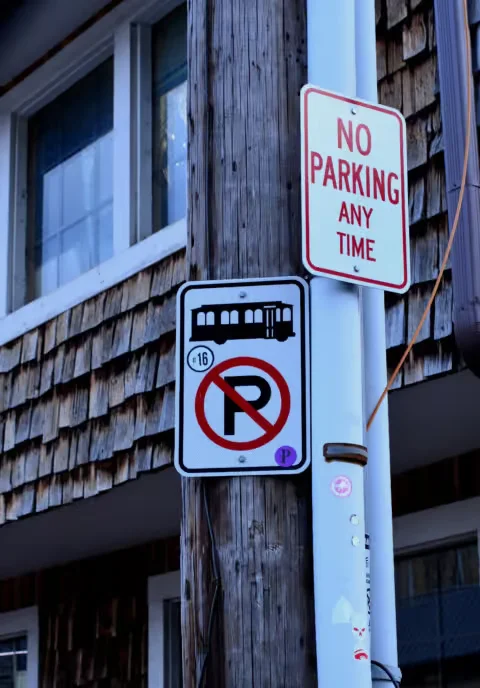
The curb. Oakland has entire blocks where a 26 foot truck cannot legally stop. Residential Permit Parking zones, street sweeping schedules, bike lanes, and narrow one ways all remove options, and Adams Point, Temescal, and Grand Lake are the neighborhoods where this bites hardest. Where the loading zone will not work, the fix is a temporary no parking permit from OakDOT, posted in advance so the space is actually clear when the truck arrives. We pull it and post it as part of the job, but it takes lead time, so the address needs to be on the booking. Our Oakland moving permit guide walks through the application, the fees, and the posting rules in detail.
One detail people miss: a no parking permit and a street sweeping restriction are two different things. If your block sweeps on Thursday morning and your move is Thursday morning, you have not solved the problem, you have just paid for a permit and a ticket. Check the posted signs on your block before you pick a date.
If the truck cannot get close at all, in parts of the Oakland hills and on some hillside stretches above Piedmont Avenue, the answer is a shuttle: a smaller vehicle ferrying loads to the truck parked lower down. It adds hours. Better to know that during the estimate than at 9 a.m. on move day.
Days 14 to 7: The deposit window most Oakland renters sleep through

This is the part almost no moving company writes about, and it is worth more money to you than anything else on this list.
Under California law, you have the right to request an initial inspection, also called a pre move-out inspection, during the final two weeks of your tenancy. Your property owner is required to notify you in writing of that right within that window, but the inspection itself only happens if you ask for it.
Here is why it matters. At the inspection, the property owner walks the unit with you and gives you an itemized statement of the repairs and cleaning they intend to deduct from your deposit. You then have until the end of the tenancy to fix those items yourself. A $60 can of paint and an afternoon beats a $400 line item on a statement you receive three weeks after you have moved. Tenants who skip the inspection typically learn what they are being charged for after they have lost any ability to do something about it.
A few other rules worth knowing before you hand over keys:
- The 21 day clock. After you vacate, the property owner has 21 calendar days to return your deposit, or to send an itemized statement of deductions with the balance and supporting documentation.
- Photographs are now required. California amended the security deposit statute effective in 2025. Property owners must photograph the unit after move-out and before any cleaning or repairs that will be charged against the deposit, and those photographs have to be provided along with the itemized statement. For tenancies that started on or after July 1, 2025, there are move-in photographs too. Take your own set as well, timestamped, every room, the day you finish. Two sets of photographs turn a disagreement into a comparison.
- Automatic cleaning charges are out. A lease cannot impose a blanket carpet cleaning fee on every vacancy. Deductions have to reflect an actual condition beyond ordinary wear and tear.
- Oakland deposits do not earn interest. Unlike some neighboring cities, Oakland does not require property owners to pay interest on security deposits. Do not expect it, and do not build it into your budget for first month’s rent at the next place.
- Give a forwarding address in writing. The 21 day statement goes to the address you provide. No address, no statement, and a much harder conversation later.
- If the deadline passes, the Rent Adjustment Program offers mediation, and small claims court is available for deposit disputes, with the possibility of statutory damages where a property owner has acted in bad faith. The city publishes a plain language information sheet on security deposits that is worth ten minutes of reading before you hand over keys.
None of this is moving work. All of it is money, and the window closes quietly.
Days 7 to 1: Pack for an elevator, not for a driveway

Packing for an apartment move is a different problem from packing for a house, because the constraint is not the truck. It is the elevator window and the walk from your door to it.
- Everything in boxes, nothing loose. In a building move, every loose item is a separate trip down a hallway. Fifteen loose items is an extra half hour of elevator time you are paying for.
- Stage by the door. Boxes stacked in the entry hall, furniture cleared to the walls, path from the door to the elevator open. Crews load in waves, and a clear staging area is the difference between two elevator runs and four.
- Label by destination room, not by contents. The crew is reading labels at speed in a hallway, not studying them.
- Flag anything that will not fit the freight elevator. If the building gave you the car’s dimensions and your sectional exceeds them, say so before move day so the crew plans a stairwell carry with the right headcount.
- Set aside what rides with you. Documents, medication, laptops, keys, jewelry, and the box you will need the first night.
- If packing is not happening, decide now rather than at 11 p.m. the night before. Professional packing can be the whole apartment or just the kitchen and the fragile items, but it has to be scheduled, usually for the day before.
And clean after the furniture leaves, not before. An empty unit cleans in a fraction of the time and photographs far better.
Move day: where the hours actually go

A two person crew, a one bedroom, a working elevator, and a truck within about 75 feet of the door is a three to five hour job. What extends it is never square footage. It is access.
| What changes the clock |
Typical effect |
| Third floor walk-up instead of an elevator |
Adds one to two hours |
| Single shared passenger elevator, no service car |
Adds one to three hours |
| Truck parked more than 75 feet away, or around a corner |
Adds one to two hours |
| Shuttle required for hillside access |
Adds two or more hours |
| Furniture that needs disassembly to clear a doorway |
Adds 30 to 90 minutes per piece |
| Packing not finished when the crew arrives |
Unpredictable, and the most expensive of the list |
Local moves in California are billed hourly, and double drive time is a state requirement that applies to every licensed mover, not a company policy. Our Oakland moving cost breakdown has the full picture of how an hourly local move is priced.
On the day itself, walk the unit with the crew lead before anything is loaded and point out the two or three items you are most concerned about. Then get out of the hallway. The single most useful thing a customer does on move day is stay reachable and stay out of the load path.
After the keys: the last 30 minutes that protect your money
Before you lock up for the last time:
- Photograph every room, the appliances, the floors, and inside the closets and cabinets. Timestamped, empty unit, before cleaning if the property owner is handling cleaning.
- Note the date and time you handed over keys, and to whom.
- Confirm your forwarding address in writing with the property manager.
- Close out utilities for the old address and confirm they are on at the new one.
- Keep your written notice, the inspection statement, and your photographs together in one place for 30 days. If a statement arrives that you disagree with, that folder is your entire case.
The short version
An Oakland apartment move fails in one of three places: the insurance paperwork, the elevator schedule, or the curb. It costs you money in a fourth, the deposit, and that one is entirely on the calendar rather than on the movers. Handle the first three by day 14 and use days 14 through 7 for the fourth, and moving day becomes what it should be, which is a few hours of lifting.
Let us handle the parts the building cares about
Tell us the address, the floor, and what your building requires. We will tell you whether your block needs a permit, get the certificate of insurance issued to your property manager with the right entities on it, coordinate the elevator window, and give you a written estimate with the crew size and hours spelled out.
Get a free estimate or call (510) 666-6480. See what is included on our Oakland apartment movers page, or the full range of what we handle as a moving company in Oakland, from studios to houses to offices.