Moving a Piano: 10 DIY Steps, U.S. Rules, and When to Hire Pros

Moving a piano is high-risk, and trained movers are the safest choice for any grand, any staircase, or any valuable instrument. If you do it yourself, you need a piano board, a heavy-duty dolly, enough capable helpers, the lid closed and covered, and ratchet straps. Check your valuation options before moving day, because standard mover liability rarely matches a piano’s value.
TL;DR:
- Measure every doorway and turn; for an upright DIY move, use a piano board, properly rated dolly, padding, and straps secured to truck anchors.
- Hire professionals for any grand, stairs without an elevator, instruments over 500 pounds, or routes with narrow doors, tight turns, or sloped access.
- Released value can reimburse only $0.60 per pound per article; request valuation options in writing, declare valuable items when required, and photograph existing damage.
- Quotes depend on stairs, crew size, piano type, distance, and extras; require a written not to exceed estimate that lists services and valuation.
Table of Contents
- How do you move a piano yourself, step by step?
- What equipment do you need to move a piano safely?
- How do upright and grand piano moves differ?
- What does it cost to move a piano?
- How does mover liability and valuation work for a piano?
- When should you hire professional piano movers?
- What do universities and federal agencies say about piano handling?
- Why we treat piano moves as precision work
- Moving a piano with our crews
- FAQ
- Sources
How do you move a piano yourself, step by step?
Piano moving rewards patience. The mistakes that wreck instruments and backs usually happen when a team rushes, skips measuring, or improvises. This procedure fits an upright piano; the next sections cover gear and grand pianos.
- Measure and photograph the route. Record every doorway width, hallway turn, stair count, and the height of your truck’s tailgate or ramp. Measure the piano too, then compare. If the numbers are close, plan for a pro.
- Clear the path. Remove rugs, open doors fully, and pad corners. Lay plywood over soft ground or thresholds.
- Prepare the instrument. Close and lock the lid over the keys. Remove the music desk and any detachable legs or pedals where the design allows. Wrap the cabinet in moving blankets and secure them with straps or stretch wrap, never tape on the finish.
- Lock or check the casters. Institutional piano-handling procedures stress locking casters and moving the piano with the lid down and covered. Casters left unlocked can send a piano rolling.
- Assign roles. Pick one person to call commands, one at the keyboard end, one at the tail, and one to clear the path and handle doors. Agree on words like “lift,” “hold,” and “set” before anyone touches the piano.
- Tilt and slide the board. Tip the piano gently onto its back edge or side, slide the piano board underneath, and strap the piano to it snugly. Keep hands on the board or the structural frame, never on the keys, legs, or pedals.
- Move it in short runs. Roll it on the dolly slowly. Stop at every threshold, turn, or ramp and reset your grip. If anyone is struggling, stop.
- Load it upright when possible. Push it against the truck’s front wall, pad all sides, and run ratchet straps through the truck’s anchor points so it cannot shift sideways.
- Unload in reverse and place it. Roll it to its final spot, set it against an interior wall away from heat vents, and lock the casters.
- Inspect before celebrating. Check the finish, legs, and pedals for damage, then photograph what you find.
Pro Tip: Do a dry run with an empty dolly along the whole route first. Doorframes and tight turns reveal themselves much more cheaply with no piano on board.
What equipment do you need to move a piano safely?
Improvised gear is a common cause of dropped pianos. Rent specialty items rather than borrowing a household hand truck.
- Piano or skid board: a padded, flat platform that supports the instrument’s weight and protects the back and sides.
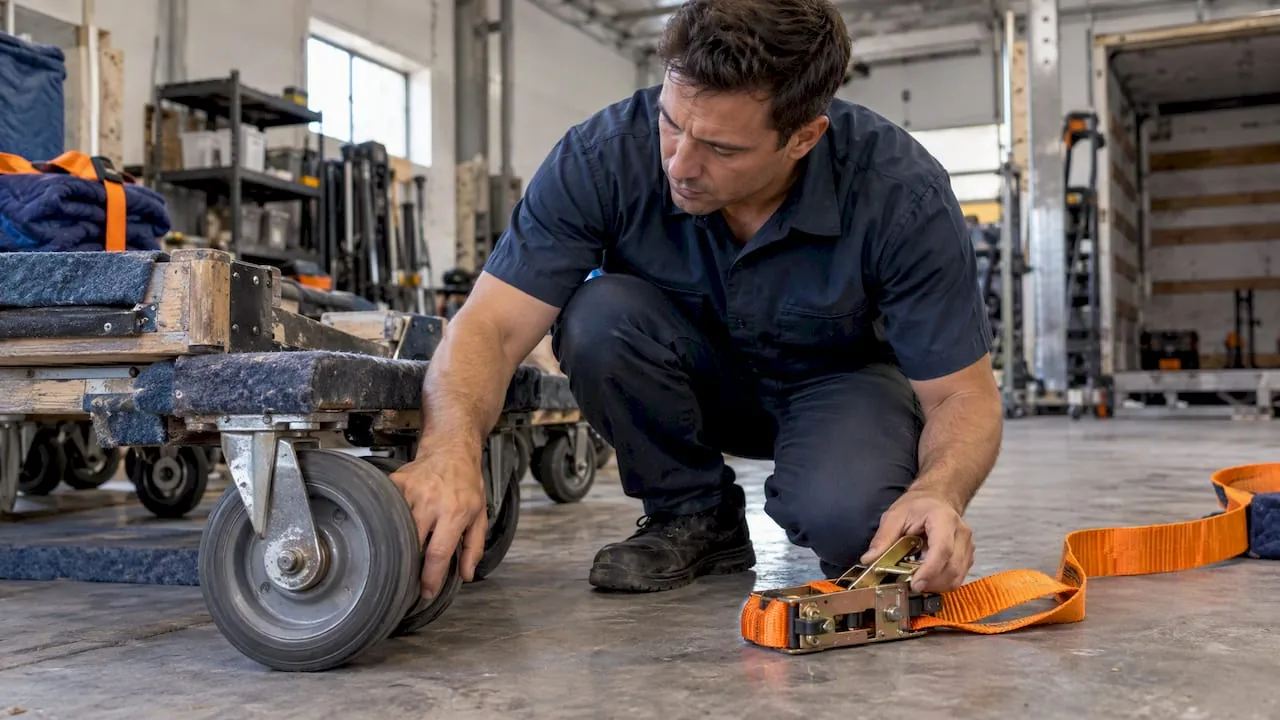
- Heavy-duty furniture dolly: large rubber wheels and a load rating well above the piano’s weight.
- Padded moving blankets: several layers to protect the finish from scuffs and strap marks.
- Ratchet straps: to hold the piano to the board and to the truck wall.
- Lifting straps or shoulder harnesses: help the team share weight, though they do not replace enough people.
- Plywood sheets or ramps: to bridge thresholds and soft surfaces.
Consumer gear is built for couches and boxes, while professional piano gear is built around a piano’s awkward center of gravity. That mismatch is why most homeowners find a regular appliance dolly unsafe for this job.
Before you leave the rental counter, check the stated load rating, run your hands along strap webbing for fraying, spin each dolly wheel, and confirm the ratchets lock and release cleanly. When fastening, pull straps snug enough to stop movement, keep metal buckles off the finish with blanket layers, and never wrap straps around the legs or pedal lyre.
How do upright and grand piano moves differ?
The right technique depends on the instrument. Treat these as starting points, not promises that any given crew size is safe for your piano.
- Uprights: often tilted slightly and rolled on a dolly or board. Watch the caster locks and check whether legs or other parts are removable. Weight is concentrated in the back, so keep the keyboard side supported.
- Grands: the tail carries serious weight, so a grand typically goes on a skid board, with legs and pedal lyre removed and the lid secured. A grand may require a larger crew, and very large grands may require a crane or stage equipment.
- Crew size: crew needs depend on the piano’s weight and the access route. Adding mechanical aids becomes essential as weight and stair count rise.
- Staying vertical: university policy says heavy equipment over 500 pounds, including pianos, should move only with appropriate equipment and trained manpower, and that the job should go to qualified firms when those resources are unavailable.
What does it cost to move a piano?
Professional piano moves are priced by effort, not distance alone. The biggest drivers are the number of stairs or flights, how many movers the job needs, the piano type, the distance, and extras like white-glove handling or crating.
- Stairs and carries: every flight or long carry adds labor, and apartment carries or shuttle trucks can raise the quote.
- Crew size: a grand needs more people than an upright, which affects the hourly or fixed fee.
- Distance: local moves are typically cheaper than long-distance ones, which may add fuel and handling.
- Billing method: some companies charge a fixed piano-move fee, others bill crew hours.
- Accessorial services: federal consumer rules say services such as piano carrying must be identified and may carry additional charges.
Experts quoted by NerdWallet emphasize that most homeowners lack professional-grade equipment, specialized lifting techniques, and sufficient insurance coverage for a DIY piano move. That gap is why a low DIY estimate can become expensive after one incident.
For our own standard local moves we list $190–200 per hour plus an $80 one-off truck fee. Piano-specific pricing depends on the job, so ask for a written not-to-exceed estimate and confirm in writing which valuation level it includes.
How does mover liability and valuation work for a piano?
Valuation is not the same as insurance, and the difference matters for a piano.
- Released rates: the Surface Transportation Board explains that movers may limit liability by published released rates, commonly $0.60 per pound per article. A high-value piano could be reimbursed at a tiny fraction of its worth.
- Full-value protection: federal guidance separates a mover’s limited liability from optional full-value or third-party coverage and encourages customers to understand the options.
- Third-party policy: consider one when full-value protection is unavailable or excludes your instrument.
Before moving day, declare extraordinary-value items if the mover requires it, get valuation choices in writing, and photograph the piano from every angle, noting existing marks. Keep copies of your inventory and the bill of lading for any later claim.
When should you hire professional piano movers?
Some situations make the decision for you.
- Any grand piano. The tail weight and need for a skid board put it beyond typical DIY gear.
- Any piano with stairs and no elevator. Stairs are where injuries and drops cluster.
- Any instrument over 500 pounds.
- Narrow doorways, tight turns, or tricky access.
- High replacement or sentimental value.
Softer triggers also push toward pros: sloped driveways, multiple tight corners, or delicate finish work you cannot afford to scuff.
When vetting a company, ask about specific piano experience, which equipment they use, what valuation options they offer, and whether they will put a written not-to-exceed quote on paper.
What do universities and federal agencies say about piano handling?
Institutions that own many pianos have written down what works. The University of Michigan School of Music, Theatre & Dance warns that moving an open piano or bumping it against surfaces causes irreversible cosmetic or internal damage that lowers value. Concert-hall policies at the University of Wisconsin call for at least two people to move a concert piano, three recommended, with the piano covered and casters locked before the lid is opened.
Your mover is contractually liable under the bill of lading; full-value protection is the most comprehensive option, and released-value protection reimburses at $0.60 per pound per article unless the customer chooses otherwise. (FMCSA)
The practical lesson on casters and lids is simple: casters left unlocked let the piano roll under its own weight, and an open lid exposes the keys and action to impact.
Why we treat piano moves as precision work
We have found that the best piano moves are boring ones: measured routes, locked casters, closed lids, and a crew that stops the moment anything feels wrong. Most damage stories begin with a team that trusted muscle over method. I also think people underestimate how much a piano’s value sits in details you cannot see, like action alignment and finish integrity. A dent can be fixed, but a jolt to the internals can quietly hurt tone for years. Treat the instrument like precision equipment, not heavy furniture. If you doubt your route or your helpers, ask a professional crew to assess it before you commit.
— Dennis
Moving a piano with our crews
Our licensed crews handle piano moves with careful padding, secure strapping, and written quotes. For high-care jobs, our white-glove movers are the right fit, and we also run local moves around the Bay Area, with professional packing available. Customers have shared positive feedback about our service. We keep you informed from the first call to the final box.

When you request a quote, we suggest asking for:
- A written not-to-exceed estimate that names the piano type and any stairs.
- Which valuation level is included, and whether full-value protection or a third-party policy is available.
- Confirmation of crew size and the equipment we will bring.
Next steps are simple: tell us the piano type and approximate weight, describe the access at both addresses, and send photos of stairs and doorways. Then get in touch with our team to book an assessment.
FAQ
What is the average price to move a piano?
Price depends on the piano type, stairs, crew size, and distance, so quotes vary widely. Ask for a written not-to-exceed estimate and confirm which valuation level it includes.
How difficult is it to move a piano?
It is hard and risky. Institutional procedures point to challenging centers of gravity and specialized boards and dollies that most households do not have.
Can I lay a piano on its back to transport it?
Avoid it. Transport an upright vertically when possible, padded and strapped to the truck wall, because tipping an instrument onto its back puts stress on the cabinet and internal action.
Can you move an upright piano with a pickup truck?
It is not recommended. An open bed offers little side support or weather protection, and the piano needs padding, anchor points for straps, and a secure upright position.
Sources
- Understanding Valuation and Insurance Options | FMCSA
- Grand Piano Moving Procedure
- Surface Transportation Board
- Piano Policies - University of Michigan School of Music, Theatre & Dance