Moving Box Sizes: What Each One Holds and How to Choose
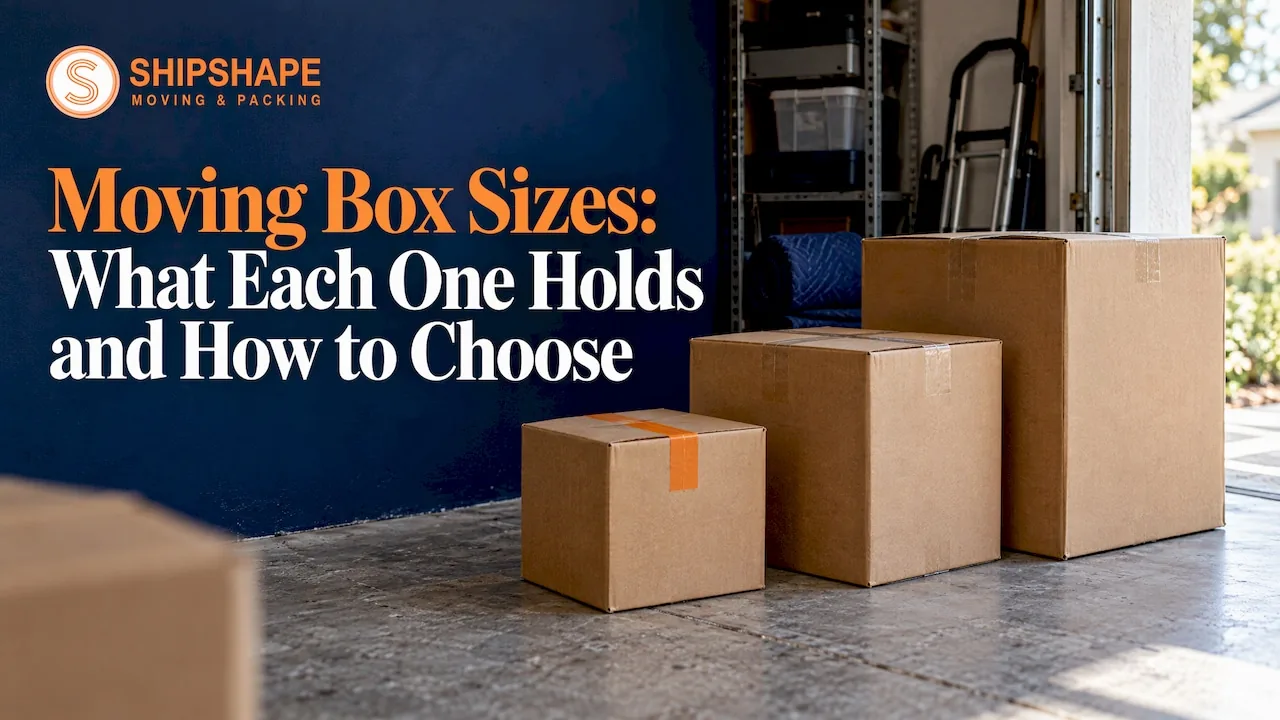
Most moving boxes fall into four sizes: small (about 16 x 12 x 12 inches), medium (about 18 x 18 x 16), large (18 x 18 x 24) and extra-large (24 x 18 x 24). Add a dish pack, a wardrobe box and a TV box, and you can pack almost an entire home. The trick is matching the box to the weight of what goes inside: heavy things in small boxes, light things in big ones.
Below you will find the dimensions and capacities, what belongs in each box, how to handle dishes and TVs, and a simple way to estimate how many boxes you need.
Key Takeaways
- The standard range runs from a 12 x 12 x 10 inch box (0.83 cubic feet) up to a 24 x 18 x 24 inch box (6 cubic feet), with specialty cartons for dishes, clothes on hangers and TVs.
- Pack by weight, not by room: books and tools in small boxes, linens and pillows in large ones. Aim to keep any filled box at or under 50 pounds.
- Sizes differ slightly from one supplier to the next, so check the printed dimensions on the box you buy rather than relying on the name.
- Dishes go in a double-walled dish pack, wrapped individually and stood on edge. Flat-screen TVs need a TV-specific box or a professional wrap.
- If you would rather skip the box math, our crews can pack, label and move everything for you.
Table of Contents
- Standard Moving Box Sizes at a Glance
- What to Pack in Each Box Size
- How Heavy Should a Packed Box Be?
- Dish Pack Boxes: Size and Packing Method
- TV Boxes: Choosing the Right One
- How to Measure and Compare Box Sizes
- How Many Boxes Will You Need?
- Our Perspective on Box Sizes
- Let Us Do the Packing
- FAQ
- Sources
Standard Moving Box Sizes at a Glance
Box makers publish slightly different numbers, but the common sizes cluster tightly. This chart uses the dimensions and volumes listed by Material Handling USA, a box manufacturer.
| Box | Dimensions (inches) | Volume (cubic feet) | Best for |
|---|---|---|---|
| Extra-small / book | 12 x 12 x 10 | 0.83 | Books, records, canned goods, tools |
| Small | 16 x 12 x 12 | 1.33 | Heavy, dense items, small kitchen gear |
| Medium | 18 x 18 x 16 | 3.00 | Pots, small appliances, toys, décor |
| Large | 18 x 18 x 24 | 4.50 | Lightweight bulky items, linens, lampshades |
| Extra-large | 24 x 18 x 24 | 6.00 | Pillows, comforters, stuffed animals |
| Dish pack | 18 x 18 x 28 | 5.20 | Plates, glasses, fragile kitchenware |
| Wardrobe | 20 x 20 x 45 | 10.4 | Hanging clothes |
Treat these as typical, not universal. Public Storage’s moving guide notes that box dimensions and capacity vary by supplier. One store’s medium might be 18 x 18 x 15 and another’s 18 x 18 x 16. A half inch rarely matters for one box, but it matters when you are stacking thirty of them in a truck or trying to fit a set of boxes under a staircase.
Why the sizes work the way they do
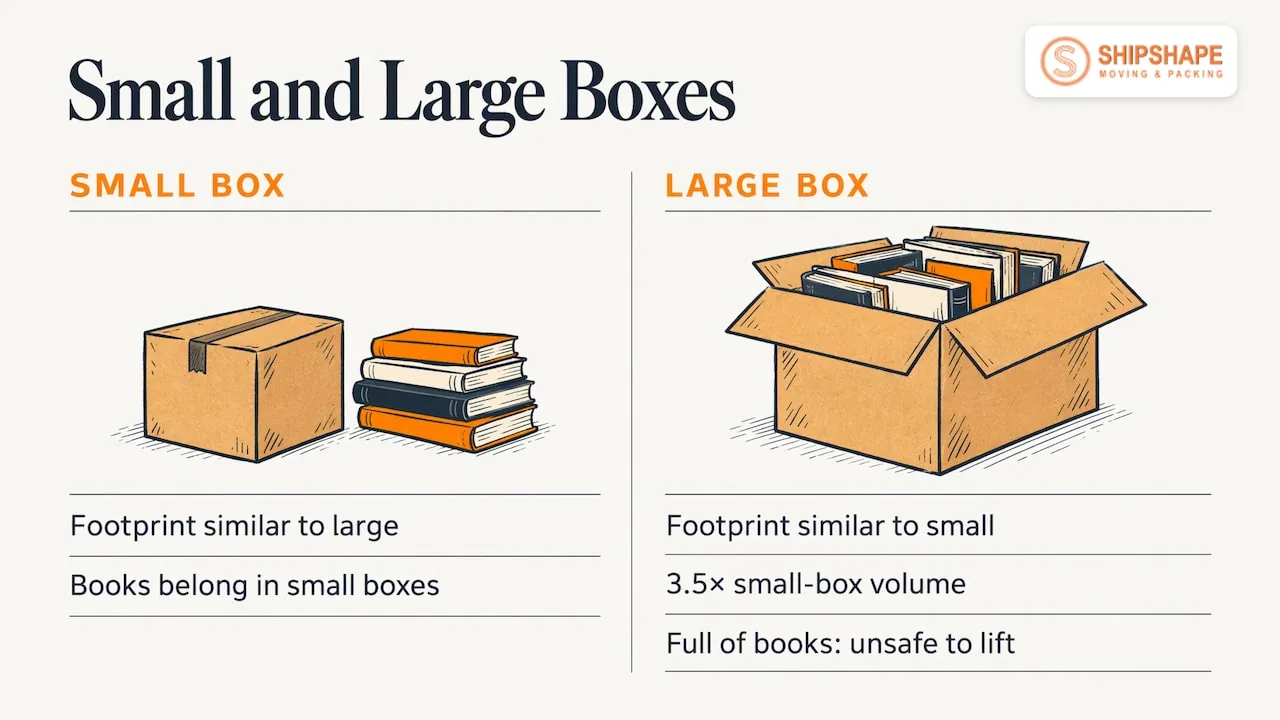
The sizes are not random. Small, medium and large boxes share a similar footprint, so they stack in neat columns on a truck. A large box holds about three and a half times the volume of a small one, which is exactly why you do not put books in it. A box that size filled with paperbacks would be too heavy to lift safely.
What to Pack in Each Box Size
The rule that saves the most backs and the most box bottoms: Public Storage’s guide puts it as pack heavy items in small boxes and lightweight items in larger boxes. It sounds backward until you try to carry a large box of cast iron pans.
Small and book boxes
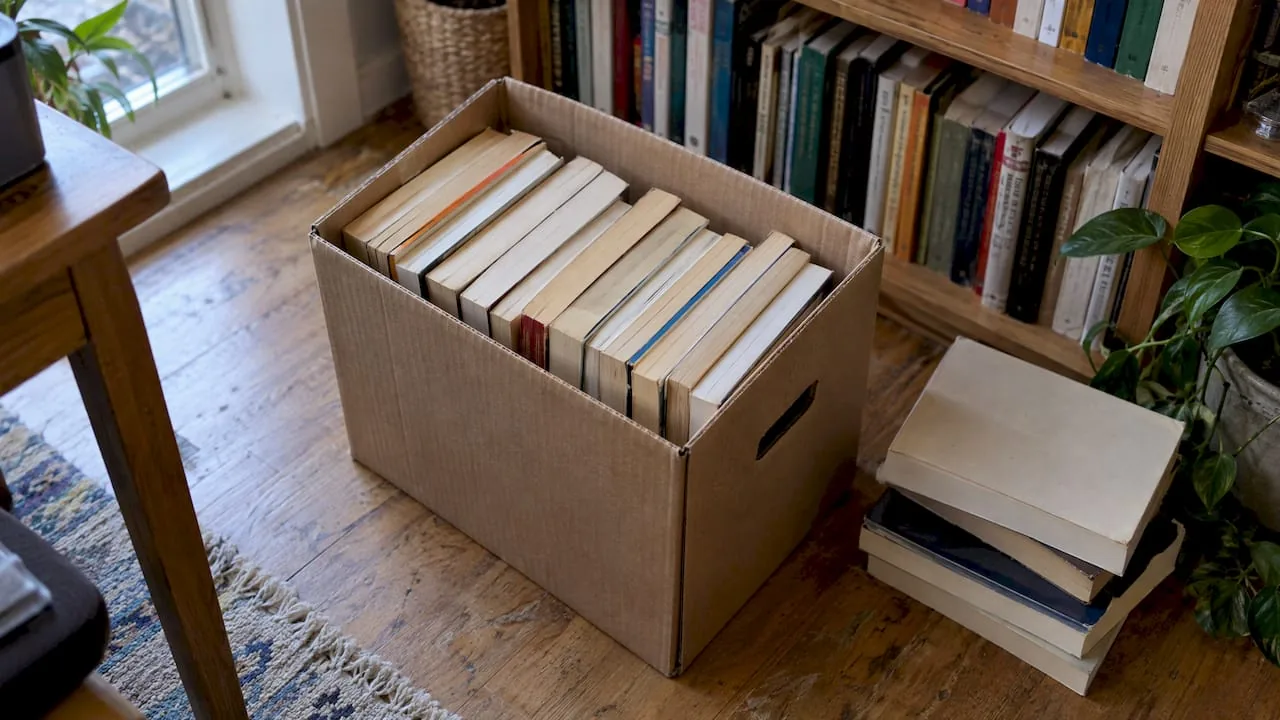
Use these for anything dense: books, magazines, files, vinyl records, canned and jarred food, hand tools, paperweights and small stone or metal décor. Fill them to the top with no gaps, and tape the seams. A small box packed solid with books is already heavy, so do not be tempted to move up a size.
Medium boxes
Medium boxes are the workhorse. They suit pots and pans, small appliances, toys, shoes, bathroom items, cleaning supplies and mixed kitchen goods. Pack heavier items on the bottom and lighter ones on top, and fill empty space with crumpled packing paper so nothing shifts.
Large and extra-large boxes
These are for volume, not weight: bed pillows, comforters, towels, throw blankets, lampshades, stuffed animals and plastic storage items. If you lift a large box and it feels heavier than a medium, something dense has snuck in. Move it to a smaller box.
Specialty boxes
A wardrobe box has a built-in hanging bar so your clothes travel on their hangers and arrive ready for the closet. Picture and mirror boxes come in flat, adjustable cartons. A file box has an attached lid and handles. For anything delicate or irreplaceable, such as heirlooms, ask us about moving antiques safely.
How Heavy Should a Packed Box Be?
There is no single legal limit, but there is a practical one. Most moving companies ask that boxes stay at 50 pounds or less, because a box one person can lift keeps the move moving and avoids two-person carries that slow things down.
If you are carrying boxes yourself up stairs, aim lower. Many people find 30 pounds is where a box stops feeling easy. A good test: lift it from the floor to hip height with a straight back. If you have to brace yourself, repack it into two boxes.
A few habits make boxes stronger:
- Use the “H” taping method: run tape along the center seam, then along both edges of the bottom flaps. Public Storage recommends this for reinforcing box bottoms.
- Put heavier items at the bottom and lighter items on top.
- Fill gaps so the contents cannot shift, but do not bulge the lid. A closed box should be flat on top so it stacks.
- Label each box with the room, a general description of what is inside and any handling note such as “fragile” or “this side up”.
Dish Pack Boxes: Size and Packing Method
A dish pack, sometimes called a dish barrel, is a double-walled carton built to take the weight and pressure of plates, bowls and glasses. The common size is about 18 x 18 x 28 inches, which matches the 18 x 18 x 28 inch, 5.2 cubic foot dish pack in the chart above. This Old House recommends double-walled boxes of roughly that size, individually wrapped plates and packing the heaviest dishes first.
Here is a reliable sequence:
- Line the bottom with several sheets of crumpled packing paper or a layer of foam.
- Wrap each plate individually in packing paper. Stack a small bundle of wrapped plates and wrap the bundle again.
- Stand plates on edge, never flat. Think of how they sit in a dishwasher rack.
- Place heavy items such as dinner plates at the bottom, then bowls, then cups and glasses on top.
- Wrap glasses and stemware one by one, and stuff paper inside them as well.
- Fill every gap, add a paper layer on top, close and tape the box, and mark it “fragile, dishes” on several sides.
Because a full dish pack can be heavy, do not stretch it by adding silverware or pots. Keep those in a small or medium box.
If packing a kitchen sounds like the longest part of your move, it often is. Our professional packing service handles kitchens, with crews that wrap, box and label as they go.
TV Boxes: Choosing the Right One
Televisions are the item people most often get wrong, because a regular box is the wrong shape. Flat screens are wide, thin and fragile at the surface, so the box has to hold the set upright with padding on all sides.
The best container is the original carton and foam inserts, if you kept them. If not, a purpose-made TV box is adjustable in length and often includes foam corners. When you choose one:
- Match the box to the screen diagonal, not the width of your TV stand. Measure your TV’s diagonal, plus its width, height and depth, and compare those with the box’s stated range.
- Choose a box rated for the weight of your set.
- Never lay a flat screen on its face. Transport it upright, the way it stands on a shelf.
- Wrap the screen in a soft layer first, such as a blanket or foam sheet, and remove stands, cables and wall mounts. Keep screws in a labeled bag taped to the back.
For step-by-step photos and details, see our guide on how to pack a TV for moving. Very large or wall-mounted sets are often safest left to the crew.
How to Measure and Compare Box Sizes
Because one brand’s medium is another’s “standard”, compare numbers, not names.
Read the three dimensions. Box dimensions are listed as length x width x height, and they are almost always inside measurements. Check this against the product description.
Compare cubic feet. Multiply length by width by height in inches, then divide by 1,728. An 18 x 18 x 16 inch box gives 5,184 cubic inches, or 3 cubic feet. Comparing volume tells you quickly whether two “medium” boxes really match.
Measure your items. For awkward things such as lamps, artwork and small appliances, measure the longest dimension and add two inches on each side for padding. If the item will not fit with that margin, step up one size or use a specialty box.
Mind the stacking. Boxes of one supplier stack neatly with each other. Mixing many brands creates leaning towers. Try to buy most of your boxes from one source.
How Many Boxes Will You Need?
There is no exact number, since a bookworm and a minimalist living in the same size apartment will differ wildly. As a rough planning approach, count your rooms and think in terms of what the kitchen, closets and books will need:
| Room or category | Likely box mix |
|---|---|
| Kitchen | Several dish packs, medium boxes, a few small boxes |
| Bedrooms | Wardrobe boxes, large boxes for linens, medium for shoes and accessories |
| Living room | Medium boxes, a TV box, picture boxes |
| Books and files | Small or book boxes, which add up faster than people expect |
| Bathroom and garage | Small and medium boxes |
Buy about 10 percent more than you think you need. Running out on the last night is a classic problem, and spare boxes are easy to return or reuse. Public Storage and many retailers also offer online calculators, which can give you a starting figure for your home size.
Our Perspective on Box Sizes
We have seen boxes packed every way imaginable, and the problems repeat. Books go in large boxes. Dishes go in a regular medium box with no padding. A TV rides flat on its screen. None of it is careless on purpose. People simply have not been told which box does which job.
What we encourage is clear communication before the move, so nothing is a surprise on moving day. When we pack, we label every box with its room and contents, so unpacking is a matter of reading, not guessing. Our crews pay close attention to detail, and for valuable or fragile items we offer white glove handling.
If you want to pack some rooms yourself and leave the fragile ones to us, that is a sensible split. We can pack the kitchen, the art and the electronics, while you handle the closets and books. Whatever the mix, we will tell you plainly what to expect, and we give written not-to-exceed quotes.
Dennis
Let Us Do the Packing
Packing is often the most tiring part of a move. Our crews bring the right box for each item, wrap carefully, label clearly and load with care, across Berkeley, Oakland, San Francisco and the wider Bay Area. Our website lists local moves at $190-200 per hour, plus an $80 truck fee. Packing and other services are quoted individually, because the cost depends on crew size, how complex the move is and the hours worked.

To get a quote, start at our local moving page, or look at our residential moving services. Planning a bigger relocation? See our long-distance moving service, and for more practical advice, browse our moving tips and tricks.
FAQ
What are the standard moving box sizes?
The usual set is small (about 16 x 12 x 12 inches, 1.33 cubic feet), medium (18 x 18 x 16, 3 cubic feet), large (18 x 18 x 24, 4.5 cubic feet) and extra-large (24 x 18 x 24, 6 cubic feet). Book boxes are smaller, around 12 x 12 x 10. Exact dimensions vary a little by supplier, so check the label.
What size is a dish pack box?
The common dish pack measures 18 x 18 x 28 inches, with about 5.2 cubic feet of space. It is double-walled for strength. Wrap each piece individually and pack plates on edge rather than flat.
What size TV box do I need?
Choose one that matches your TV’s screen diagonal and weight, and make sure it keeps the screen upright with padding all around. If you still have the original box and foam, use that. A professional crew can also wrap and move a TV without a box.
How much weight can a moving box hold?
Most moving companies ask for 50 pounds or less per box. In practice, many people find boxes around 30 pounds much easier to carry. Put dense items in small boxes to stay under the limit.
Which boxes do I need for clothes?
A wardrobe box, about 20 x 20 x 45 inches, lets you move clothes on hangers. Fold the rest into large boxes, since clothes are light, and keep shoes in medium boxes.
Sources
- Moving Boxes: Sizes, Wardrobe & Dish Pack Cartons, Material Handling USA
- What Size Moving Boxes Do I Need? Public Storage
- How heavy can moving boxes be? Yahoo Local
- How To Pack Dishes for Moving, This Old House