Moving Company Fees: What You’ll Pay and Why

Moving company fees come down to a few building blocks: an hourly labor rate or a weight-and-distance charge, a truck fee, and add-ons such as packing, stairs, long carries and specialty items. In the Bay Area, our local moves run $190-$200 per hour plus an $80 one-off truck fee. The rest of this guide shows how those pieces add up, which extra charges are legitimate, and how to read a quote so the number on moving day matches the number you were given.
Key Takeaways
- Local moves are billed by the hour, with a crew, a truck fee and any add-on services. Long-distance moves are priced by shipment weight and mileage.
- Access problems (stairs, elevators, long carries, difficult parking) and specialty items are the most common reasons a bill grows.
- In California, a household mover must give you a written “Not to Exceed” price after inspecting your items. Verbal or internet-only estimates are a warning sign.
- Get at least three written estimates based on a look at your home, then compare what each one includes, not just the bottom line.
Table of Contents
- What a moving bill is made of
- How movers calculate local fees
- How long-distance fees work
- Extra fees that can appear on a bill
- Binding, nonbinding and California’s “Not to Exceed” rule
- How to compare quotes without getting burned
- Our perspective on moving fees
- Ways to keep your moving bill under control
- Get a clear number from ShipShape Moving
- FAQ
- Sources
What a moving bill is made of
Every moving bill is a stack of line items. Some are obvious, some hide in the fine print. Here is the structure most reputable movers use.
| Charge | What it covers | How it is usually billed |
|---|---|---|
| Labor | The crew that loads, drives and unloads | Per hour for local moves, built into a weight-based price for long distance |
| Truck fee | Getting the truck and equipment to the job | One-off flat fee |
| Packing | Materials plus the labor to pack and label | Per box, per room or per hour |
| Access charges | Stairs, elevators, long carries, shuttles | Flat amount or extra labor time |
| Specialty handling | Pianos, safes, art, fragile collections | Flat fee or extra crew time |
| Storage | Short-term holding between homes | Per month or per day |
At ShipShape Moving, local moves are $190-$200 per hour and the truck fee is $80, charged once. Packing, office relocations, long-distance and white glove work are quoted individually because they depend on your inventory, your building and your timeline. We do not publish a number for those because a number without a walk-through would only be a guess.
How movers calculate local fees
Local moves are almost always billed by time. Three variables drive the total: how many movers are on the crew, how long the job takes, and the hourly rate.
A larger crew costs more per hour but often finishes faster, so the total does not always rise in proportion. A well-prepared home with boxes sealed, furniture disassembled and a clear path to the truck moves faster than one where the crew waits on last-minute packing.
Published national averages vary a lot. Forbes reports that local moves typically cost $45 to $80 per hour per mover, and that some circumstances push the price above $150 per mover per hour. NerdWallet, citing HomeAdvisor, puts a typical local move between $880 and $2,570. Bay Area labor, parking and building rules sit at the upper end of any national range, which is why a crew-rate quote here looks higher than a national average. When you compare, ask whether a quoted hourly rate is for the whole crew or per mover. That single detail changes the math by a factor of three or four.
Hourly minimums and travel time
Many movers set a minimum number of hours. Ask whether the clock starts when the crew arrives at your door or when they leave the office, and whether the drive between the old and new address is billed. Both practices are common, and neither is wrong, but you need to know which one applies before you sign.
The worked example
Take a hypothetical two-bedroom apartment move at a $195 hourly rate, with a four-hour job. Labor is $780. Add the $80 truck fee and the total is $860 before any packing, stairs or specialty items. If the crew runs an extra hour because the elevator is shared and slow, that is another $195. This is an illustration of the arithmetic, not a quote: your actual hours depend on your inventory and your building.
How long-distance fees work
Long-distance moves use a different model. Instead of billing by the hour, the carrier prices your shipment by weight and mileage, plus services. That is why the size of the home matters less than what is actually going on the truck.
National figures give a sense of scale. HomeAdvisor’s estimate, reported by NerdWallet, is that a long-distance move averages $4,582, with a typical range of $2,417 to $6,863. Another 2026 breakdown puts long-distance costs at $2,500 to $7,500 or more, depending on home size and distance. These are broad ranges. A move from Berkeley to the East Coast with a full house will not look like a move from Oakland to Sacramento.
If you are leaving the Bay Area, our long-distance moving team builds the quote from a visual inventory so the weight estimate is grounded in your actual belongings.
Extra fees that can appear on a bill
This is where most surprises live. The federal glossary of moving terms from the FMCSA lists the charges that can be added: packing, appliance servicing, unpacking, piano stair carries, shuttle service and extra labor, bulky-article charges, storage-in-transit, and third-party services. Here is what each means in practice.
Packing and unpacking
Packing is billed for materials and labor. A fully packed three-bedroom home can add a meaningful share to the total, because packing is slow, careful work. If you want to control that cost, pack low-risk items yourself (books, linens, off-season clothes) and leave kitchens, art and fragile pieces to professionals. Our packing services include labeling by room, which saves hours on the unpacking side.
Stairs, elevators and long carries
Access conditions can add charges: stairs, elevators, long carries and difficult parking. The FMCSA also defines a shuttle as an additional smaller vehicle plus extra labor, used when the main truck cannot reach your residence. In Berkeley hillside streets and San Francisco’s tight blocks, this is not rare. Tell your mover about the third-floor walk-up, the loading dock reservation and the street that a 26-foot truck cannot enter. Federal rules say the mover is supposed to determine accessorial charges such as elevators and long carries before preparing the bill of lading, but if it did not ask, the rule allows billing those charges after delivery. Being upfront at the quote stage protects you.
Specialty items
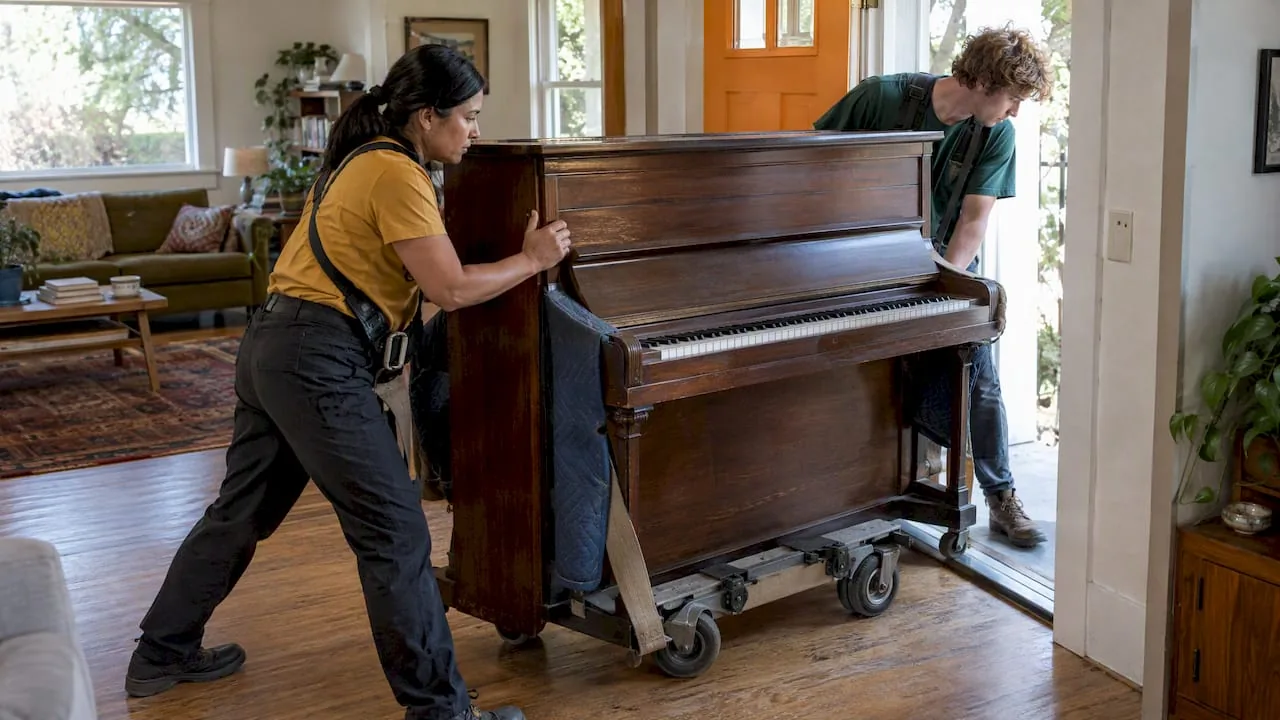
Pianos, safes, gun cabinets, large artwork and antiques need extra people, equipment or custom crating. This is the realm of white glove handling, where items are wrapped, moved and placed with extra care. Ask for the specialty line item in writing rather than a lump sum.
Storage and timing
If your closing date and lease end do not match, you may need storage between homes. Weekends, month-end and summer are the busiest periods, and demand can lift prices or limit availability. A weekday mid-month move is often easier to book.
After-hours and business moves
Offices, clinics and retail stores often cannot afford downtime, so moves happen at night or on weekends. Crews working outside normal hours may be priced differently than a standard daytime job. We plan office and commercial moves around your operating hours and quote them after we see the space.
Binding, nonbinding and California’s “Not to Exceed” rule
The type of estimate you accept decides how much room the final bill has to move.
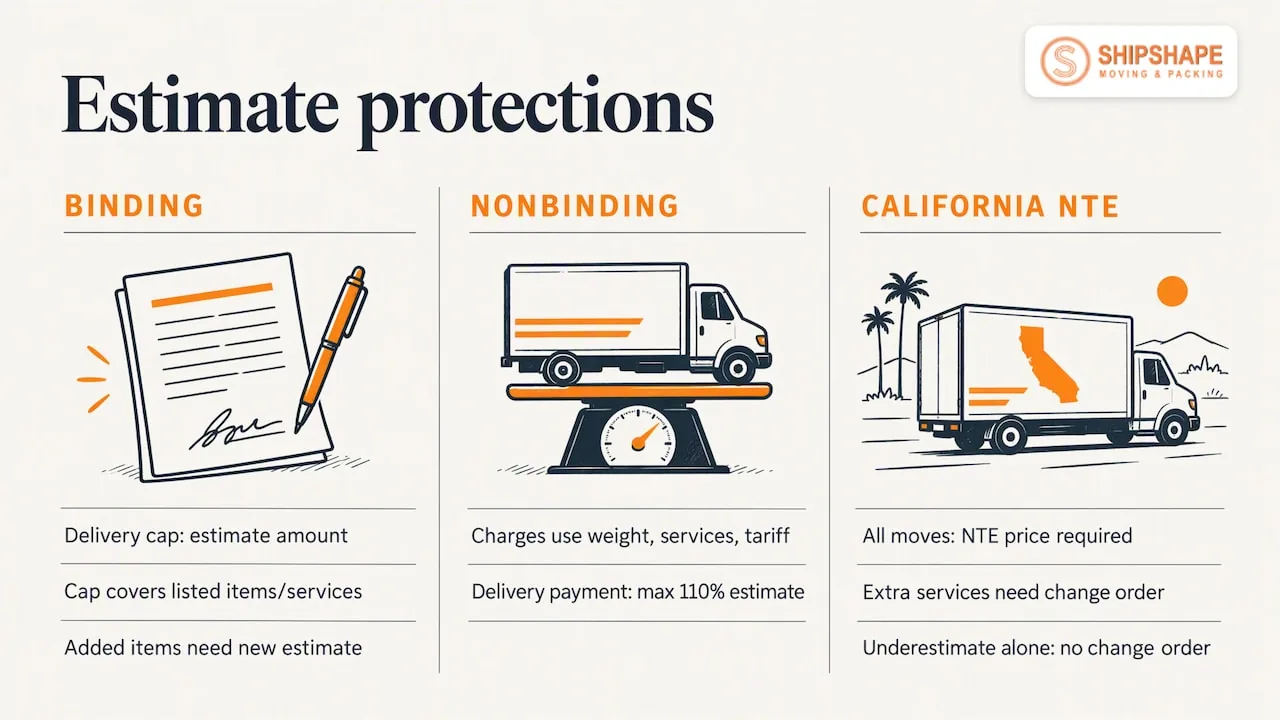
Under federal rules for interstate moves, a binding estimate guarantees you will not pay more than the estimate at delivery for the listed items and services. Added items or unforeseen circumstances require a new estimate. A nonbinding estimate is not a guarantee: final charges are based on actual weight, services and the mover’s tariff, and generally no more than 110% of the estimate can be required at delivery.
For moves within California, the state’s Bureau of Household Goods and Services sets its own protections. According to the bureau, a moving company must provide a “Not to Exceed” price for all household moves, the maximum you can be charged unless you request additional services, which are then detailed in a change order. A change order cannot be used simply because the mover underestimated. The bureau also states that a written estimate may come only after the mover has visually inspected the items, and that verbal or internet-only estimates are illegal and may not be enforceable. It further notes that loss or damage claims must be filed in writing within nine months of delivery.
That last point deserves a calendar reminder. Keep your paperwork, and photograph valuable items before the move.
How to compare quotes without getting burned
The Better Business Bureau advises getting at least three written estimates from different movers, preferably based on visits to your home. The North Carolina Utilities Commission adds a caution that internet-only quotes may come from uncertificated brokers rather than the company that will show up. The advice applies in California as well.
When the quotes arrive, line them up on the same terms:
- Estimate type. Is it a not-to-exceed price or an open-ended hourly guess?
- Crew size and hourly rate. Is the rate per crew or per mover?
- Truck fee and travel time. What is charged before the first box moves?
- Packing. Are materials included or billed separately?
- Access charges. Did the estimator ask about stairs, elevators and parking?
- Deposit. Some movers ask for a deposit to hold a date. Get the amount and the refund terms in writing.
- License. Confirm the company is licensed to move household goods in California.
The lowest number is not always the lowest cost. A quote that leaves out packing, stairs and a truck fee will look tempting until the final invoice arrives.
Our perspective on moving fees
Most fee complaints we hear about from people who moved with someone else are not about the price. They are about surprise. A number that grows on moving day feels like a broken promise, even when each item was technically allowed.
So we build quotes backwards from that feeling. We want to know about the staircase, the loading zone and the grand piano before the quote, not after. We put the price in writing as a not-to-exceed figure, explain the hourly rate and the truck fee, and tell you what would trigger a change order and what would not. If you add boxes to the pile the night before, that is a change you asked for. If we underestimated, that is on us.
We also think crew quality is a pricing issue. A careful crew that wraps furniture, labels every box and keeps you informed from the first call to the final sign-off costs less in the long run than a rushed one that leaves you with damage claims and a missing lamp. Our 5.0 Google rating across 332 reviews is built on that, and we would rather earn the next review than stretch a quote.
If you are comparing movers, ask each of them the same four questions: Is this a not-to-exceed price? What triggers a change order? What is the truck fee? Who exactly is coming to my door? The answers tell you more than the headline rate.
— Dennis
Ways to keep your moving bill under control
You can lower the total without giving up the services that protect your belongings.
- Declutter first. Fewer items means fewer hours locally and less weight on a long-distance move.
- Prepare the home. Disassemble beds, empty drawers if the mover advises it, and clear paths and parking before the crew arrives.
- Reserve parking and elevators. Waiting time is billed time.
- Choose your day. Mid-month weekdays are generally easier to schedule than month-end weekends.
- Pack selectively. Do the easy rooms yourself and hire help for the fragile ones.
- Decide before the day. Adding services on the spot is how not-to-exceed prices turn into change orders.
NerdWallet’s experts note that professional movers are the most expensive option for long-distance moves, but they save significant time and stress compared with doing it yourself. If your time, your back or your furniture matter to you, that tradeoff is worth pricing honestly.
Get a clear number from ShipShape Moving
We are a licensed moving company based in Berkeley, serving Berkeley, Oakland, San Francisco and the surrounding Bay Area. Local moves are $190-$200 per hour with a one-time $80 truck fee, and we provide written not-to-exceed quotes for the rest, from apartments and large homes to offices and long-distance relocations. Some dates may require a deposit to secure them.

Tell us about your move and we will give you a written number you can compare with the others. Start with our local moving rates, or see how we handle an apartment move or a large home move. For local price context, our Oakland moving cost guide breaks down real-world scenarios.
FAQ
What is a typical truck fee?
It varies by company, and some movers fold it into the hourly rate. Ours is an $80 one-off charge for local moves. Ask any mover whether the truck fee is separate, and whether fuel or travel time is billed on top.
Can a moving company charge more than the estimate?
It depends on the estimate. A binding estimate caps what you pay for the listed items and services. A nonbinding estimate allows the final bill to differ, but no more than 110% of the estimate can generally be demanded at delivery on interstate moves. In California, household movers must provide a not-to-exceed price, and changes require a written change order.
Are online quotes reliable?
Treat them as a rough starting point. California’s bureau says that written estimates may be given only after a visual inspection, and that internet estimates may not be enforceable. A video walk-through or an in-home visit gives you a number you can rely on.
Why do stairs and elevators cost extra?
They slow the crew and can require extra labor or a shuttle vehicle. The FMCSA lists these access conditions among the charges that can appear on a bill. Tell your mover about them at the quote stage so they are priced in, not added later.
Do I need to tip movers?
Tipping is a personal choice and is not a required fee. Many customers tip for an excellent job, but it should never be part of what a company demands in a quote.
Sources
- How Much Does It Cost to Move? (NerdWallet)
- How Much Do Movers Cost? (Forbes Advisor)
- How Much Does It Cost to Move in 2026? (Opendoor)
- Glossary (FMCSA)
- 49 CFR 375.401, Must I estimate charges?
- What is a binding move estimate? (FMCSA)
- BBB Tip: Hiring a mover
- A North Carolina Consumer’s Guide to moving (NCUC)