Moving From the Bay Area: Where to Go and How to Plan

Moving from the Bay Area works best when you settle three things in order: where you are going, what the new place will really cost you, and how the move itself will run. Most people who leave end up in cheaper neighborhoods, often elsewhere in California, and the move goes more smoothly when the logistics are planned as early as the destination. Below you will find the research on where Bay Area residents go, what to compare before you pick a city, and how to plan the move day.
Key Takeaways
- Housing and the cost of living are the main reasons people leave. In a Silicon Valley Leadership Group poll reported by KQED, 83 percent called housing costs a very or extremely serious problem.
- Many leavers stay in California. Lower-income households in particular tend to head to the Sacramento region or the Central Valley.
- Cheaper homes and rents often come with trade-offs in incomes, schools and climate risk, so compare the whole picture, not just the price.
- Remote work drives much of the recent exodus, so your employer’s policy shapes which destinations are realistic.
- A written not-to-exceed quote, an early packing plan and a clear moving-day schedule take most of the stress out of a long-distance move.
Table of Contents
- Why people are leaving the Bay Area
- Where people go when they leave
- What to compare before you choose a destination
- Planning the move itself
- Packing and handling for a longer trip
- Different movers, different plans
- Our perspective
- Get a quote for your move
- FAQ
- Sources
Why people are leaving the Bay Area
Cost is the common thread. A 2025 Silicon Valley Poll, reported by Joint Venture, found that 43% of residents say they are likely to move out of the Bay Area in the next few years. They named the cost of living, housing and a wish for better work-life balance.
Earlier polling points the same way. A KQED report on Silicon Valley Leadership Group polls found that 65 percent of respondents in the five most populous Bay Area counties felt quality of life had gotten worse over five years. Another 44 percent were considering leaving, and 83 percent called housing costs an extremely or very serious problem.
Money is not the whole story, and the research says so. A Stanford policy brief on California’s population drain found that two-thirds of Californians who moved said politics was not a factor in their decision. Your reasons are probably practical: space, a first home, a shorter commute, a slower pace. Write them down before you pick a destination, because they decide which trade-offs are acceptable.
Where people go when they leave
Staying in California
A large share of Bay Area out-movers do not leave the state. A Terner Center study at UC Berkeley found that between 2010 and 2016, more than 55 percent of out-migrants in households earning under $50,000 a year stayed in California. Among households earning over $200,000, only about one-third did. The lowest-income movers were most likely to go to the Sacramento region or Central Valley metros such as Modesto or Fresno.
The flow toward the Central Valley is well documented. A USC research brief found that from 1994 to 2015, migration from the Bay Area to the Central Valley ran 60% higher than migration the other way. Places like Roseville and Folsom north of Sacramento drew far more higher-income movers than the areas around Stockton.
An in-state move has practical perks. You keep your California license and professional credentials, you stay within driving distance of family, and the move is usually a one-day job rather than a multi-day trip.
Leaving the state
For those who do leave, the destinations are fairly concentrated. A PPIC analysis found California has a substantial net loss to Texas (21,438 people) and Florida (12,645). It also found a disproportionate loss to Nevada and Idaho relative to their size. High-income Californians continue to favor states without income taxes, though the gap has narrowed.
Out-of-state movers do see a difference in housing outcomes. The California Policy Lab found that a year after leaving the Bay for another state, former residents were 15% more likely to be homeowners. After five years, out-of-state movers were nearly 33% more likely to own than before they left.
What to compare before you choose a destination
A lower price tag is the starting point, not the answer. The California Policy Lab found that people who leave the Bay Area see home values about 50% lower and rents about 33% lower on average. Those neighborhoods also tend to have lower incomes, lower-performing schools and greater climate vulnerability.
Use a short list of criteria and score each candidate city against it:
| Criterion | What to check | Why it matters |
|---|---|---|
| Housing | Median rent and purchase price for the neighborhoods you would really live in | City averages hide big differences between neighborhoods |
| Income and taxes | Your state income tax, property tax and any change in salary | Savings depend on your tax picture, not only on rent |
| Jobs | Local employers in your field, or your employer’s remote policy | Research ties migration to job availability and similar industries |
| Schools | Ratings and visits for the specific schools in your zone | Lower housing costs can come with lower-performing schools |
| Climate risk | Heat, wildfire smoke and flood exposure | The cheapest areas often carry the highest exposure |
| Family and community | Distance to relatives, friends, healthcare | Savings mean little if you are isolated |
A peer-reviewed study of California DMV mobility data from 2014 to 2021 found that migration is strongly associated with population size, proximity, job availability and similarity of industry between origin and destination. In plain terms, people tend to move to places that look economically like the place they left. That is a useful check on your own list: if your field has no footprint in a city, the low rents may not help you.
Your employer and your income
Remote work has reshaped who moves. A PPIC blog post found that since the pandemic, remote workers account for the entire increase in movers out of the Bay Area. It also found the region’s 28% remote work rate in 2021-2022 would have been the highest in the country if it were a state.
If you work remotely, confirm in writing what your employer will allow. Some companies adjust pay by location, and some restrict which states they can employ people in. Do the math with your real salary, not an average one. Moving within California will not change your state income tax, while a move to a no-income-tax state will. Rent savings, tax changes and a possible pay adjustment all pull in different directions, and you need the net figure.
Check the downside before you sign a lease
Before committing, spend a few days in the new city at the times you would actually live there: a weekday commute, a weekend, an August afternoon. The same Stanford brief found that 45 percent of surveyed migrants agreed the weather was better in California than in Arizona or Texas. Many leavers discover they miss something they did not expect to, so test the day-to-day, not just the listing photos.
Planning the move itself
Once the destination is chosen, the timeline matters more than most people expect. Here is a sequence that works for most households.
- Eight to six weeks out: Decide the move date and get written quotes. Ask whether the quote is a not-to-exceed figure, what the hourly rate covers, and whether a deposit is needed to hold your date.
- Six to four weeks out: Sort and purge. Every item you sell or donate is an item you do not pay to move, load or unpack.
- Four to two weeks out: Start packing rooms you rarely use. Label every box by room and contents so unpacking is quick.
- The final week: Confirm access at both addresses: elevator reservations, parking, loading zones, building move-in hours.
- Moving day: Keep documents, medications, chargers and valuables with you, not on the truck.
Bay Area buildings add their own wrinkles. Narrow streets, hills, walk-ups and strict elevator windows are common, and they affect how many movers you need and how long the job takes. Our guide on preparing for moving day in San Francisco covers the access questions in detail. If animals are coming along, see our calm moving-day plan for pets.
What a move costs here
For local Bay Area moves, we bill by crew size, hours worked and the complexity of the job. Our local moves run $190-$200 per hour, plus an $80 truck fee. Packing and other add-ons are priced according to the scope of the job, and we provide written not-to-exceed quotes. Long-distance and specialty moves are quoted individually, because distance, volume and access at both ends change the work.
Two habits keep the final bill predictable. Get the quote in writing, and make the inventory honest: a move quoted for a one-bedroom that turns out to be a two-bedroom with a garage will cost more on any day with any crew.
Packing and handling for a longer trip
A move out of the Bay Area usually means your belongings spend longer in the truck and are handled more times than in a cross-town move. That raises the stakes on packing. Boxes need to be sturdy, dishes and glassware need proper padding, and furniture needs protection from shifting in transit.

Our crews specialize in careful packing and labeling, designed to make unpacking simpler and to prevent surprises at the other end. If you would rather not spend your last two weekends wrapping dishes, our packing service can handle part or all of the house. For art, antiques, instruments or collections, white glove handling gives those pieces dedicated care rather than a place in the general load.
Different movers, different plans
Families. The biggest variable is volume. A larger house usually means more crew and more hours, so a quote built on a walkthrough or a detailed inventory is the safest basis. Our large home moving service is built around these bigger jobs, and our residential movers page covers the standard process.
Renters and apartment dwellers. Building rules drive the schedule. Reserve the elevator and loading zone early, and check the move-out requirements in your lease so the deposit comes back in full.
Students. If you are moving between campuses, the load is small but the deadlines are rigid. Plan around term dates and dorm or apartment check-in windows, and ship or sell what you do not need.
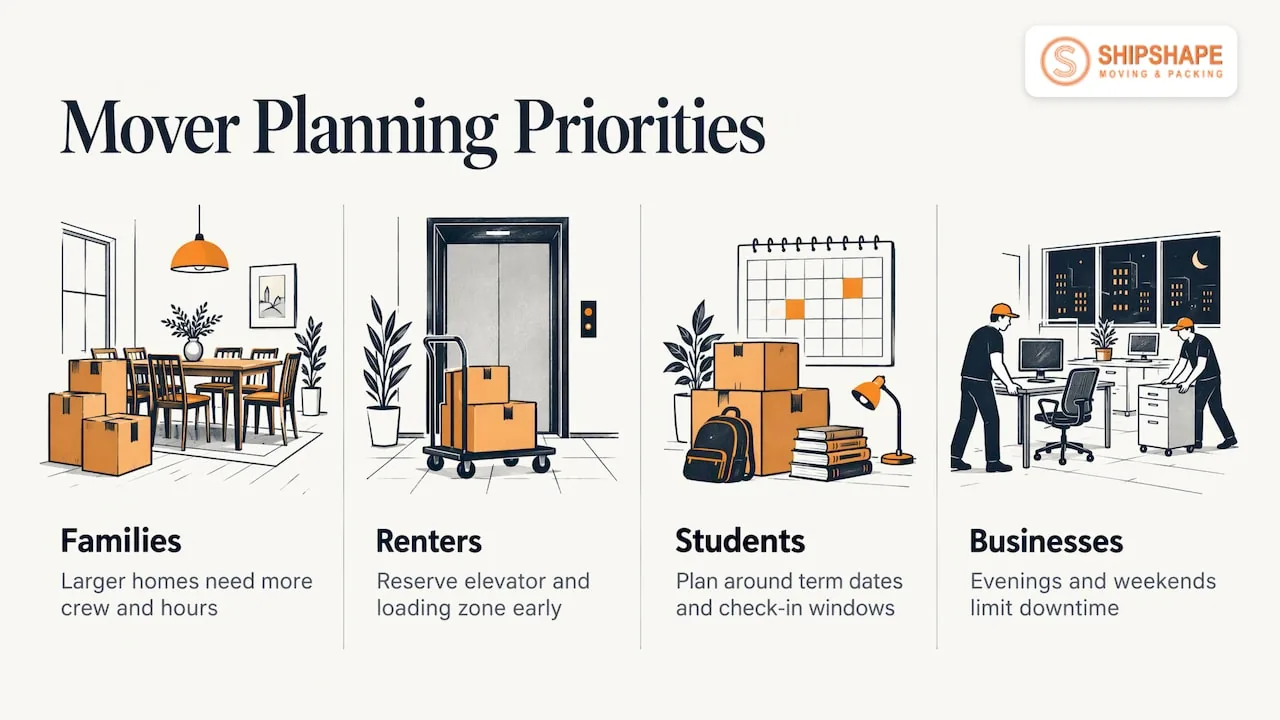
Businesses. An office that relocates out of the Bay Area cannot afford long downtime. Moves planned around operating hours, including evenings and weekends, keep the team working. See our office relocation and commercial moving pages for how we plan them.
Our perspective
Most people who call us about leaving the Bay Area have already done the hard thinking about where they are going. What they have not planned is the move, and that is where stress builds.
Our view is simple: the move should not be the part you worry about. We keep clients informed from the first call to the final box, we give written not-to-exceed quotes so the number does not drift, and we pack and label with the unpacking in mind. Every box that arrives marked for the right room is an hour you get back in your new home.
If you are weighing a move, call us before you pick your date. Access rules at both ends, the size of the crew and the packing plan are far easier to arrange early than in the last week.
Dennis
Get a quote for your move
If you are leaving the Bay Area, we can plan the move with you, from a local move across the region to a long-distance relocation. Tell us your addresses, your rough inventory and your preferred dates, and we will put the plan and the price in writing. Start with our long-distance moving page, or contact us through ShipShape Moving.
Our crews are licensed and based in Berkeley, serving Oakland, San Francisco and the surrounding Bay Area. We hold a 5.0 Google rating across 332 reviews. See our service areas to confirm we cover your address.
FAQ
Where are most Californians moving?
The largest net losses are to Texas and Florida, and Nevada and Idaho gain disproportionately for their size, according to PPIC research. Many Bay Area leavers also stay in California, especially in the Sacramento region and the Central Valley.
Why do people move out of the Bay Area?
The cost of housing and living is the main reason in the polling. The 2025 Silicon Valley Poll also found work-life balance is a factor. Remote work has made leaving easier for people whose jobs no longer tie them to the region.
How far ahead should I book movers?
Start getting quotes six to eight weeks before your date. Earlier is better if you are moving at the end of a month, in summer, or into a building with a limited elevator schedule. Some moving companies, including us on occasion, ask for a deposit to hold a date.
Is moving cheaper than staying?
It depends on your income, taxes and housing. The California Policy Lab found that people who leave typically see lower home values and rents, along with trade-offs in incomes, schools and climate risk. Add the cost of the move itself to your budget so the comparison is complete.
Sources
- A Region in Motion: Who’s Leaving Silicon Valley and Why (Joint Venture Silicon Valley)
- Bay Area Polls: Housing and Traffic Misery Abound (KQED)
- California’s population drain (Stanford SIEPR)
- Disparity in Departure: Who Leaves the Bay Area and Where (Terner Center)
- Bay Area to Central Valley Migration and Its Impacts (USC)
- Where Are Californians Going When They Leave the Golden State? (PPIC)
- Priced Out of the Bay (California Policy Lab)
- Spatial Patterns and Determinants of Inter-county Migration (PMC)
- How Has Remote Work Affected Migration around the State? (PPIC)