Moving in the Rain: How to Keep Your Belongings Dry
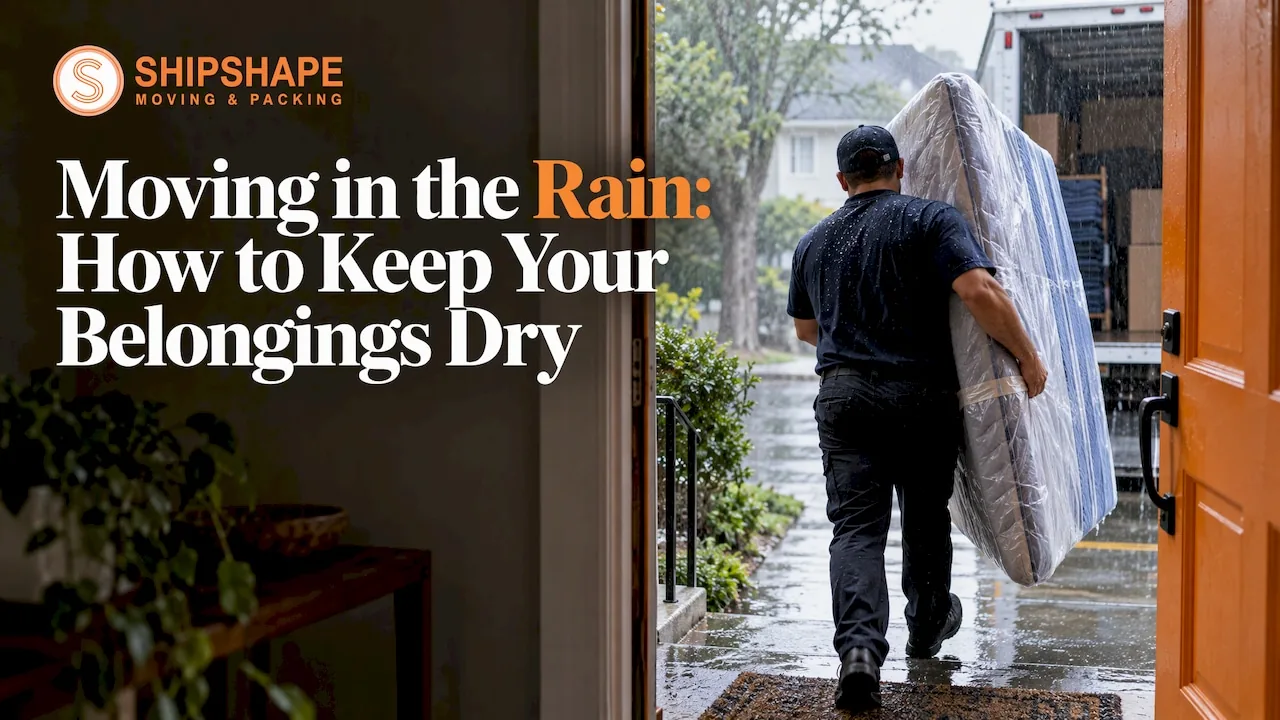
You can move in the rain, and most light-to-moderate rain days go fine when you plan for them. The work comes down to three things: wrap everything that water can hurt, shorten every trip between the door and the truck, and keep people on their feet. Heavy storms, flooding and lightning are a different matter, and those are reasons to push the move back a day or two.
This guide walks through what to do the week before, what to do on the day, how to handle the truck and the house, and what to check once the last box is inside.
Key Takeaways
- Light or steady rain rarely stops a move. Severe thunderstorm warnings, flooded roads and lightning do, so check the forecast several days out and again the night before.
- Cover furniture and mattresses, bag soft goods, tarp the truck path, and protect floors at both addresses before the first item moves.
- Shorten the exposed distance: back the truck as close as you can, split into an indoor crew and an outdoor crew, and load fragile or water-sensitive items last.
- Wet ground causes more injuries than wet boxes. Wear shoes with real grip, wipe ramps and steps, and never rush.
- Once you arrive, unpack damp items first, dry wood and fabric quickly, and photograph anything that was damaged.
Table of Contents
- First, decide whether to go ahead or reschedule
- Prepare the week before
- Protect what rain damages most
- Organize the move around the weather
- Stay safe on wet ground
- What our crews do on rain days
- Insurance and documentation
- After the move: check for water damage
- Moving day checklist for a rainy forecast
- Plan your rainy move with ShipShape
- FAQ
- Sources
First, decide whether to go ahead or reschedule
The question is not “is it raining?” but “is it raining in a way that makes the move unsafe?” A steady drizzle is an inconvenience. A storm cell, a flash flood watch or standing water on the road is a hazard.
Start watching the forecast about five days ahead. If severe weather is forecast and your lease, closing or elevator booking allows it, moving the date is often the cleanest answer. Look again the evening before, and once more an hour before the crew arrives.
Here is a practical way to sort it out.
| Conditions | What to do |
|---|---|
| Light rain or drizzle | Go ahead with full protection and a slightly slower pace |
| Steady, moderate rain | Go ahead, add tarps, an indoor/outdoor crew split and extra towels |
| Heavy rain with poor visibility | Delay the start, or pause loading until it eases |
| Thunderstorm warning, lightning or flooding | Postpone; do not load or drive |
The National Weather Service is direct on the storm end of that table: when a Severe Thunderstorm Warning is issued, outdoor activities should be postponed. The same page notes that it takes only about 1 to 2 feet of water to float most vehicles, and that even 6 inches of fast-moving flood water can knock a person off their feet. A moving truck is no exception, and neither is a person carrying a dresser down a driveway.
If you live in the Bay Area, remember that our wet season brings atmospheric rivers that can drop a lot of rain quickly, and storms combined with high tides have closed highways and local roads in the region. Check road conditions for your actual route, not just the weather at your front door.
Talk to your mover early about how they handle weather. Ask how they treat rain days, whether they will pause for lightning or flooding, and how rescheduling works. A written quote that spells out the plan removes a lot of stress on a day when plans are already shifting.
Prepare the week before
Most of what protects your belongings is done before the first drop of rain falls. If you are packing yourself, treat the forecast as a reason to pack tighter than usual.
Pack with water in mind
Cardboard weakens fast when it gets wet. A box that sits in a puddle at the bottom of a truck ramp can lose its bottom and drop its contents. A few habits help:
- Use sturdy boxes in good condition and tape the bottoms with extra strips.
- Line boxes holding books, papers or electronics with a plastic bag or sheet before you fill them.
- Put clothes, bedding and towels in clean, sealable plastic bags or bins with lids. Use unscented bags so your linens do not pick up a chemical smell.
- Move photos, documents and important papers in a lidded plastic tub, and carry that tub with you in your own car.
- Label every box on the side and top, so your crew does not stack or set down the wrong box in a wet spot.
If packing a whole home in the time before a forecast storm sounds like too much, that is a good place to hand the work over. Our packing service handles careful packing and labeling so each box is built to hold up and easy to unpack later.
Gather rain-day supplies
A short shopping list covers almost everything:
- Tarps or plastic sheeting for the truck path, the porch and the floor
- Stretch wrap (furniture plastic wrap) for upholstered pieces
- Mattress bags that seal
- Moving blankets, which also soak up splashes
- Old towels, a mop and a few absorbent mats for entry areas
- Painter’s tape or duct tape to hold floor coverings in place
- Large trash bags and a few extra plastic bins
- Ponchos or rain jackets and a spare dry shirt for each helper
Buy more towels than you think you need. They end up on the floor, on furniture and in the hands of every person who steps inside.
Prepare both addresses
Walk both locations and picture the path from door to truck. Where will water pool? Is there a step with no railing? Is the driveway sloped? Clear leaves, toys and clutter. If the property has a loading dock or shared elevator, confirm your reserved window, since rain can back up schedules. Our guide to loading dock scheduling for a move explains how to line that up.
If your move involves a long haul, weather at the destination matters as much as weather at home. Our long-distance moving team plans around conditions along the route, and you should check the forecast at both ends.
Protect what rain damages most
Not everything in your home reacts to water the same way. Here is how to treat each category.
Furniture
Wood furniture can swell, stain or warp, and upholstery can hold moisture and develop mildew. Wrap upholstered pieces in stretch wrap, then cover with a moving blanket if you can. Wrap wood pieces in blankets first, and then plastic over the top. Keep plastic wrap off bare wood finishes for long periods, since trapped moisture can mark them. The goal is a short exposed trip, not a sealed-in journey.
For antiques and heirlooms, take extra care and consider whether rain day is the right day. Our guide to moving antiques covers packing, protecting and insuring them.
Mattresses
Protect each mattress with a sealable mattress bag, and carry it straight from the door to the truck without leaning it on wet surfaces. A wet mattress is slow to dry and can develop mildew, so this is one item worth bagging twice if the rain is heavy.
Electronics and screens
Televisions, computers and speakers should stay in their original boxes if you still have them, or in sturdy boxes lined with plastic and padded well. Do not set them down on the ground, even for a moment. Load them last and unload them first, so they spend as little time as possible in the truck during a downpour. Here is how to pack a TV for moving so it stays protected.
Plants
Indoor plants dislike cold, wet air as much as they dislike heat. Wrap them loosely, keep them in the cab or a dry car if possible, and bring them in first. See how to move large indoor plants without damage.
Floors and entryways
Wet shoes and wet boxes track water through the whole house. Lay tarps or plastic sheeting from the door along the path your crew will take, and use absorbent mats or old towels at the threshold so shoes can be wiped before stepping inside. Tape the edges of sheeting down so it does not slide underfoot. Do this at both addresses.
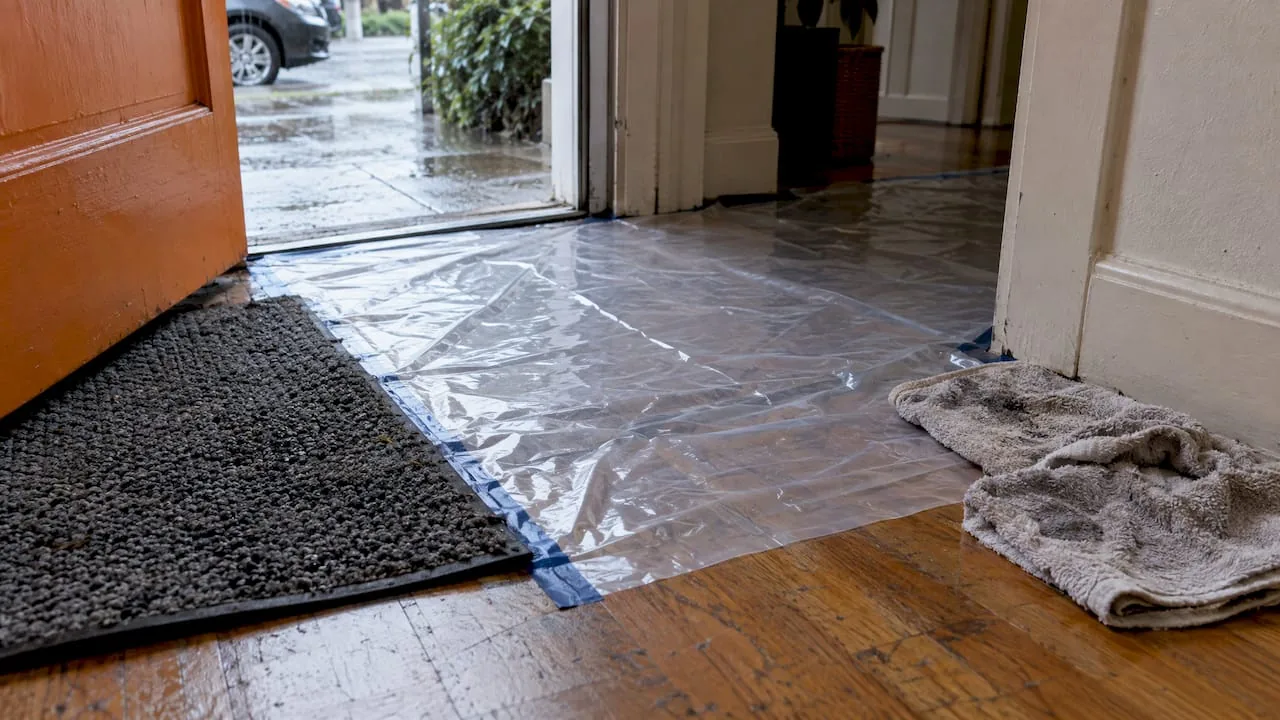
Remember that carpet runners and floor protection can themselves become slippery once wet. Replace soaked towels often.
Organize the move around the weather
How you load matters more than how you wrap. The shorter the time an item spends outdoors, the less water it meets.
Split into an indoor crew and an outdoor crew
Rather than everyone walking in and out, have one group stay inside to stage and hand off items near the door, and another group handle the carrying and loading outside. This keeps wet, muddy shoes out of the house and cuts the number of times anyone crosses the threshold. The inside group can also wipe each item before it goes out.
Shorten the trip
Park the truck as close to the door as the street, driveway or building rules allow. Set up a covered path: an awning, a pop-up canopy, or a tarp strung along the route. A Pacific Northwest moving guide makes the point well: a rainy move is largely won or lost at the thresholds, between the door and the truck, and tarps are a cheap tool that protect belongings.
Load in a smart order
- Start with heavy or water-tolerant items such as plastic bins, appliances and metal furniture.
- Follow with boxes and wrapped furniture.
- Leave fragile and water-sensitive items, such as electronics, artwork and documents, for last, so they are exposed for the shortest time when the door is open.
- Close the truck door whenever you pause.
At the destination, reverse the idea. Unload the items that most need protection first, while the hall is fresh and dry.
Keep things off the ground
Never set boxes on wet pavement or grass. Use a few plastic pallets, a stack of flattened boxes or a tarp as a staging surface. A hand truck with wet wheels can also leave a track on your floors, so wipe the wheels at the door.
Stay safe on wet ground
Wet belongings can be replaced. People are harder to fix. Slips, dropped furniture and strained backs are the real risk on a rainy move.
- Footwear: wear sturdy shoes with good tread. Smooth soles on wet ramps and steps are a recipe for a fall.
- Clothing: rain jackets and hats help, but avoid gear that blocks your vision or catches on furniture.
- Surfaces: keep paths clear and dry, and wipe down ramps and steps as needed.
- Pace: do not rush. Hurrying is when people slip and drop things.
- Visibility: keep a flashlight handy if the sky is dark, and make sure the path is lit.
- Hydration and breaks: damp clothes can chill you quickly, so swap into dry layers during breaks.
Heavy furniture is where good judgment matters most. If a piece is too heavy to carry safely on wet stairs, wait for the rain to ease or have professionals handle it with the right equipment.
Driving the truck in rain
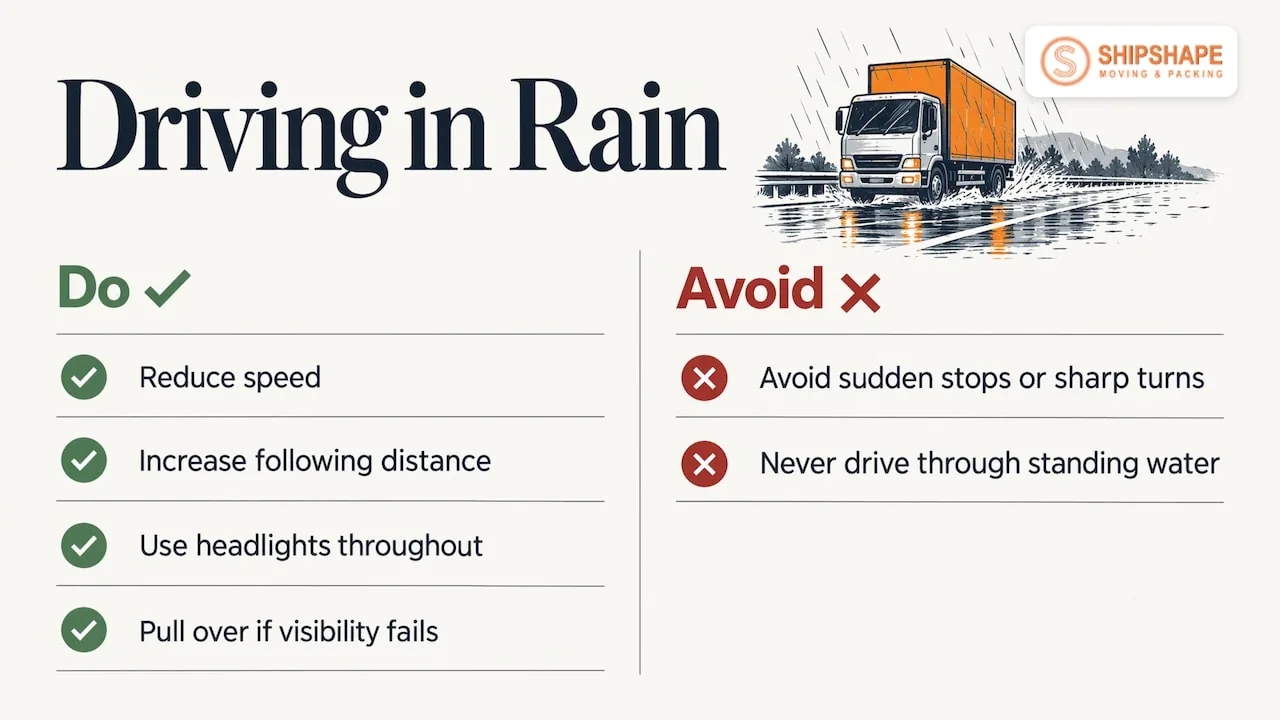
Wet roads reduce traction, and a loaded moving truck takes longer to stop. The California Highway Patrol advises drivers in rain to reduce speed, increase following distance and avoid sudden stops or sharp turns, and to allow extra time. It also recommends staying off the road during the heaviest rainfall if you can. If rain becomes so heavy that you cannot see, pull over somewhere safe until it clears, and use your headlights throughout.
If you are driving a truck for the first time, plan more time, not less. Wide turns, long braking distances and a big blind spot all get harder in wet weather. Never drive through standing water, since it can be deeper than it looks.
What our crews do on rain days
We do not treat a forecast as a reason to cancel by default. On a rain day, our crews plan the route from the door to the truck, protect floors and entries, and cover furniture before it goes outside. We communicate with you before, during and after, so you know whether the move is on track or whether weather means a change.
If you are comparing options, here is how doing it with a professional crew compares with handling a rainy move on your own.
| Task | On your own | With a professional crew |
|---|---|---|
| Wrapping furniture and mattresses | You buy and apply materials | Done as part of the job |
| Protecting floors | You lay and tape coverings | Handled at pickup and delivery |
| Carrying on wet steps | Friends and family, varied experience | Trained crew with the right equipment |
| Driving a loaded truck in rain | You or a friend | Experienced drivers |
| Deciding to pause | You decide alone | We talk it through with you |
Our perspective
Rain does not ruin a move. A lack of preparation does. Over the years, we have found that the moves that go badly in wet weather are the ones where nobody planned the first ten feet: the stretch between the front door and the truck.
That is why we think about a rainy move as a flow, not a list of items. Floors get covered first. Furniture gets wrapped before it leaves the room. Fragile pieces go on last and come off first. Crews stay in their roles so mud stays outside and boxes stay dry.
Just as important is talking to you. We believe in clear communication from the first call to the final box, which means you hear from us about the forecast, not just about the price. If conditions turn unsafe, we tell you, and we work out the next step together.
Careful packing and labeling matter even more when the sky is gray. A well-packed, well-labeled box can take a splash. A rushed one can not. That is why packing is such a large part of what we do.
Dennis
Insurance and documentation
Rain can lead to damage claims, so know where you stand before moving day. Read the coverage details in your mover’s paperwork, and ask what is and is not covered for water-related damage. Our explainer on moving company insurance breaks down the common terms.
Take photos or short videos of valuable furniture and electronics before they are wrapped. If something does get wet or damaged, you will have a before-and-after record, and the crew lead can note it on the spot.
After the move: check for water damage
Expect that some items will get a little damp even with good planning. What matters is what you do in the first hours.
- Wipe as you go. Dry boxes and furniture as they come in the door.
- Unpack wet items right away. Damp cardboard and trapped moisture breed mildew.
- Prioritize moisture-sensitive items. Electronics, artwork, books and documents come first. Leave electronics unplugged until they are fully dry.
- Dry wood and fabric furniture promptly. Open windows if the air is dry, use fans, and keep upholstery out of closed rooms.
- Lift bags and covers. Remove plastic wrap from furniture once it is inside, so moisture does not stay trapped.
- Photograph any damage. Take clear photos or video, and tell your mover and your insurer promptly.
If water has come into the home itself, for example through an open door or a leak in a hallway, check where it may have traveled. Look at flooring seams, baseboards, drywall near the floor, cabinets and vanities, neighboring rooms and ceilings below any upstairs area. If you find saturated materials or signs of mold, call a licensed water-damage or restoration professional, since that is beyond a normal unpacking job.
Moving day checklist for a rainy forecast
Print this or keep it on your phone:
- Forecast checked five days, one day and one hour before
- Mover contacted about weather and any change of plans
- Boxes taped, labeled and lined where needed
- Mattress bags, stretch wrap and moving blankets ready
- Tarps and towels at both addresses
- Truck parking spot confirmed and as close as possible
- Indoor and outdoor crews assigned
- Valuables, documents and medications in your own car
- Dry clothes and shoes for everyone
- Flashlight and phone charger within reach
Plan your rainy move with ShipShape
If you would rather not manage tarps, trucks and wet stairs yourself, we can do it for you. ShipShape Moving is a licensed moving company based in Berkeley, serving Oakland, San Francisco and the surrounding Bay Area with residential, apartment, large home, commercial and long-distance moves.
Our local moves are billed at $190-$200 per hour, plus an $80 one-off truck fee. We provide written not-to-exceed quotes, and we may ask for a deposit to hold your date. Tell us about the forecast when you call and we will plan around it.

For families, our residential movers handle the full job from packing to the final box. For businesses that need to move around operating hours, see our commercial moving services. For tips ahead of your date, our moving tips and tricks page is a good place to start.
FAQ
What should I do if I have to move in the rain?
Protect floors and entryways with tarps or plastic sheeting, wrap furniture and mattresses, and bag soft goods. Park the truck as close to the door as you can, split into an indoor and an outdoor crew, and load fragile items last. Wear shoes with good grip and do not rush.
Is it bad luck or harmful to move in the rain?
Rain is mostly a logistics challenge, not a harm in itself. Light or steady rain is manageable with the right covers and a good plan. Thunderstorms, lightning and flooding are the point at which you should pause or reschedule for safety.
How far ahead should I check the weather before moving day?
Start about five days out, then check again the night before and an hour before the crew arrives. If severe weather is forecast, talk to your mover early about rescheduling rather than waiting until the morning of the move.
Will movers still work if it is raining?
Often yes, with extra protection and a slower pace, as long as conditions are safe. At ShipShape, we plan rainy moves in advance and keep you updated, and we will talk with you about changing the date if storms, flooding or lightning make the move unsafe.
How do I protect a mattress in the rain?
Use a sealable mattress bag, and carry the mattress directly from the door to the covered truck without resting it on wet ground. Load it in the dry part of the truck, and unwrap it as soon as it arrives so moisture does not stay trapped.
Sources
- National Weather Service: Monsoon Safety
- California Highway Patrol: CHP urges safe driving ahead of major rainstorm
- The New Pelican: How to Move in Portland Rain, a Wet-Weather Moving Guide