Moving Permits in San Francisco: How to Reserve Curb Space
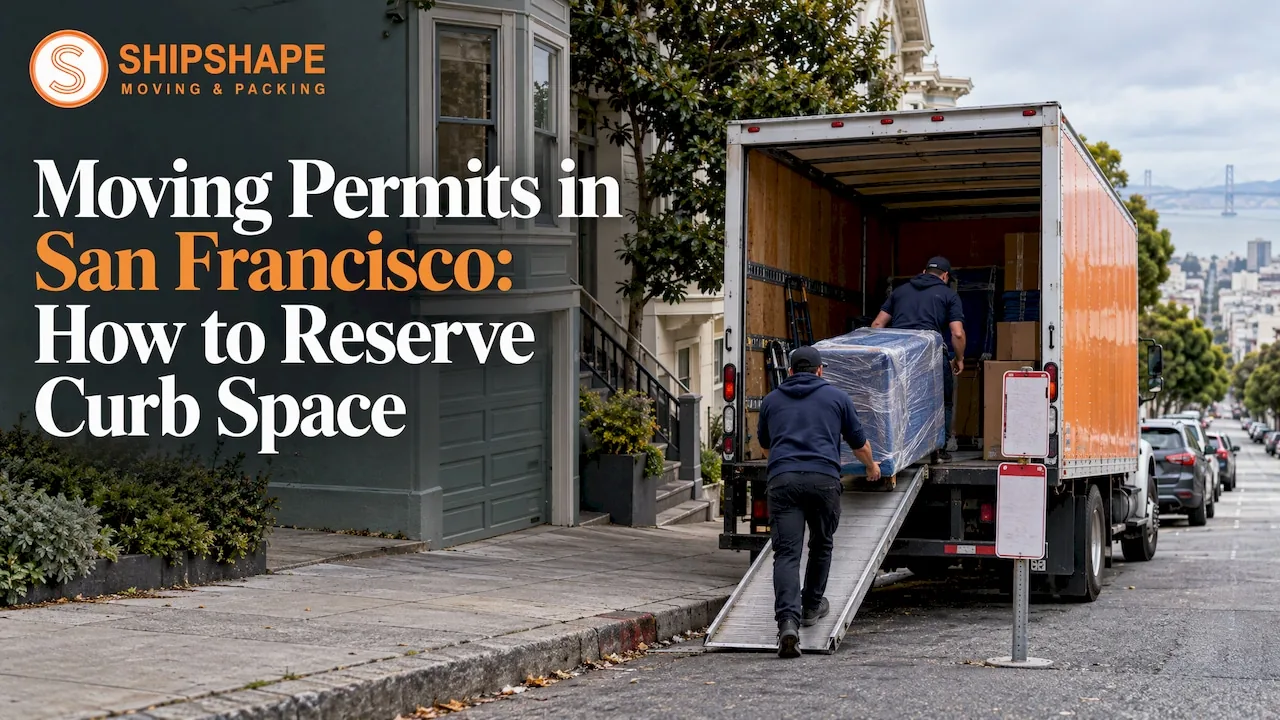
If you are moving in San Francisco and a truck needs to park on a public street, you apply to the SFMTA for temporary tow-away no stopping (TANS) signs. They are not a parking pass. They are signs posted on your block that turn the spaces they cover into a tow-away zone for the dates and times printed on them. You apply online or through 311, you need at least 5 business days of lead time, and for FY 2026/27 the fee starts at $355. The details below cover the rest of the process, the posting rules, and what to do when plans change.
Key Takeaways
- The SFMTA’s Temporary Signage program is how you reserve curb space for a moving truck in San Francisco. Allow a minimum of 5 business days between applying and the day enforcement begins.
- For FY 2026/27, a permit of up to 3 days costs $355 for 1-4 signs, $489 for 5-9 signs, $614 for 10-15 signs, and $736 for 16-21 signs. SFMTA staff decide how many signs your block needs.
- Signs must go up at least 72 hours ahead in unmetered areas and 24 hours ahead at meters. Enforcement hours run between 7am and 10pm.
- A temporary sign does not cancel street cleaning, red curbs, or other existing restrictions, and vehicles in a posted zone are towed.
- Moving between two San Francisco addresses may require a permit at each end. Ask your mover who handles the application before you book.
Table of Contents
- When you need a moving truck permit in San Francisco
- What the SFMTA sign actually does
- How to apply, step by step
- What a San Francisco moving permit costs
- Posting rules and timing on moving day
- Moving between two San Francisco addresses
- What if your date changes or someone takes the space?
- Oakland and Berkeley are different
- Who should apply: you or your mover?
- How we plan the truck and the timing with you
- A simple timeline you can follow
- FAQ
- Sources
When you need a moving truck permit in San Francisco
You need one whenever a moving truck or van will sit on a public street and you want the curb in front of your door kept clear. San Francisco has steep hills, narrow streets and active parking enforcement, so a truck that cannot park close to the entrance costs you time. Crews carry items farther, and the truck risks a citation if it blocks a lane or a driveway.
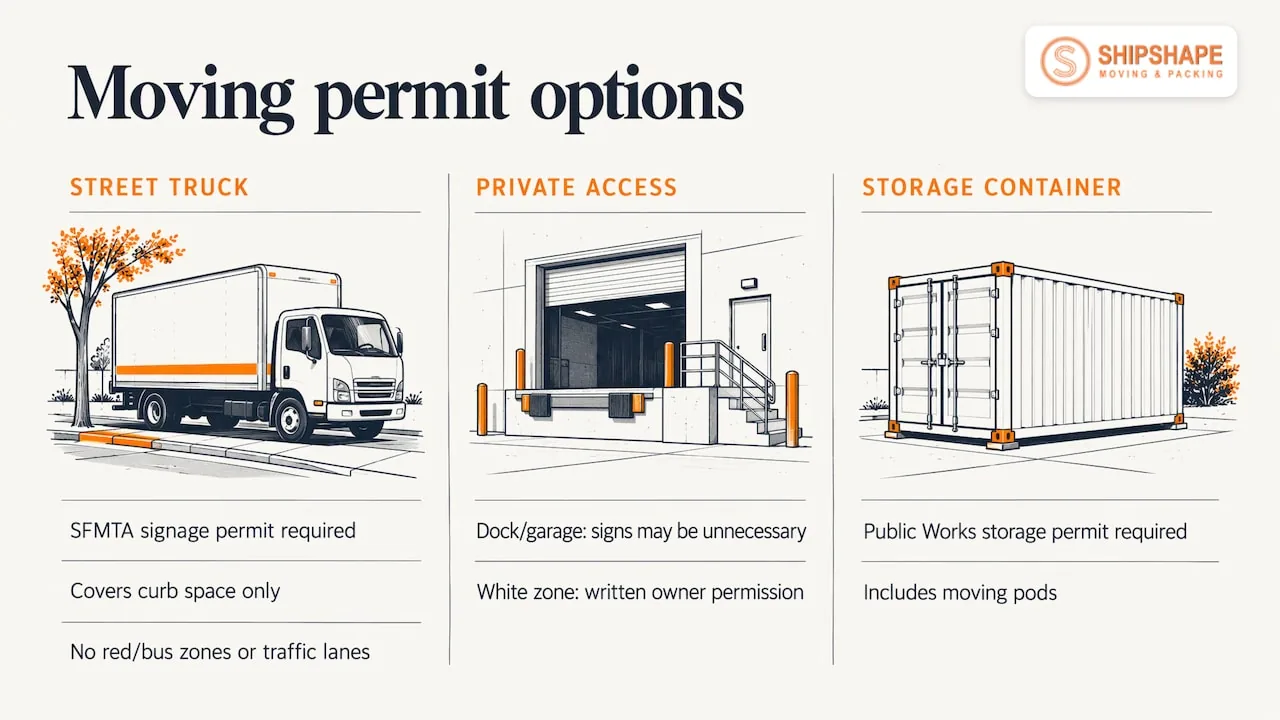
The rules say a permit covers the curb space only. It does not give a truck permission to stop in a red zone, a bus zone or a lane of traffic. If your building has a private loading dock, a garage, or a white zone owned by the property, you may not need street signs at all. The SFMTA allows white zones to be blocked with written permission from the zone’s owner, sent to temporarysign@sfmta.com with the owner’s name, the dates and times, and the service request number.
Portable storage containers follow a different path. For mobile storage containers, including moving pods, San Francisco Public Works requires its own storage container permit. If you rent a truck or use any vehicle on wheels, the SFMTA signage program applies instead.
What the SFMTA sign actually does
The TANS sign is posted by the city on your block. The SFMTA describes it as a way to reserve parking for residential or commercial moves, corporate events, funerals and similar needs. Once the legally required posting period has passed, the zone is enforceable. Cars parked in it during the printed dates and times are towed.
A few practical consequences follow:
- Neighbors get notice from the sign, not from you. Cars already parked when the signs go up have to move before the enforcement start time. That is why the posting window exists.
- The zone has limited reach. According to the SFMTA brochure Streets of San Francisco, signs apply to vehicles parked within 100 feet, or 50 feet for residential or commercial moves.
- Existing rules still apply. Temporary no parking signs do not override street cleaning signs, No Stopping signs, No Parking signs or red curbs. If your block has street sweeping on the morning of your move, check the posted schedule when you pick your date.
How to apply, step by step
- Pick your date and a backup. Count at least 5 business days from the day you apply to the day enforcement starts. Legal holidays do not count as business days, so a move right after a holiday weekend needs more lead time.
- Decide how much curb you need. A studio or one-bedroom needs less than a large home with a 26-foot truck. SFMTA staff inspect the requested area and set the final number of signs, so describe the truck size honestly.
- Apply through the SFMTA online portal. First-time users register with an email address. You can also call 311, or 415.701.2311 if you are outside San Francisco.
- Pay the fee. Fees are billed for the signage, not per truck.
- Confirm the signs went up. Check the block 72 hours before a move in an unmetered area, or 24 hours before at meters. If a sign has gone missing or been knocked down, report it right away so the city can repost it.
If your street falls under Port of San Francisco jurisdiction, such as parts of the waterfront, the lead time is longer. A permit guide for city permits reports a 15-calendar-day advance submission requirement for those streets. Confirm this with the SFMTA when you apply.
What a San Francisco moving permit costs
The SFMTA publishes the fee schedule each fiscal year. These are the numbers for the year that began July 1, 2026, for permits of up to 3 days requested through the portal or 311:
| Number of signs | Fee, FY 2026/27 |
|---|---|
| 1-4 signs | $355 |
| 5-9 signs | $489 |
| 10-15 signs | $614 |
| 16-21 signs | $736 |
The SFMTA says the zone is billed in five-day increments for metered spaces and seven-day increments for unmetered spaces. The previous year’s schedule was lower: fees effective July 1, 2025 were $341 for 1-4 signs, $470 for 5-9 and $590 for 10-15. The same document lists a $135 late filing fee for requests made under 14 days ahead, so apply early when you can. Fees change every July, so check the current figure on the SFMTA page before you budget.
A typical apartment move on a single block usually lands in the smallest bracket, but the number of signs is the city’s decision, not yours.
The cost of skipping it
Skipping the permit is the expensive choice. A vehicle in a tow-away zone goes to a city impound facility. The SFMTA lists a first-time tow administrative fee of $335 plus a $317 tow fee, before any citation. That is more than the permit fee for most moves, and a towed truck can stall your entire day.
Posting rules and timing on moving day
Timing is where most moves go wrong, so build your calendar backward from the day you load.
- Unmetered curb: signs must be posted no less than 72 hours before enforcement starts.
- Metered spaces: signs must be posted no less than 24 hours before.
- Hours: per the SFMTA, start times for moving requests begin no earlier than 7am and end no later than 10pm each day.
Those windows are why the 5-business-day minimum matters. The city has to review the request, inspect the block, and post the signs, and the posting clock only starts after that. If you apply with exactly 5 business days and something slips, you have no margin.
Transportation Code Section 3.4(d), as summarized by a city permit guide, calls for signs at each end of the restricted zone and at intervals of no more than 50 linear feet, with a contact person and phone number available during business hours. Keep your phone on, and give your mover the permit number.
Moving between two San Francisco addresses
If you are leaving one San Francisco address and arriving at another, treat them as two separate curb problems. Each block has its own parking, its own street cleaning schedule and its own sign count. You may need a separate permit at each end, so apply for both at once and line up the dates. If the two moves share a day, make sure the enforcement hours at each address match the crew’s actual schedule, including the drive between them.
For help sequencing the rest of the day, our guide on how to prepare for moving day in San Francisco walks through access, elevators, and building rules.
What if your date changes or someone takes the space?
If the date changes, contact the SFMTA’s temporary signage staff as soon as you know, through 311 or the portal. A new date is treated like a request that needs its own lead time, and the 5-business-day minimum and posting windows apply again. This is why a backup date and a mover with some schedule flexibility are worth having before you apply. Ask the SFMTA what it can do with your existing request, since the answer depends on how close you are to the enforcement date.
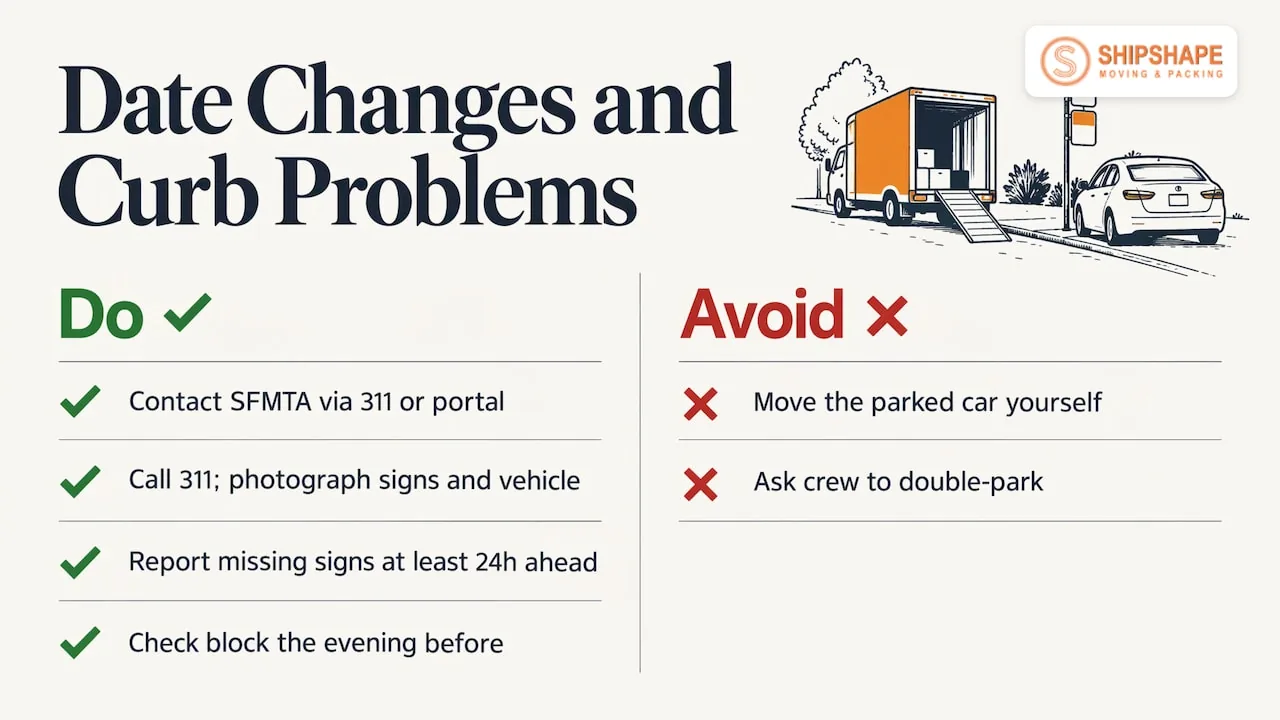
If a car is parked in your zone, do not try to move it yourself and do not ask your crew to double-park. Once the signs are enforceable and the dates and times have started, vehicles in the zone can be cited or towed. Have your mover or your contact person call 311 to request enforcement and take photos of the posted signs and the parked vehicle. If it will take time, ask the crew to start loading from the nearest legal spot, then shuttle items to the truck.
If signs go missing, report the problem at least 24 hours before posting is needed so the city can repost, as the permit guide cited above notes. Check the block the evening before your move as well.
Oakland and Berkeley are different
Many people searching for a Bay Area moving permit are really moving in Oakland or Berkeley. Neither city uses the SFMTA, and each runs its own process and fee schedule, so do not assume the San Francisco steps apply. Oakland calls its version an obstruction permit. Our Oakland moving permit guide covers the no-parking and obstruction process there. For Berkeley, confirm the current process with the city’s transportation or permit office before you book a truck.
Who should apply: you or your mover?
Some movers handle the permit as part of the job, and others expect the customer to apply. Ask at the quote stage, in writing: who applies, who pays the city fee, and who confirms the signs are posted. A clear answer prevents the most common surprise on moving day, a truck arriving to a curb with no signs.
Our perspective: the curb is part of the move
We move families, offices, students and collectors across San Francisco, Oakland and Berkeley, and the plan for the truck matters as much as the plan for the boxes. A crew that must carry furniture a block uphill spends your paid hours walking instead of moving, and a ticket or a tow can wipe out a day’s work.
That is why we talk about parking at the first call, not on the morning of the move. Clear communication is how we work: we tell you what the curb situation looks like, what the timeline requires, and what we need from you so signs are posted when they should be.
Careful packing and labeling help here too. When every box is labeled and the load order is planned, the truck spends less time at the curb and the whole job runs smoothly from first contact to final sign-off.
Dennis
How we plan the truck and the timing with you
When you book with ShipShape Moving, we plan around your building, your block and your schedule. Our local moves are billed at $190-$200 per hour, plus an $80 truck fee, and we provide written not-to-exceed quotes so you know the ceiling before moving day. Hours worked drive the cost, so a truck that can park right at the door is good for your budget too. Check the Local Moves details for current terms, or see our residential movers page if you are moving out of a home or apartment.
Businesses can plan around operating hours, with after-hours scheduling for offices and retail. See our commercial moves page, and if you are planning a full office move, our office move checklist for Bay Area businesses covers the timeline.
A simple timeline you can follow
| When | What to do |
|---|---|
| 3-4 weeks before | Choose your date and a backup, and confirm with your mover who applies for the permit |
| At least 5 business days before enforcement | Submit your SFMTA request, longer if you are near a holiday or on a Port street |
| 72 hours before (24 at meters) | Confirm signs are posted on both ends of the zone |
| Day before | Re-check the block, warn your building manager, and confirm street cleaning does not conflict |
| Moving day | Keep the permit details handy and a phone number posted for the contact person |
FAQ
Do I need a permit if I am only moving for a couple of hours?
If the truck needs reserved curb space on a public street, yes, the process is the same regardless of how short the move is. The fee is for the signage and the zone, not the hours you actually use. If a loading zone, driveway or private lot is available to you, you may not need street signs.
How far ahead should I apply?
Allow a minimum of 5 business days between your application and the day enforcement begins, and more if a holiday falls in that window. Late filings under 14 days incur an extra fee according to the SFMTA’s fee schedule. Applying a few weeks out gives you room if you need to change the date.
Can I get a permit through 311?
Yes. You can apply through the SFMTA online portal or by calling 311, or 415.701.2311 if you are calling from outside San Francisco. The fee table for permits up to 3 days applies to both routes.
What happens if someone parks in my reserved space?
Vehicles in a posted zone during the dates and times on the sign can be towed. Call 311 to request enforcement, photograph the signs and the vehicle, and have your crew work from the nearest legal spot until the space clears.
Does the permit cover Oakland or Berkeley?
No. The SFMTA program covers San Francisco streets only. Oakland and Berkeley each have their own process, so check with the city where you are moving.
Sources
- Temporary Signage, SFMTA
- Fees Effective July 1, 2025, SFMTA
- Towed Vehicles, SFMTA
- Streets of San Francisco, SFMTA
- Storage Container permit, San Francisco Public Works
- San Francisco Moving Parking Permit: Curb Space & 2026 Fees, CityPermitGuide