Office Move Budget: What to Include and How to Plan It

A workable office move budget is a category-by-category plan, not one headline number. Moving labor and trucks are only one pool of cost. Technology, the old lease, the new space and lost working time each sit in their own pool, and the surprises almost always come from the pools nobody priced. Start with a firm, written quote for the physical move, add the other categories one by one, and hold a contingency on top. At ShipShape Moving, we plan commercial moves around your operating hours and give written not-to-exceed quotes, so the largest controllable line in your budget stays fixed.
Key Takeaways
- Budget by category: physical move, IT, furniture and fixtures, lease obligations, build-out, downtime and contingency. Kastle’s relocation guidance treats these as separate cost pools rather than one lump.
- Hold a contingency of 10% to 15% at minimum, and more if your scope is still moving. Published planning guidance ranges from 10%–15% to 20%–25%.
- Decommissioning the old space can cost 3 to 5 times the physical move when the lease requires it restored to its original condition. Read your lease before you set the budget.
- Get every mover quote written, for the same scope, with a not-to-exceed ceiling. That turns your biggest variable into a known number.
- Moving after hours or on a weekend protects revenue, because downtime is a real cost line.
Table of Contents
- Why there is no single office move cost
- The categories every office relocation budget needs
- Planning ranges to sanity-check your numbers
- The costs that blow budgets
- How to build the budget, step by step
- A worked example: a 25-person office
- Ways to control the cost without cutting corners
- Perspective: the move line should be the most predictable one
- Get a written quote for your office move
- FAQ
- Sources
Why there is no single office move cost
Search for the typical price of an office move and you will find ranges so wide they are useless on their own: a few thousand dollars at the low end, tens of thousands at the high end. That is not sloppiness. A ten-person office with laptops and a few desks is a different job from a clinic with equipment, a server room and a loading dock shared with three other tenants.
What drives the total is consistent from one office to the next:
- Headcount and workstations. More desks, chairs, files and equipment mean more crew hours and more truck space.
- Distance. Across the hall, across town or across the state changes drive time, fuel and truck count. Mileage-based pricing works the same way in other vehicle businesses too, as this look at mileage-based vehicle pricing shows.
- Access. Stairs, elevator reservations, loading dock windows, parking permits and long carries all add hours. Our guide to loading dock scheduling explains how to avoid paying a crew to wait.
- Specialized items. Lab equipment, safes, art, server racks and anything that needs careful handling.
- Timing. After-hours and weekend moves can cost differently from a weekday move, but they save the revenue you would lose with staff sitting idle.
The practical lesson: use ranges only as a sanity check. Your budget is built from your own inventory and your own quotes.
The categories every office relocation budget needs
Budgeting guidance from Advantaico lists the pools an office move budget must cover: physical moving (labor, transport, packing), IT infrastructure such as cabling and server migration, lease obligations such as overlap rent and decommissioning, build-out, insurance, downtime and a contingency fund. Here is how to use them.
1. Physical move: labor, truck and packing
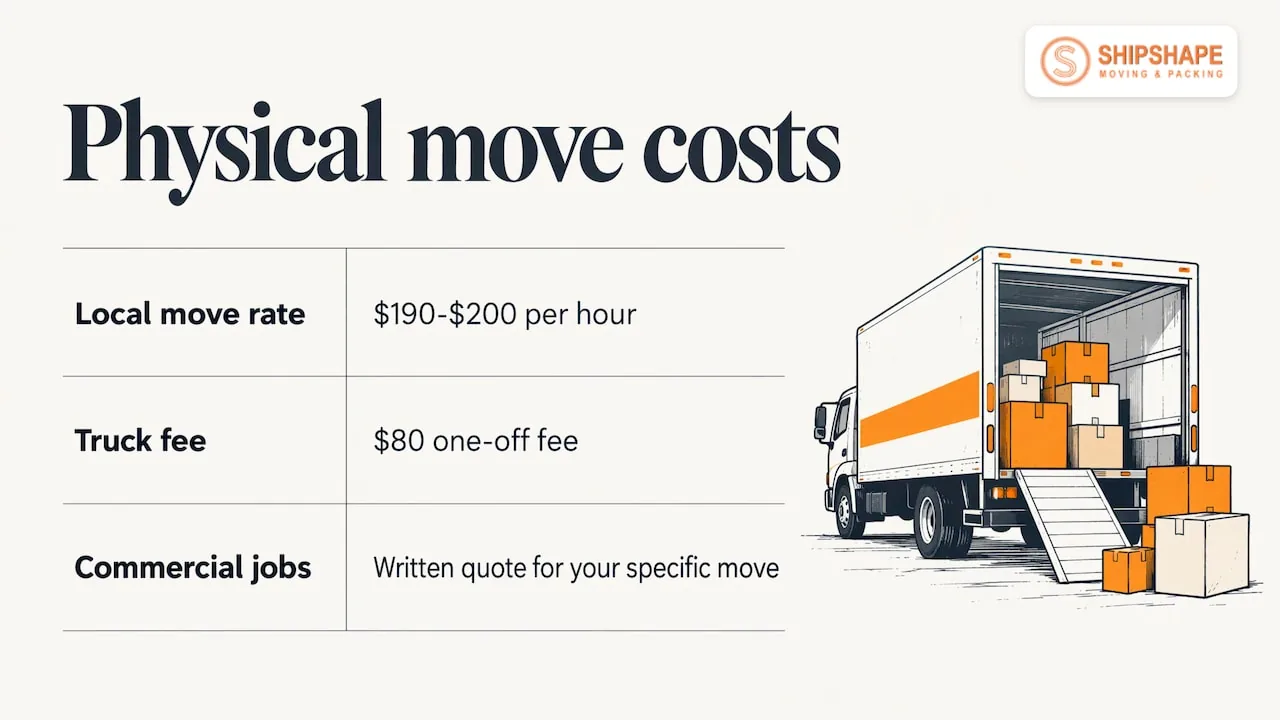
This is the line a mover controls. It is billed by crew size, move complexity and hours worked, plus extras such as packing. Ask for the quote in writing and ask whether it is a ceiling or an estimate. Our local moves are published at $190-$200 per hour, with a one-off truck fee of $80. Office and commercial jobs are scoped to your layout and hours, so we quote them in writing for your specific move.
Packing belongs here too. Files, supplies, monitors and break-room contents all need boxes, labels and a destination. Labeling by new room or desk is what lets your team work on Monday instead of hunting for cables. Our packing service packs and labels so unpacking is simple.
2. IT and telecom
Disconnecting, transporting and reinstalling servers, phones, switches and workstations is often a separate vendor and a separate invoice. One 2026 cost guide, which assumes a local move within 20 miles and moderate IT reconfiguration, puts IT relocation at $1,500 to $15,000. Treat that as a wide planning range, then get your IT provider’s own number. Also budget for internet installation at the new address, which can have lead time. Your internet and phone lines need to be live before your first working day, not after.
3. Furniture, fixtures and installation
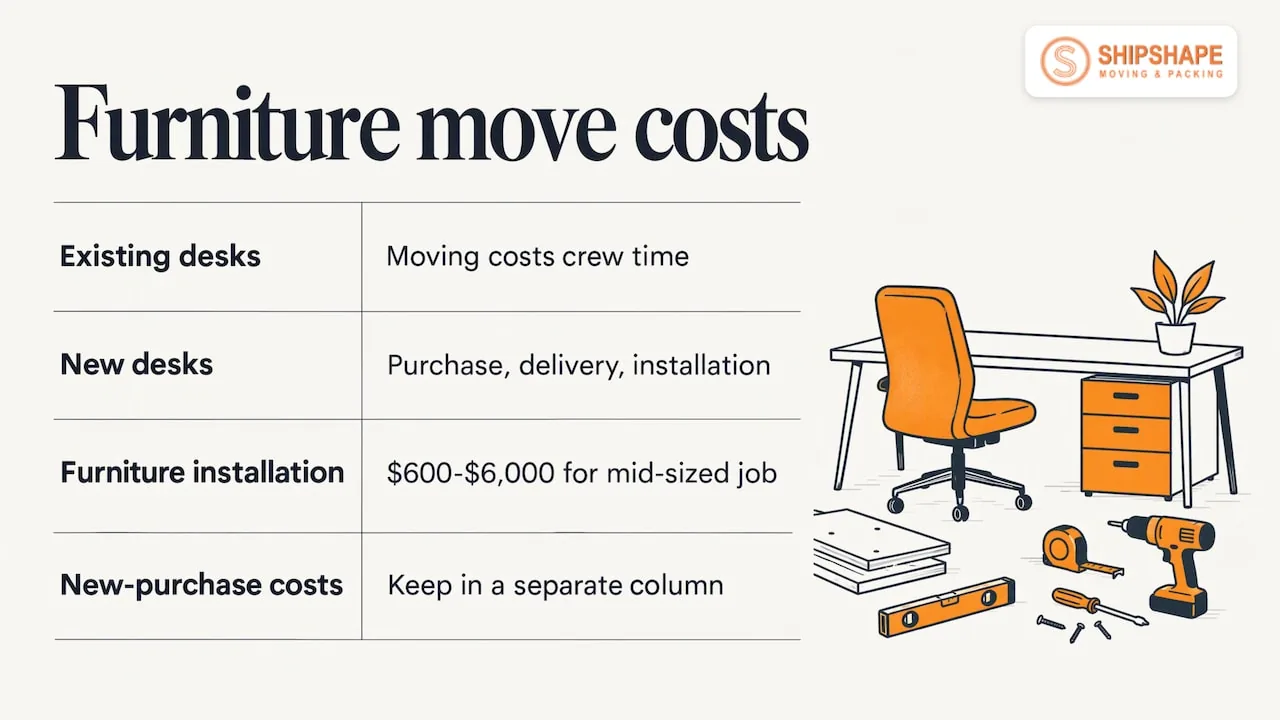
Decide early what moves and what is replaced. Moving existing desks costs crew time. Buying new ones costs purchase price, delivery and installation. The same 2026 guide lists furniture installation at $600 to $6,000 for a mid-sized job. Keep new-purchase costs in a separate column from moving costs, because they come from a different budget owner and are often capital spending.
4. Lease obligations
This is where budgets break. Overlap rent (paying for both spaces while you transition), restoration of the old premises and security deposits at the new one can outweigh the move itself. Pull your current lease and find the clause on surrender condition before you do anything else.
5. Build-out, access control and signage
New space may need walls, cabling, badge readers, locks, signage and furniture layout. Guidance from Kastle includes access control and security in a realistic budget, and it is easy to forget until the week before move-in.
6. Downtime and productivity
Every hour your team cannot work has a cost: salaries, missed sales, delayed client work. Moving over a weekend can reduce lost workdays. We schedule office and retail moves around your operating hours, including after hours, so the downtime line can shrink to almost nothing.
7. Contingency
Keep it as its own line. A reserve hidden inside other numbers disappears quietly.
Planning ranges to sanity-check your numbers
The figures below come from one 2026 U.S. cost guide. They assume a local move within 20 miles, mid-range building access, standard furniture and moderate IT reconfiguration. LatestCost publishes them as broad planning ranges, so use them to spot a missing line, not as a quote.
| Budget line | Planning range |
|---|---|
| Planning | $750–$6,000 |
| Packing and decommissioning | $1,000–$7,000 |
| Labor | $1,200–$12,000 |
| Transportation and fuel | $800–$9,000 |
| IT relocation | $1,500–$15,000 |
| Furniture installation | $600–$6,000 |
| Permits | $0–$1,800 |
| Disposal | $200–$4,000 |
| Contingency | $500–$6,000 |
The spread inside every row is the point. A small office near the bottom of every row and a larger office near the top of every row are both normal. Your inventory, your building and your schedule decide where you land.
The costs that blow budgets
Most overruns come from lines that were never on the page. Check each of these before you finalize.
- Restoring the old space. Decommissioning to the lease-required condition can cost 3 to 5 times the physical move. Ask your landlord for the surrender requirements in writing.
- Overlap rent. Even one extra month at the old address changes the total.
- Building rules. Freight elevator reservations, certificates of insurance, parking permits and dock windows can add fees or force a schedule you did not plan for.
- Disposal. Old furniture, e-waste and shredding are rarely in the mover’s scope unless you ask.
- Reprinting and rebranding. Stationery, signage, website and listings with the new address. Businesses should also budget for marketing to announce the move so customers can find them.
- Scope changes. More desks, a second floor, a late-added lab. Each change reprices the move.
How to build the budget, step by step
Step 1: Define the scope
Count workstations, offices, conference rooms, storage rooms, equipment and anything unusual. Photograph each space. A move priced against a vague description will be repriced against the real one.
Step 2: Separate new-space spending from move logistics
Advantaico’s guidance recommends separating capital spending for the new space from logistics and technology transition. It lets finance approve each on its own terms and shows what the move itself costs.
Step 3: Collect quotes for the same scope
Give every vendor the same inventory, floor plans, access details and date. Guidance from Smart Storage calls this normalizing quotes. If one quote includes packing and another does not, the cheaper-looking one is not cheaper.
Step 4: Ask for a not-to-exceed number
An hourly rate tells you the price of an hour. A written not-to-exceed quote tells you the most you will pay for the defined job. That is the number to put in your budget. We provide written not-to-exceed quotes, and for some dates we may ask for a deposit to secure the booking, so put that in your cash plan.
Step 5: Add the other pools and a contingency
Add IT, furniture, lease, build-out and downtime from their own quotes. Then add the reserve. Planning guidance runs from 10%–15% for a well-defined move to 20%–25% when scope or timing are less certain. The less you know, the higher the reserve.
Step 6: Review on a schedule
A budget is a living document. Recalculate whenever scope, timing or pricing changes, and set a short review every couple of weeks as the move date approaches. Our office move checklist lays out what to do and when, so each cost decision lands before it becomes urgent.
A worked example: a 25-person office
Take an illustrative office with 25 workstations, a small server closet, a conference room and a kitchenette, moving across town.
- Physical move. Quote for crew, truck and packing: your fixed number, confirmed in writing. Call it line A.
- IT. Your IT provider quotes the server move and cabling at the new site. Line B.
- Furniture. Keep existing desks, buy six new chairs and a conference table. Line C, in the capital column.
- Lease. One month of overlap rent plus the surrender requirements from the old lease. Line D.
- Build-out. Badge readers, signage, minor cabling. Line E.
- Downtime. If the move happens after hours or over a weekend, one lost day is avoided. Line F is small.
- Subtotal A through F, then add 15% contingency because the scope is defined, or 20% if the new space is not yet fully surveyed.
The example uses letters instead of dollar totals on purpose. Your numbers will come from your own quotes, and putting invented totals in a template makes them look like benchmarks.
Ways to control the cost without cutting corners
- Purge before you pack. Every box you do not move is crew time you do not pay for. Shred, recycle and donate first.
- Move on your schedule, not the building’s. Book dock and elevator time early. Our guide to the best day to move covers how timing affects cost and stress.
- Label by destination. Room and desk labels cut unpacking time and the hours of rework that follow.
- Fix the scope. Late additions are the most common reason a quote changes.
- Plan early. A longer runway gives you time to compare vendors and avoid rush charges. Our planning and checklist articles walk through timelines.
- Lock the quote. A not-to-exceed number protects the largest variable in your budget.
Perspective: the move line should be the most predictable one
We think the budget fails when the moving line is the vague one. Lease, IT and build-out numbers come from landlords and vendors, and they are hard to change. The move itself is the part you can fix completely, if the mover walks your space, understands your hours and puts a ceiling in writing.
That is how we approach commercial jobs. We keep you informed from the first call to the final box, we plan around when your business operates, including after hours, and we pack and label by destination so your team starts working again quickly. The less your staff improvise on move day, the fewer surprises reach the budget.
If you are building a relocation budget, start with the number you can lock and let that anchor everything else.
Dennis
Get a written quote for your office move
If you are ready to put a real number in the moving line, our office relocation service covers offices, retail and clinics around the Bay Area, planned around your operating hours. Send us your floor plan, headcount and target dates, and we will provide a written not-to-exceed quote. Our crews pack and label carefully, so the move itself is the part of your budget that does not move.

For retail and other business moves, see our commercial moving services.
FAQ
How much should I budget for an office move?
There is no universal figure, because size, distance, IT and lease terms vary so widely. Build it by category from written quotes, then add a contingency of at least 10% to 15%. Published planning ranges for a local move run from a few thousand dollars for a small office to far more for large or specialized ones.
What are the most overlooked office relocation expenses?
Restoring the old space to lease condition, overlap rent, building fees for elevators and parking, disposal, and new signage or printed materials. Decommissioning alone can reach 3 to 5 times the physical move. Reading your lease early is the best defense.
How big should the contingency fund be?
Guidance ranges from 10%–15% to 20%–25%. Use the low end when your inventory is counted, quotes are written and the new space is surveyed. Use the high end when any of those is still open.
Can moving after hours or on a weekend reduce my costs?
It can reduce the cost that is easiest to miss: lost working time. A weekend move can cut lost workdays. We plan office and retail moves around your operating hours, so ask for a quote for the schedule that fits your business.
Sources
- Office Relocation & Office Move Checklist Guide, Kastle
- How to Build a Complete Relocation Budget for an Office Move, Advantaico
- How to Move an Office: Timeline, Costs & Hybrid Workspace, Elia
- Office Relocation Budget Template Guide, Smart Storage
- Cost to Move an Office 2026, LatestCost