Packing Services Can Cost $300 to $2,200 in 2026

A professional packing job typically costs $300 to $2,200, depending on the size of your home. You can estimate yours with one formula: packers × hourly rate × hours, plus materials. Per-packer rates commonly run about $40 to $60 an hour, so the hours and the crew size decide most of the bill.
TL;DR:
- A sample three bedroom packing estimate totals $1,150, including $900 in labor for three packers over six hours and $250 for supplies.
- Choose hourly billing for uncertain scope, per carton when the box count is fixed, or flat room pricing when you can define what is included.
- Request an in person or video inspection and an itemized written estimate that separates labor, materials, crating, and unpacking before you book.
- Decluttering before booking can save an estimated $200 to $800 or more by reducing both packing hours and the materials your crew needs.
Table of Contents
- What do packers charge per hour, and how does crew math work?
- How do movers price packing: hourly, per carton, or flat?
- What does packing cost by home size?
- What do packing materials, specialty items, and crating cost?
- What drives your packing bill up or down?
- How do you get an accurate, itemized packing estimate?
- How can you cut your packing costs?
- Our view on transparent, itemized packing quotes
- Ready for an itemized packing quote from our team?
- FAQ
- Sources
What do packers charge per hour, and how does crew math work?
Most packing quotes start with a per-packer hourly rate. One 2026 guide puts it at roughly $40 to $60 per packer per hour, billed on top of materials. Another labor study reports that worker rates commonly range from $28 to $55 per hour depending on how complex the work is, which shows how much the rate moves with the job.
To turn a per-packer rate into a crew rate, multiply by the number of people on the crew. For example, multiply the number of packers by each person’s hourly rate to get the crew rate. Then multiply that rate by the hours worked to estimate labor before materials. That is why crew size matters as much as the headline rate.
Here is how the tiers usually break down:
- Basic packing: Clothes, books, pantry items, and other sturdy goods sit at the low end of the range.
- Full-home packing: Kitchens, closets, and décor take longer per room, so expect mid-range rates.
- Art and fragile handling: Framed pieces, glassware, and collectibles need trained hands and often cost the most per hour.
Packing labor is often marked up 40% to 60% above a provider’s internal loaded labor cost. That markup is one reason to ask for labor and materials as separate lines, so you can see what you are paying for. (MoveCost)
Separating the lines also lets you compare two quotes fairly. A low hourly rate can hide expensive materials, and a flat total can hide a padded labor estimate.
How do movers price packing: hourly, per carton, or flat?
Movers generally charge for packing in three ways: hourly labor, per-carton or per-item rates, or a flat price by room or tier. Each one shifts risk between you and the mover.
- Hourly billing: You pay for the time worked, and materials are usually billed separately. It works best when the scope is hard to predict, such as a cluttered garage or a home full of small items. The risk is that a slow crew or a surprise closet raises your total.
- Per-carton pricing: Each packed box has a set price, which gives you a firm number once the box count is agreed. The pitfall is the count itself. Small boxes, odd-shaped items, and fragile goods that need extra padding can push the carton total up fast.
- Flat-by-room or tier pricing: A partial pack usually covers the rooms or categories you name, while a fragile-only tier covers kitchens, glassware, art, and electronics. Ask exactly which rooms and item types each tier includes.
Whichever model you pick, ask for labor and materials separated on the estimate. Without that split, you cannot tell whether a “cheap” quote is cheap on labor, thin on supplies, or missing services you assumed were included. A clear breakdown also makes it easier to drop one line, such as unpacking, if you decide to handle it yourself.
What does packing cost by home size?
Total cost scales with volume, so the number of bedrooms is a good first guide. A 2026 market guide gives sample ranges by home size, and a separate consumer guide reports that packing often centers around $1,000 across all home sizes, with packing and unpacking commonly billed as add-ons to the move itself.
Use these labor-plus-materials ranges as a rough starting point, then adjust for your own clutter and fragile items:
These ranges sit inside the guide’s published low-to-high span of $300 to $2,200 and are illustrative budgeting bands, not quotes.
Here is a worked example you can copy with your own numbers. Say a 3-bedroom home needs a full pack, and the illustrative inputs are $50 per packer per hour, a crew of three, and 6 hours:
- Multiply the crew by the rate: 3 packers × $50 = $150 per hour.
- Multiply by the hours: $150 × 6 = $900 in labor.
- Add materials, say $250 for boxes, paper, and tape.
- Add the two: $900 + $250 = $1,150 total.
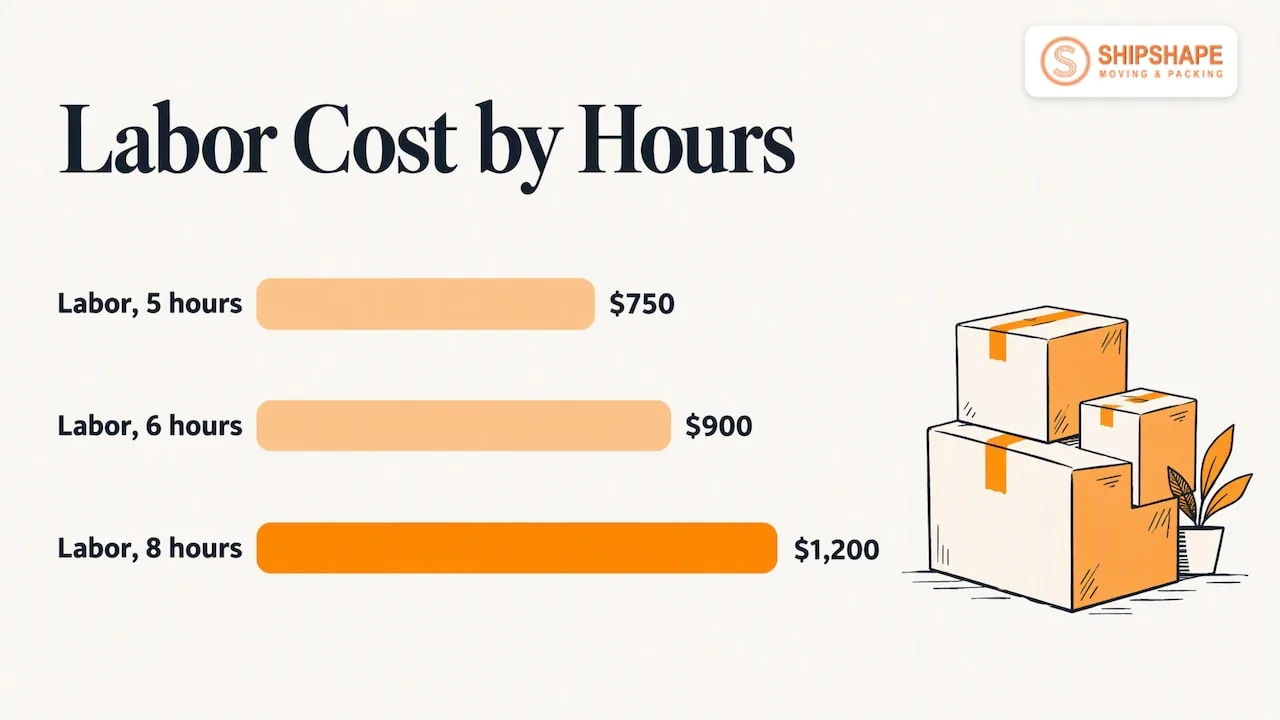
If the same crew finishes in five hours instead of six, labor drops to $750. If it needs eight, labor climbs to $1,200. That is why a realistic hour count from an inspection matters more than a pretty hourly rate.
What do packing materials, specialty items, and crating cost?
Materials are usually billed separately from labor under the hourly model, so budget for them as their own line. Typical 2026 material prices, in line with the price lists in the market guide, run along these lines:
- Boxes: Small, medium, and large cartons are the bulk of your supply bill, with large boxes costing the most each.
- Dish packs: Double-walled boxes for plates and glassware cost more than standard cartons.
- Wardrobe boxes: Tall hanging boxes let clothes go straight from closet to truck.
- Padding and sealing: Packing paper, bubble wrap, and tape add up over a whole home, especially in kitchens.
Specialty items are priced differently. Crating is a custom wooden or reinforced container built to fit a single piece, and the price depends on its size and the item’s value. Common candidates include flat-screen TVs, framed artwork, marble tabletops, and sculptures. As a rule, anything that is heavy, brittle, irregular, or hard to replace is a crating candidate, while standard glassware and household goods go in dish packs and cartons.
Ask for each crate as its own line, with the size and the item named. A single “specialty” charge makes it impossible to tell whether you are paying for one crate or three.
What drives your packing bill up or down?
Several factors can move your total substantially.
- Volume and fragile counts: More belongings mean more hours, and every fragile item takes longer and uses more material.
- Layout: Stairs, long carries, tight elevators, and parking or permit limits slow the crew and add time. A home with narrow halls costs more to pack and carry than an open ground-floor apartment.
- Travel, setup, and day-of changes: Crew travel time, setup, and last-minute additions all add billable hours. Rooms you “forgot” to mention on the estimate are the classic source of an overrun.
- Add-ons: Unpacking, specialty handling, and debris removal are often priced separately.
Clearing space before the crew arrives also helps. Staging a home before trades arrive can speed up the work, and the same logic applies to packers: open floors and cleared surfaces mean fewer minutes lost to moving furniture and hunting for outlets.
Pro Tip: Photograph every room and list your fragile items before you request quotes, so each company prices the same scope.
How do you get an accurate, itemized packing estimate?
Start with an in-home or virtual inspection. Reputable movers should provide a detailed, itemized quote from one, and flat-rate phone quotes without an inventory often lead to surprise fees. Federal rules back you up: the FMCSA requires movers to prepare a written estimate of all charges.
Know which kind of estimate you are signing. Under a binding estimate, you will not pay more than the stated amount at delivery.
Before you accept any quote, run through this checklist:
- Did the mover inspect the home in person or on video?
- Is the estimate in writing and itemized?
- Are labor, materials, crating, and unpacking on separate lines?
- Is the estimate binding or non-binding, and what happens if the scope changes?
- What is the minimum charge, and are there fees for stairs, long carries, or travel?
- Which items are covered if something breaks, and how do I file a claim?
If a company hesitates on any of these, treat that as useful information before you book.
How can you cut your packing costs?
You can lower the bill without leaving valuables unprotected.
- Declutter first: This is the biggest lever. Packing is labor-intensive, so decluttering before you book cuts both hours and materials. Another guide estimates it can save $200 to $800 or more.
- Choose partial or fragile-only packing: Let the crew handle kitchens, art, and electronics, and pack books, linens, and clothes yourself.
- Schedule off-peak: Midweek and mid-month dates are often easier to book and can be less expensive than weekends and month-end.
- Bundle services: Ask whether packing priced alongside the move itself changes your total.
- Buy only what you need: Pick up standard cartons yourself, and reserve specialty materials for items that truly need them.
Our own moving tips and tricks cover the preparation side if you want a room-by-room game plan before the crew arrives.
Our view on transparent, itemized packing quotes
A packing quote should never feel like a surprise waiting to happen. We believe the price is only as trustworthy as the detail behind it, which is why we provide written quotes and keep you informed from the first call through the final sign-off. Careful packing, clear labeling, and white-glove handling help us simplify your move.
— Ilya
Ready for an itemized packing quote from our team?
If you want a number you can plan around, our packing team is ready to build you one. We can run an in-home or virtual estimate, and it helps to have a rough room list, a count of fragile items, and your target move date ready when you reach out. We provide written quotes so you can see the costs before booking. We also offer packing and white-glove handling for the pieces and rooms you would rather not touch. Tell us what you want packed, and we will send back a clear, written breakdown with no guesswork.

FAQ
How much does a packing service cost?
A professional packing service typically costs between $300 and $2,200, depending on the size of your home. The final number comes from crew size, hours, and materials.
How much do packers charge per hour?
Most packers bill by the hour per person, and a 2026 guide lists roughly $40 to $60 per packer per hour plus materials. Multiply by crew size to get your hourly crew rate.
Is it cheaper to pack myself?
Packing yourself removes the labor line entirely, but it costs you time and gives up some protection for fragile goods. Many people compromise with fragile-only packing, and professional packers can simplify claims for damaged goods compared with boxes you packed yourself.
What is the minimum charge for packers?
Minimums vary by company and are usually set as a minimum number of hours or a minimum job total. Ask for the minimum in writing before you book, along with any fees for travel, stairs, or long carries.
Sources
- How Much Do Movers Cost? (2026 Update) – Forbes Home
- Professional Packing Service Cost 2026: Movers Packing Prices | Moving Calculator
- 2026 Moving Labor Rates: Average Hourly Costs for Packers, Loaders, and Drivers by Region — MoveCost
- Estimating Charges (Subpart D) | FMCSA