Wine Collection Moving: How to Move Bottles Safely
Moving a wine collection safely comes down to four things: knowing what you own and what it is worth, keeping the bottles out of heat, packing each one so it cannot move, and giving them time to rest at the other end. A few dozen everyday bottles can go in your own car with some care. A collection with real value, a cellar, or a long-distance route is a job for a crew that packs and handles wine on purpose.
This guide walks through each step in the order you will do it, and says plainly where doing it yourself stops making sense.
TL;DR
- Before anything moves, appraise the collection, photograph it, and tell your mover you have high-value wine. Ask for a high-value inventory form.
- Heat is the main threat. Wine kept for one to four weeks should stay at 75°F or below and should never reach 86°F.
- Pack every bottle individually in a fitted insert inside a sturdy double-wall box, with no empty space.
- Use temporary climate-controlled storage or specialized transport when the move is long, the weather is hot, or the wine is old or valuable.
- Let bottles rest after arrival before you open the best ones.
Table of Contents
- Why wine is not like the rest of your boxes
- Before the move: appraise, photograph, inventory
- Keep the wine cool: the temperature rules
- Packing wine bottles for a move
- Should you move it yourself or hire pros?
- When temporary storage or specialized transport makes sense
- Moving a collection long-distance or across state lines
- After the move: let the wine settle
- Our perspective on moving wine
- How we help with wine collection moves
- FAQ
- Sources
Why wine is not like the rest of your boxes
A box of dishes that gets bumped loses a plate. A box of wine that gets too warm can lose the character of every bottle in it, and you may not know until you open them years later. Wine is sensitive to heat, vibration and time in ways that books and towels are not. It is also heavy, awkward to carry, and often worth far more per box than anything else you own.
That is why the question is not just “how do I pack it” but “who is responsible if something goes wrong, and what is it worth.” Start there.
Before the move: appraise, photograph, inventory
A relocation tip sheet written for movers and their customers recommends getting an appraisal, photographing the collection, telling your mover about the high-value wine, and filling out a high-value inventory form. Those steps are the foundation for everything else, including any claim you might ever have to make. An insurer also advises collectors to get a professional appraisal before a move so the valuation is accurate and a claim is easier to support.
In practice, build a simple spreadsheet:
- One row per bottle or case: producer, wine, vintage, quantity, and where it sits in your cellar or rack.
- A current value for each line, from your appraisal or recent purchase receipts.
- Photos of labels, fill levels on older bottles, and the cellar or racks as they are now.
- A note of which bottles are replaceable and which are not.
The last column matters. A case of everyday red you can rebuy for a few hundred dollars is a different risk from a single bottle you will never find again. Your plan for the two groups may be different.
Then call your insurance company. Homeowner and renter policies often have limits on wine, and standard mover liability is based on weight, not on the value of what is in the box. Ask what your policy covers while the wine is in transit, and whether you need a rider or declared-value coverage. Get the answer in writing before moving day, not after.
Keep the wine cool: the temperature rules
The guidance from Purdue Extension is simple. For long-term storage, wine does best at 50 to 60°F. For one to four weeks, it should be kept at 75°F or below, and it should never be exposed to 86°F or higher.
Those numbers shape every decision about moving:
- A parked car is the enemy. On a warm day, the inside of a closed vehicle can pass those limits quickly. Never leave wine in the trunk while you run errands or stop for a meal.
- An unconditioned moving truck can also get hot. A standard truck sitting in the sun, or a load that waits overnight in a parking lot, is a risk in summer. In much of California, that includes late spring through early fall, especially inland.
- Timing helps. If you can choose, move wine on a mild day, load it last, and unload it first into a cool room.
- Short exposure is different from long exposure. A few hours at a moderate temperature is not the same as days in a hot truck. The guidance above is measured in weeks for a reason. Plan the shortest route from cellar to cellar.
For a local move within the Bay Area, the wine can often be packed and moved the same day, which keeps exposure low. Fog and coastal air help in Berkeley, Oakland and San Francisco. Drive east to the Central Valley in July and the picture changes completely.
Packing wine bottles for a move
Packing is where most home moves go wrong, usually because someone tries to save boxes. The principles are straightforward.
Use boxes made for bottles
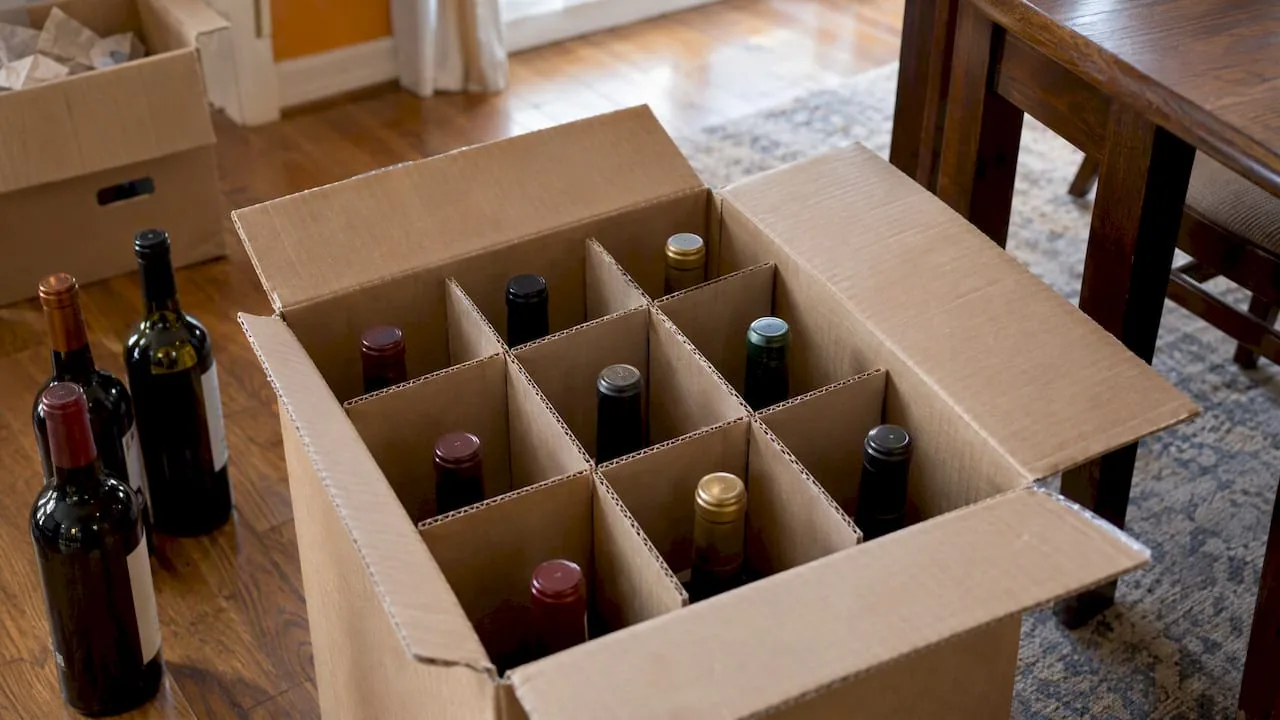
A packaging guide for beverage shipping explains that separation alone is not enough: inserts should hold each bottle in place, cushioning should absorb impact, and a double-wall carton adds crush resistance. Ordinary cardboard dividers from a liquor store are better than nothing, but they are meant for the shelf and a short trip, not for a truck.
For most households, the options are:
| Packing option | Best for | Watch out for |
|---|---|---|
| Foam or molded-pulp wine shipper (typically 12 bottles) | Valuable bottles, long trips, anything stacked | Cost per box; they take space on the truck |
| Cardboard wine box with cell dividers | Everyday bottles, local moves | Weaker box walls; do not stack high |
| Standard box with wrapped bottles and fill | Last resort for a few bottles | Easy to leave gaps; bottles can shift |
| Original wooden case | Bottles you bought in case lots | Check the wood and the lid; they can crack on older cases |
Wrap, seat, fill, seal
A sound routine for each bottle:
- Wrap the bottle in soft paper or bubble wrap, covering the neck and shoulders, so glass never touches glass.
- Seat it in its cell or insert.
- Fill any remaining gap so nothing can slide.
- Do not go beyond the box’s designed capacity. An over-stuffed box puts pressure on the bottles in the middle.
- Tape the box shut and mark it with the contents, “fragile,” and “this side up.”
Most collectors keep bottles on their sides, which is how wine is generally stored and keeps the cork in contact with the wine. For a short move, the more important point is that the bottle is immobilized, whichever way the box is oriented.
Special cases
- Old bottles with low fill levels or loose, crumbly corks need extra care and often a conversation with a specialist before you move them. Photograph them first.
- Magnums and large formats do not fit standard inserts. Ask about custom padding.
- Sparkling wine is under pressure; the heat guidance above matters even more.
- Wine in the fridge or a cooler should be moved last, in an insulated container, and unloaded first.
Should you move it yourself or hire pros?
Do it yourself if all of these are true: the collection is small, the bottles are replaceable, the distance is short, the weather is mild, and you have a cool vehicle and room to carry boxes carefully.
Hand it to professionals if any of these are true:
- The collection is worth more than your insurance would pay out.
- You have a built-in cellar, large racks, or hundreds of bottles.
- You are moving long-distance or out of state.
- Your move date falls in hot weather and the wine cannot go in a cool vehicle.
- You have older or rare bottles you cannot afford to lose.
- You simply do not want to carry 40 heavy boxes down a flight of stairs in a San Francisco walk-up.
If you do hire, ask direct questions. Will the crew pack the wine, or will you? Is the wine covered under the mover’s valuation, and at what amount? Can it ride on the truck at all, or does the company route it separately? Does the crew handle wine racks and disassemble shelving? A mover who is vague on any of these is giving you an answer.
When temporary storage or specialized transport makes sense
Sometimes the move date and the arrival date do not match. Closing dates slip, a new cellar is not finished, or you are between homes for a few weeks. Climate-controlled storage at the 50 to 60°F range is the safe answer for that gap, and it is far better than a garage or a standard storage unit. The same Purdue guidance applies: the longer the wine sits, the closer it should be to proper storage conditions.
Specialized wine transport, meaning a temperature-controlled vehicle run by a company that does this all day, is worth considering when:
- the route is long and the weather is warm,
- the value of the collection is high,
- the wine will be on the road more than a day or two, or
- you want it handled separately from the household truck.
This is a separate service from a standard household move, and it costs more. For a collection that is truly valuable, the cost is usually a small fraction of the value at risk.
Moving a collection long-distance or across state lines
Three things change when the wine leaves California.
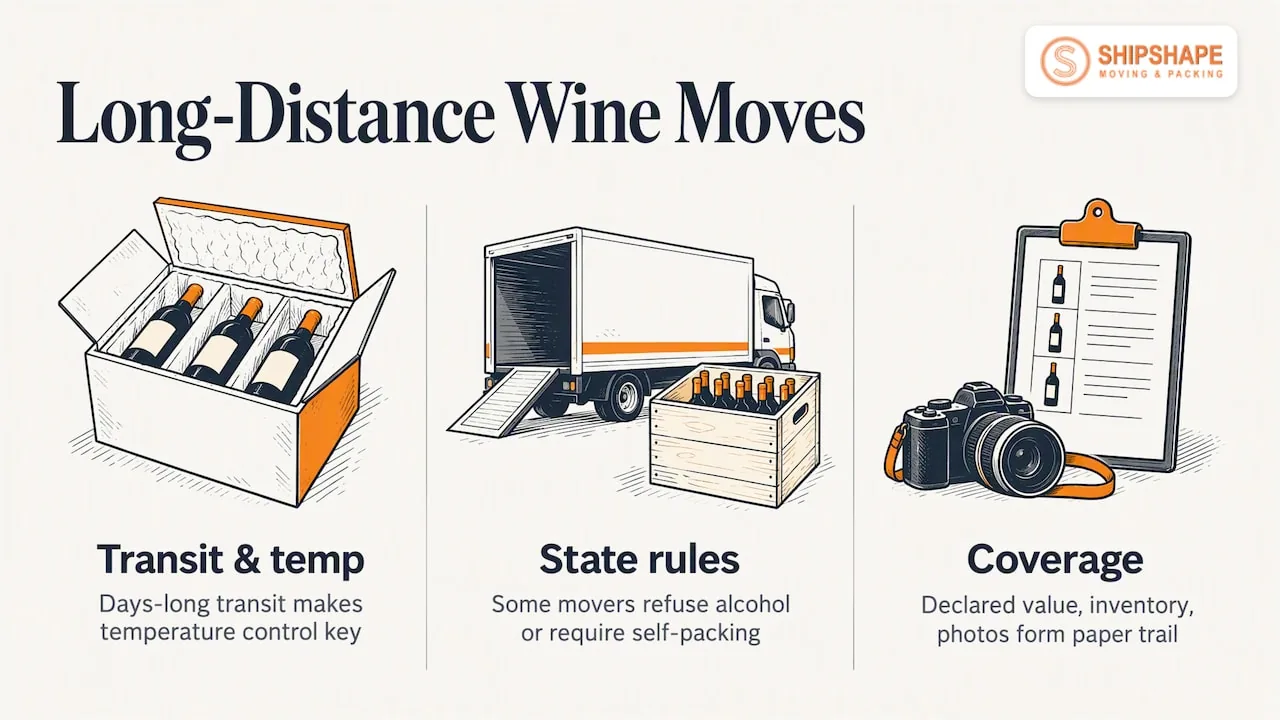
Time in transit goes up. A cross-country household move takes days, not hours. That puts the one-to-four-week guidance into play, and it makes temperature control the main question, not a side issue.
Rules on alcohol vary by state. Alcohol is regulated at the state level, and not every household mover is willing to carry it. Some will not transport alcohol at all, and others will do it only if they pack it. Ask early, in writing. Check your destination state’s rules on bringing in personal wine before you commit to a route, and ask your mover what they require.
Coverage matters more. Declared value, a high-value inventory and photographs are no longer nice to have. If the wine is professionally packed and inventoried, you have the paper trail you need.
If you are planning a move beyond the Bay Area, our long-distance moving page explains how we plan those jobs, and we are happy to talk through the wine question before you book.
After the move: let the wine settle
Once the boxes arrive, unpack them into a cool, dark, still place and leave the bottles alone for a while. The idea of “bottle shock,” a temporary dulling after travel, is contested, with little hard evidence behind it, but sommeliers generally still recommend letting wine rest after shipping. It costs nothing, and it gives sediment in older bottles time to settle.
A practical plan:
- Unpack carefully and check every bottle against your inventory.
- Look for leaks, pushed corks, and seeping around the capsule. Photograph any problem and report damage to your mover and your insurer right away, as their deadlines for claims are short.
- Rack the bottles and leave them for a few days at least. For older or special bottles, longer is better.
- Wait on the bottle you were saving for the housewarming.
Our perspective on moving wine
Most people who call us about wine are not worried about breakage so much as about being told, three weeks later, that nobody knew what was in the box. That is the part we take seriously. A move runs well when the customer knows what we are carrying, what it is worth, and who is doing what. That is how we work from the first call to the final box: we tell you the plan, we put it in a written quote, and we keep you informed.
For wine, that means we want to know early. Tell us how many bottles, whether any are valuable, and what the route looks like. We would rather spend ten minutes on the phone planning the packing than have a surprise on moving day. Careful packing and labeling is what we do, and a collection deserves the same attention you would give a piece of art.
We also think honesty is part of the job. If your collection is large, old or headed across the country in August, the right answer may be climate-controlled transport or storage, not our standard truck. We will tell you that.
— Dennis
How we help with wine collection moves
ShipShape Moving is a licensed moving company based in Berkeley, serving Berkeley, Oakland, San Francisco and the surrounding Bay Area, with long-distance moves as well. Our crews pack and label carefully, and our white glove service is built for valuables, including collections.

Our published local move rate is $190 to $200 per hour, plus a one-time $80 truck fee. You get a written not-to-exceed quote, and we sometimes ask for a deposit to hold your date. If you want us to pack the bottles, see our packing services. To plan your move, start at shipshapemoving.com and tell us about the collection.
FAQ
Can I move wine in a regular moving truck?
Often, yes, for a local move on a mild day, if the wine is packed well and loaded so it stays cool. In hot weather or over long distances, a regular truck can get too warm. Ask your mover whether they accept wine at all, and how they cover it.
What temperature is safe for wine during a move?
Purdue Extension advises 50 to 60°F for long-term storage and 75°F or below for one to four weeks. It says never to expose wine to 86°F or above. Aim for the cool end of that range whenever you can.
Is my wine covered by my mover’s insurance?
Not automatically. Standard mover liability is not based on the value of your wine, and it can exclude bottles you packed yourself. Get an appraisal, fill out a high-value inventory, and confirm the coverage in writing with both your mover and your own insurer.
How long should wine rest after a move?
There is no fixed rule. Sommeliers generally recommend a rest after travel, and a few days is common for everyday bottles. Give older or valuable bottles longer before you open them.
Should I use storage between homes?
If the wine will be out of a proper cellar for more than a few days, climate-controlled storage is safer than a garage or a standard unit. It is especially wise in warm months or for valuable bottles.
Sources
- Consumer Tip Sheet: Tips for relocating a wine collection
- Moving your wine collection to your new home, Chubb
- Wine Storage Guidelines, Purdue Extension
- Wine and Beverage Shipping Boxes: How to Choose
- Ask a Somm: Does Wine Really Need to Rest After Traveling?, VinePair