U.S. Moving Costs: Lock In a Binding Quote for Long Distance Moves

A typical long-distance move in the United States runs within a broad cost range that depends on shipment and distance, and the two numbers that move that figure the most are your shipment’s weight and your home’s size, plus the mileage between pickup and delivery. Before you book, insist on a written binding estimate so the number you see is the number you pay.
TL;DR:
- Linehaul uses weight and mileage, with rates around $0.50 to $0.80 per pound; removing 1,000 pounds can cut several hundred dollars.
- DIY truck rental costs $1,200 to $3,500 before road expenses and labor; containers cost $2,000 to $6,500, but you still pack and load.
- Get an in person or virtual survey and binding estimate; nonbinding quotes may require up to 110% at delivery, with any remainder billed later.
- Book summer dates early because peak slots fill quickly, and remove unwanted items before the survey to ensure the weight estimate reflects what will ship.
- Before signing, compare two or three binding estimates line by line, review the mover’s tariff, and weigh free released value against paid full value protection.
Table of Contents
- Quick cost ranges by home size and distance
- How movers price interstate moves: linehaul, fuel surcharges, and accessorials
- DIY truck rental vs. moving containers vs. full-service movers
- How to get an accurate quote and protect your budget
- Why a licensed professional mover protects your budget
- A detailed timeline for budgeting a long-distance move
- A practical checklist for building your moving budget
- Get a binding quote for your long-distance move
- FAQ
- Sources
Quick cost ranges by home size and distance
Interstate movers price primarily on weight and miles, so your home size sets the floor and the distance band adjusts it from there. A one-bedroom apartment moving 1,500 miles rarely costs what a four-bedroom house moving the same distance does, even though both cross the same number of state lines.
A typical two-bedroom move of 400-800 cubic feet lands around a median of $3,320, according to a long-distance subset in the CMR Move Cost Report for 2025-2026, with summer bookings running noticeably higher than January moves.
A few things worth noting when you check your own quote against these bands:
- Corridor matters: a move between two major metro areas often costs less per mile than a route with sparse return freight for the carrier.
- Seasonality adds real money: summer moves can run meaningfully above winter rates, so a January move is often the better deal.
- Home size usually outweighs distance: a cluttered one-bedroom can cost more to ship than a sparsely furnished two-bedroom going twice as far.
How movers price interstate moves: linehaul, fuel surcharges, and accessorials
Interstate movers calculate your core charge, called linehaul, using weight multiplied by mileage. Market summaries put per-pound rates around $0.50 to $0.80 per pound, meaning every extra 1,000 pounds of furniture and boxes can add several hundred dollars to a long-haul quote. The rate per pound often drops slightly as mileage increases, since longer hauls spread fixed costs like driver time and terminal handling across more miles.
On top of linehaul, expect a short list of accessorial charges that cover anything outside standard pickup-to-delivery service:
- Long carry fees when the truck can’t park near your door.
- Shuttle service when a smaller vehicle has to ferry items from a tight street or building.
- Extra stair or elevator carries in walk-up apartments.
- Packing materials and labor if you want the crew to pack for you.
- Short-term storage if your delivery date slips.
Fuel surcharges track diesel prices directly. National on-highway diesel prices averaged at the higher end of recent market ranges during summer 2026, according to EIA fuel price data, and movers typically adjust surcharges as fuel costs shift.
DIY truck rental vs. moving containers vs. full-service movers
Your service choice changes both the price and what you’re responsible for.
- DIY truck rental costs $1,200 to $3,500 for the rental itself, but that figure excludes fuel, tolls, hotels, meals, and the physical labor of loading and unloading, all of which show up as hidden costs once you’re on the road, per EIA fuel price data.
- Moving containers run $2,000 to $6,500 and sit in the middle: a company drives the container, but you still pack and often load it yourself.
- Full-service movers cost the most per move but include labor, equipment, and liability coverage, so there’s no truck to drive and no boxes to lift yourself.
Pro Tip: If you’re short on time or moving fragile, high-value items, the labor and valuation coverage in a full-service quote usually costs less than the hidden expenses and risk of doing it yourself.
How to get an accurate quote and protect your budget
A phone estimate is a guess. An in-person or virtual survey lets the mover actually see your furniture, boxes, and stairs, which is why reputable movers recommend a survey before issuing a real number.
Two estimate types matter here. A binding estimate locks in your total price unless you add services after signing. A nonbinding estimate can require up to 110% of the quoted amount at delivery, with the remainder billed later.
- Ask for a binding-not-to-exceed estimate whenever budget certainty matters.
- Request the mover’s tariff, a copy of the bill of lading, and information on the arbitration program before you sign.
- Choose between released value (minimal, free coverage) and full-value protection (higher cost, full replacement) based on what you’re shipping.
Federal law requires interstate movers to give you the “Your Rights and Responsibilities When You Move” booklet, disclose their tariff, and offer an arbitration program for resolving disputes. FMCSA
Why a licensed professional mover protects your budget
A written, binding estimate from a licensed carrier removes most of the guesswork that drives surprise charges on move day. Movers who survey your home in person or over video catch items a phone call misses, and that accuracy is what keeps your final bill matching your quote.
We operate as a licensed mover based in Berkeley, serving Berkeley, Oakland, San Francisco, and the surrounding Bay Area with residential, commercial, and long-distance moves. A few things worth knowing about how we work:
- We keep clients informed from the first call through the final box, so there’s no guessing about timeline or cost.
- Our crews handle packing and labeling carefully, which matters most for families, collectors, and anyone shipping fragile or valuable items.
- Our clients regularly highlight our careful attention to detail and efficiency.
Full-service, licensed help pays off most for large households, long corridors, and anyone moving valuables they can’t afford to risk.
A detailed timeline for budgeting a long-distance move
Costs don’t hit all at once, they arrive in waves tied to specific milestones.
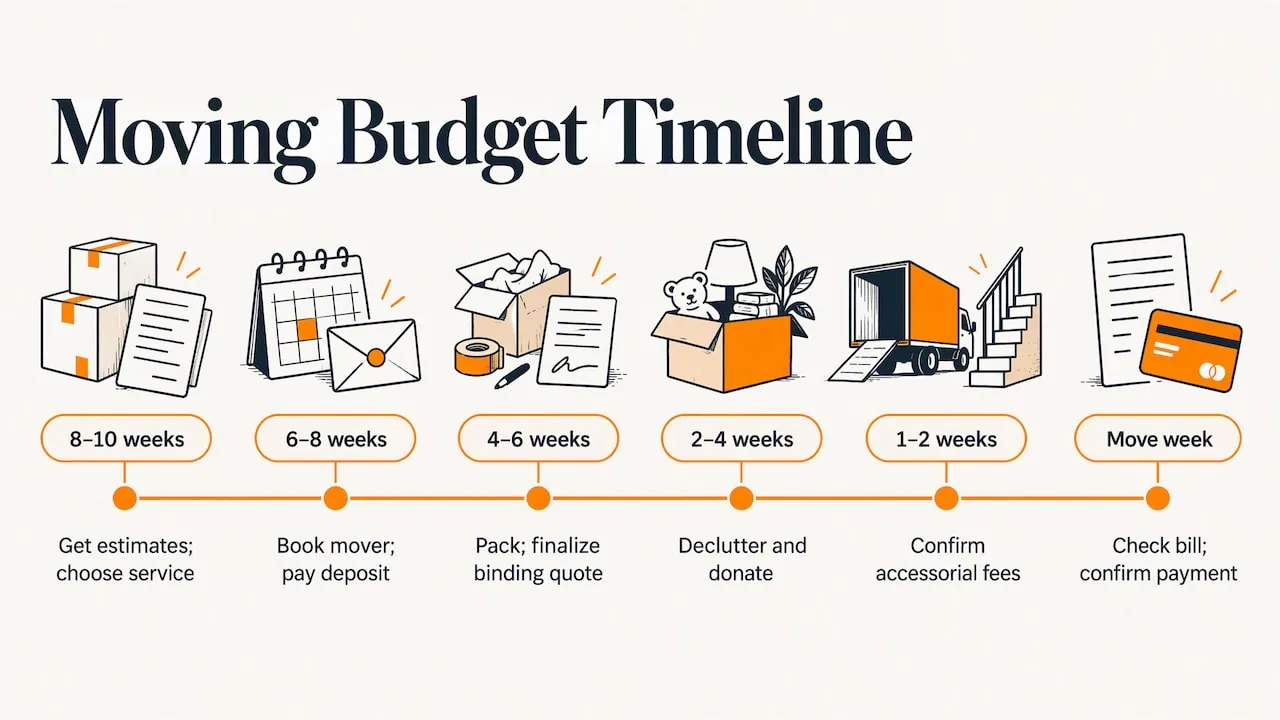
8 to 10 weeks out: Get your first estimates. This is when you decide between DIY, containers, or full-service, and that choice sets your entire budget range.
6 to 8 weeks out: Book your mover and pay any deposit required to hold your date. Rates for peak summer dates often fill up early, so booking late can mean fewer options and higher prices.
4 to 6 weeks out: Order packing materials or confirm packing service with your mover. This is also when you should finalize your binding estimate and review the tariff and bill of lading.
2 to 4 weeks out: Declutter and donate items you don’t need shipped. Every pound you remove here lowers your linehaul charge directly.
1 to 2 weeks out: Confirm accessorials like shuttle service or extra stair carries based on your actual delivery address, since these fees often get finalized close to move day.
Move week: Expect the survey crew’s estimate to match your bill, assuming nothing changed since your binding estimate was signed. Payment is typically due at delivery, so confirm accepted payment methods ahead of time.
Delivery day: Final payment and valuation claims, if needed, happen here. Keep your bill of lading accessible in case of a dispute.
A practical checklist for building your moving budget
- Estimate your shipment weight or home size. This single number drives most of your quote.
- Pick a service type early. DIY, container, or full-service changes your entire cost structure.
- Collect binding estimates from at least two or three movers. Compare them line by line, not just the bottom number.
- Schedule for off-peak months when possible. Winter dates routinely cost less than summer ones.
- Set aside a contingency fund. Accessorials and last-minute changes are common, even with a solid estimate.
- Confirm your valuation coverage before move day. Know whether you have released value or full-value protection.
Pro Tip: Decluttering two weeks before your survey, not after, means the weight estimate your mover gives you actually reflects what gets loaded.
— Ilya
Get a binding quote for your long-distance move
Moving across the country shouldn’t mean guessing what you’ll owe at delivery. We handle long-distance moving with the same clear communication and careful packing we bring to every local job, from the first estimate call to the final sign-off.

Our services cover what most long-distance moves actually need:
- Long-distance moving with binding, not-to-exceed estimates.
- Professional packing and labeling so unpacking goes faster.
- White glove handling for collectors and anyone shipping fragile or high-value items.
Request a written estimate through our long-distance moving page and get a real number before you commit to a date.
FAQ
How much does it cost to move 50 miles?
A 50-mile move typically falls under local moving rates rather than long-distance interstate pricing, since it usually stays within one state. Local movers often charge hourly, so a studio or one-bedroom move might run a few hundred dollars while a larger home costs more based on crew size and hours worked.
Is it cheaper to use a pod or a moving truck?
A moving container usually costs less than full-service movers but more than a bare DIY truck rental once you factor in your own time and labor. DIY truck rental runs $1,200 to $3,500, while containers run $2,000 to $6,500, with containers requiring you to load and unload yourself.
What is the most expensive part of moving?
For most households, the linehaul charge, weight multiplied by mileage, makes up the largest share of a long-distance moving bill. Accessorials like packing, shuttle service, and fuel surcharges add to that base cost but rarely exceed it.
Is it cheaper to move yourself?
A DIY move often looks cheaper upfront, but hidden costs like fuel, tolls, hotels, and your own labor can close much of the gap with professional movers. A full-service quote includes labor and liability coverage that a DIY move does not, which matters most for larger households or valuable items.