Floor Protection for Moving: What to Lay and Where
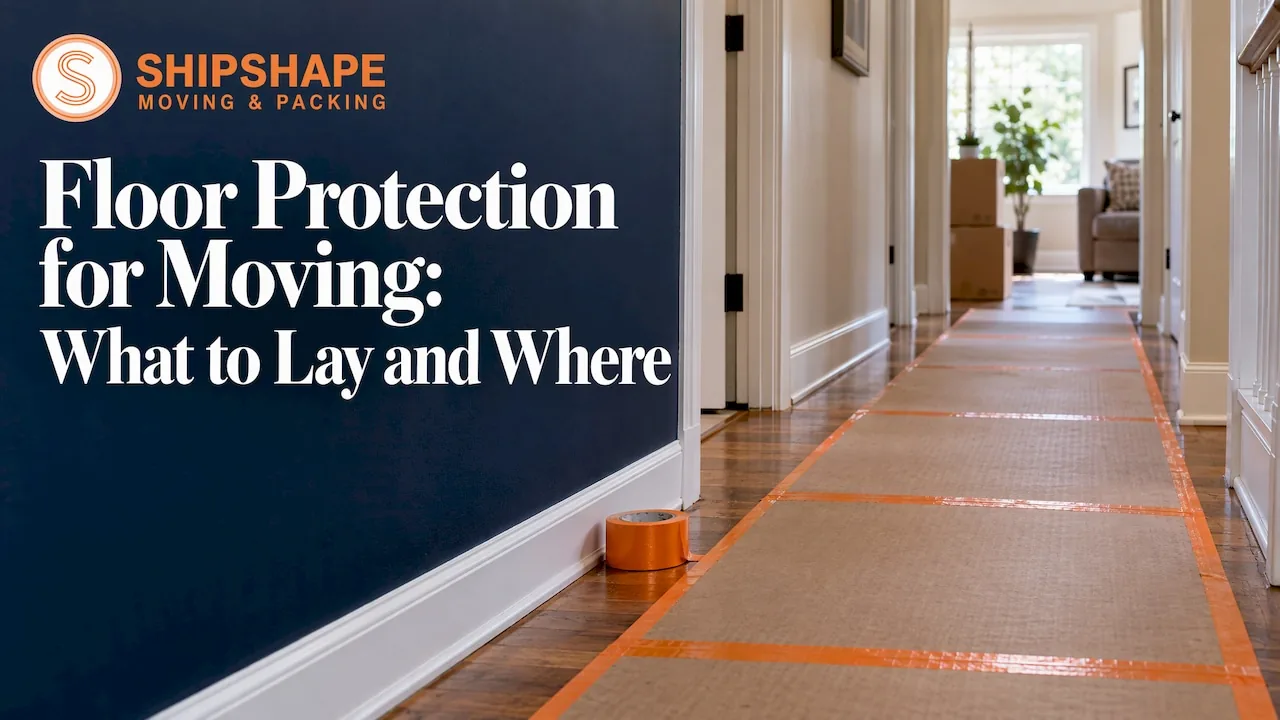
The best floor protection for moving is a continuous lane from the front door to the truck, made of the right material for each floor type. Use rigid board on hardwood, tile and vinyl, and adhesive film on carpet. Tape protection to itself, never to the finish. Lift furniture instead of dragging it. Most floor damage on moving day comes from grit under a heavy load, a dragged leg or a dropped box, and all three are preventable with the right layer in the right place.
Below you will find what to use on each surface, how Ram Board and Masonite compare, how to lay and remove protection step by step, and where professional crews take the work off your hands.
Key Takeaways
- Match the material to the floor: rigid board (Ram Board, Masonite or plywood) for hardwood, tile and vinyl, and self-adhesive carpet film for synthetic carpet.
- Never cover hardwood with plastic sheeting. It traps moisture, and Ram Board’s guidance warns it can cause cupping.
- Sweep first, overlap seams, tape protection to protection, and lift furniture rather than dragging it.
- Masonite is the low-cost reusable option, at roughly $10 to $25 per sheet. Ram Board is lighter, rolls out fast and is easier to cut.
- Our local moves run $190-$200 per hour plus an $80 truck fee, with a written not-to-exceed quote, so you know the cost of a careful move up front.
Table of Contents
- Why Floors Get Damaged on Moving Day
- What to Put on Floors When Moving, by Surface
- Ram Board vs. Masonite
- How to Lay Floor Protection, Step by Step
- Where Floor Protection Goes Wrong
- How to Remove Protection and Check the Floor
- What It Costs to Do It Yourself vs. Hiring Movers
- Special Cases
- Our Perspective
- Let Us Handle the Heavy Lifting
- FAQ
- Sources
Why Floors Get Damaged on Moving Day
A move concentrates weight, friction and foot traffic on the same few paths through your home. Dressers, sofas and appliances put hundreds of pounds on small contact points. Shoes carry in grit from the sidewalk and driveway. One dragged leg on a sandy floor can leave a scratch that outlasts the lease or the first year in a new house.
The damage usually falls into three types:
- Scratches and gouges from sliding furniture and from grit trapped under moving pads or boxes.
- Dents and cracks from dropped items and point loads. Tile is especially exposed here, and so is stone with a polished surface.
- Dirt, mud and moisture tracked in on foot traffic, which matters most on carpet.
The flooring company DG Floors makes the same split: tile’s main risks are cracked tile from dropped items and scratched stone polish, while carpet needs protection from dirt, mud and moisture more than from scratches. That is why one material does not fit every room.
What to Put on Floors When Moving, by Surface
Hardwood and engineered wood
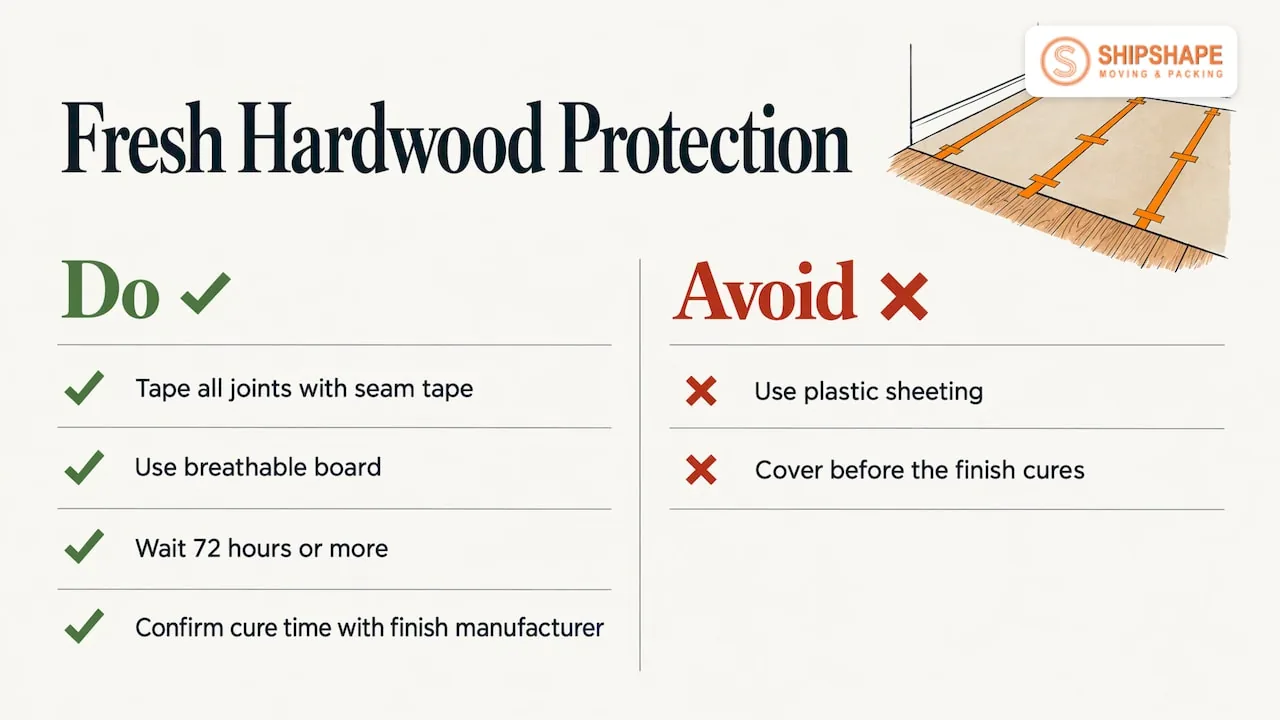
Hardwood is the surface most people worry about, and the answer is rigid, breathable board. Ram Board’s own guidance says to use seam tape at all joints and never plastic sheeting, because plastic traps moisture and causes cupping. Ram Board describes its product as breathable, so floors can breathe underneath.
If the floor was refinished recently, wait. The same guide says to allow 72 hours or more of cure time before covering freshly finished hardwood. DG Floors adds that covering a fresh finish too soon, or with a non-breathable layer, can trap solvents and cause cloudiness or adhesion problems, so confirm the cure time with the finish manufacturer first.
Tile and stone
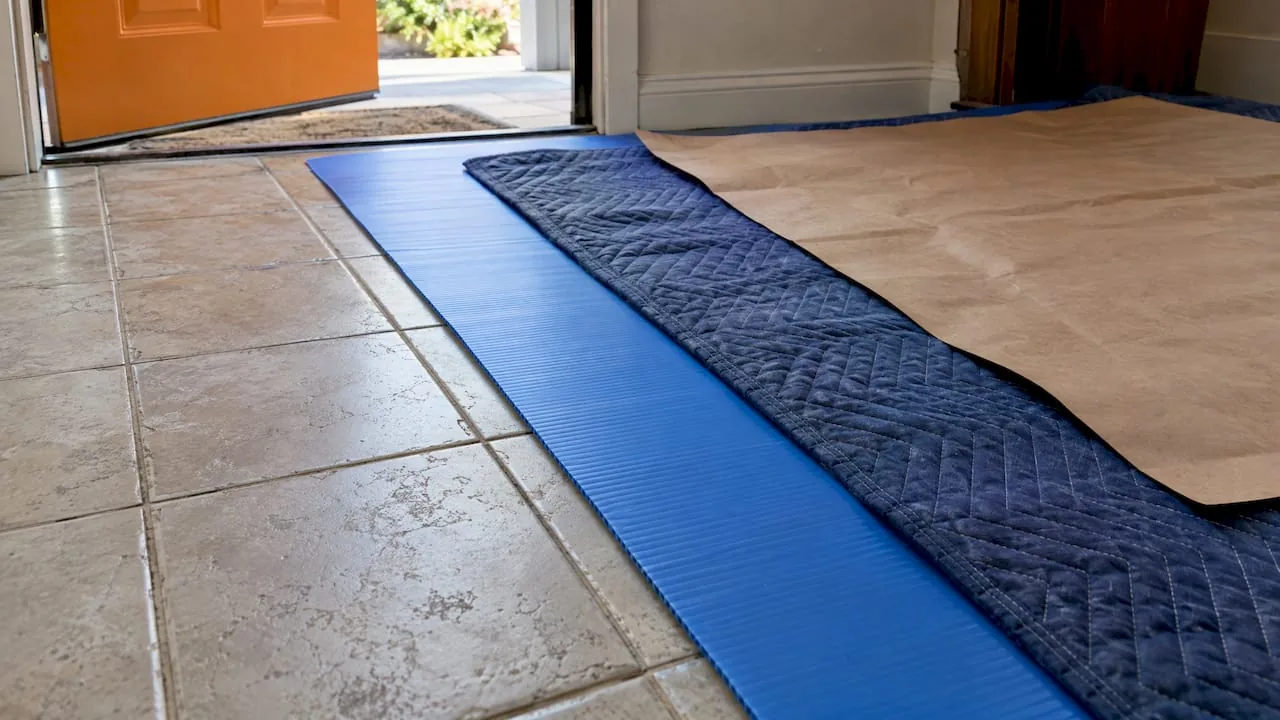
Tile rarely scratches, but it cracks under impact. Cushioning matters more than a thin film. Use rigid corrugated plastic sheets or moving blankets under paper in the places where heavy items get set down. Treat polished stone like a finish you do not want to scuff, and keep grit off it.
Carpet
Carpet needs a clean, non-slip cover, not an armored one. Self-adhesive carpet film does this job. Ram Board’s blog says carpet film resists tears and punctures and can stay down for up to 30 days, which is more than enough for a move. One limit to respect: the manufacturer’s specification says Carpet Shield is recommended for synthetic carpeting only, not wool-based carpet or hard surfaces, and should go on dry, vacuumed carpet. Cut the film to fit each stair tread so no one trips on a loose edge.
Vinyl and laminate
Treat these like hardwood: clean, dry, rigid board or paper on top, seams taped. Ark of Flooring lists hardwood, tile, carpet, vinyl and laminate among the surfaces Ram Board suits.
Quick reference
| Floor | Best primary layer | Add where needed | Avoid |
|---|---|---|---|
| Hardwood | Rigid board (Ram Board, Masonite, plywood) with taped seams | Felt sliders under furniture, blankets at set-down spots | Plastic sheeting, tape on the finish |
| Tile and stone | Rigid board or corrugated plastic sheets | Moving blankets under paper for impact | Dragging loads, unprotected dolly wheels |
| Carpet | Self-adhesive carpet film | Hard plastic or nylon sliders | Film on wool carpet |
| Vinyl and laminate | Rigid board or red rosin paper | Painter’s tape at edges | Sliding furniture across bare floor |
The Richard Elias moving guide also lists red rosin paper or builder’s paper as a lighter option on hard floors. It works for light foot traffic. For appliances, safes and loaded dollies, step up to board.
Ram Board vs. Masonite
Both are rigid enough to spread a load. They differ in weight, cost and how long they last.
Ram Board is a rolled, recycled-material product. Home Depot lists a 38 in. x 100 ft roll (317 sq. ft.) at $63.95. You cut it with a utility knife and tape it down. Fine Homebuilding’s job-site guide describes it as less expensive and easier to clean than Masonite, but not as tough.
Masonite is hardboard, normally in 4-by-8-foot sheets. DG Floors says these are about 1/8 to 1/4 inch thick, cost roughly $10 to $25 per sheet at home centers, and work out to under a dollar per square foot for one use, less if you reuse them. It is the stronger choice for heavy items over longer stretches. The catch is moisture: wet hardboard swells and loses its smooth face, so keep it dry, which matters if you are moving in wet weather. Our guide to keeping belongings dry when moving in the rain covers that side of the day.
| Ram Board | Masonite | |
|---|---|---|
| Form | Roll, cut to length | Rigid 4 x 8 ft sheets |
| Strength | Good for walking and rolling loads | Higher, spreads heavy point loads |
| Handling | Lightweight, quick to lay along a hallway | Bulky, needs two people at times |
| Reuse | Usually one project | Reusable if stored flat and dry |
| Typical cost | $63.95 per 317 sq. ft. roll (Home Depot listing) | About $10 to $25 per sheet |
For a standard apartment or house move, many people combine the two: board in the entry, hall and set-down zones, paper or film on the rest of the route. For a pro-grade hardwood job, Fine Homebuilding describes laying felt first and topping it with Masonite for maximum protection.
How to Lay Floor Protection, Step by Step
1. Walk the route and measure
Walk the exact path from the furthest room to the truck. Note every doorway, turn, stair and threshold. These are where scratches happen, because loads pivot and wheels drop. Measure the length so you buy enough to cover the whole route, not just the entry.
2. Sweep and vacuum
This is the step people skip. Grit under a rigid board acts like sandpaper when it flexes under weight. Ram Board’s guide also says to check for raised nail heads near edges before laying anything over them.
3. Lay protection in a continuous lane
Roll or place the board so it runs unbroken from door to door. Overlap seams by at least 2 inches, per the AOSaves-based advice in the DG Floors moving guide, and add extra reinforcement at turns and thresholds, where the load shifts direction.
4. Tape protection to protection
Seam tape goes on the protection itself, never directly on finished flooring. If you need to hold an edge down on a hard floor, use painter’s tape and keep it off the wood where possible. Ram Board says its 90-day edge tape is safe on factory-finished hardwoods and leaves no residue if removed within 90 days. A move takes days, not months, so that window is comfortable.
5. Add set-down zones
In each room, put a sheet of plywood, Masonite or a moving blanket where heavy items will rest while crews work around them. This is where most dents come from, because items get dropped or lowered fast.
6. Use sliders and lift properly
Felt sliders suit hard floors, and hard plastic or nylon sliders suit carpet. Ram Board’s advice is to lift, don’t drag. For items over roughly 100 lbs, use a two-person lift with straps, or a dolly on protected surface.
7. Cover the stairs
Stairs take the most concentrated abuse and the most risk to people. Fit protection to each tread so it cannot slide, and avoid anything slick. A loose sheet on a staircase is a fall waiting to happen while someone carries a box.
Where Floor Protection Goes Wrong
- Plastic on hardwood. It looks like cheap insurance, but it traps moisture. Skip it.
- Tape on the finish. Aggressive adhesive can lift finish or leave residue. Tape protector to protector.
- Gaps at the seams. Loose or unmatched edges let grit in and create trip points.
- Protection that ends at the door. Thresholds, porches and the path to the truck are where trolleys and wheels hit.
- Leaving it too long. Film has time limits. Ram Board’s carpet film is rated for up to 30 days, and tape has a removal window.
- Covering a fresh finish. Floors that were recently refinished need cure time first.
There is also the human side of this. Floor protection works only if everyone on the move follows it, from the people carrying boxes to the person holding the door. If helpers cut corners to save time, the protection ends up as a decoration. That is a real argument for hiring a crew who handle your belongings as a trade, with a plan for each room, instead of a mix of friends with different habits.
How to Remove Protection and Check the Floor
Removal is where a clean move can still go wrong, so treat it as its own step.
- Sweep the top first. Rulowin’s removal guide says to sweep or vacuum the top of protection before lifting anything, so the grit that landed on it does not get ground into the floor.
- Lift, don’t slide. Lift panels vertically. Work backward from the exit so nobody walks across bare floor you have already uncovered.
- Peel tape slowly at a low angle. If tape stayed down past its removal window, a hairdryer on low or a purpose-made adhesive remover helps. Test it on a hidden area first.
- Roll back Ram Board carefully. Ram Board says to lift the edge tape first, then roll the board back toward one end without dragging it across the protected surface.
- Peel film from a corner. For adhesive film, Phoenix Tile’s guide says to start at a corner and peel slowly with the film kept low and close to the floor. If it tears, lift a new edge rather than scraping with a blade.
- Inspect. Look for residue, discoloration, moisture or scuffs, and use only a cleaner approved for your floor and finish.
- Store reusable panels flat and dry. Check Masonite for cracks or delamination before the next use.
What It Costs to Do It Yourself vs. Hiring Movers
Material is the small part. A roll of board, painter’s tape, sliders and a few moving blankets add up to a modest line item, and Masonite sheets can be reused. The real cost is time and risk: laying the route, relaying it as rooms empty, and being the person responsible if something slips.
With us, the cost is set out in a way you can plan around. Local moves are billed at $190-$200 per hour, with a one-off $80 truck fee, and you get a written not-to-exceed quote. Crew size, move complexity, hours worked and extras like packing drive the price. For a long-distance, office or large-home move, we scope it first. If you are weighing options, our guide to comparing three estimates and checking FMCSA records explains what to look for, and our piece on moving company insurance covers what protection exists if something does go wrong.
For a family, a quick job in a rented apartment may only need a lane of board and sliders. For a large home with hardwood throughout, or for an office with polished flooring and a deadline, the stakes rise quickly. So does the value of a crew that handles it all with care.
Special Cases
Students moving between campuses. Dorm and apartment floors are usually vinyl, laminate or thin carpet, and deposits are on the line. A short lane of paper or board at the entry and felt sliders under the heaviest pieces is usually enough. Plan the route around the elevator and stairs.
Offices and retail. Commercial floors range from polished concrete to carpet tile to hardwood in reception areas. Moves often happen after hours, and the route may include loading docks and long corridors. Heavy file cabinets and equipment on carts need rigid board, not paper. Our commercial moves and office relocations are planned around your operating hours.
Collectors and valuable items. The floor is only half the story. Antiques, art and fragile pieces need packing and handling as careful as the floor. See our guide to moving antiques and our white glove handling.
San Francisco and Bay Area buildings. Many older homes and flats have original hardwood, narrow stairs and tight turns, and apartments have shared hallways. Our moving day preparation guide for San Francisco covers the logistics around the route.
Our Perspective
Floors are a sign of how a move really went. You can pack everything perfectly and still lose the deposit, or the finish on a floor you love, to a single dragged dresser.
Our view is simple: the best floor protection is a plan, not a roll of material. That means looking at the route before the day, knowing where the stairs, turns and tight doors are, and having crews who handle furniture by lifting it, not sliding it. We build our work around clear communication from the first call to the final box, so you know what is happening in your home at every step.
Careful packing and labeling matter here too. When boxes are packed well and labeled by room, crews carry fewer loose items, make fewer trips and spend less time setting things down on bare floor. That is how a move stays quiet and tidy, and the floors stay as you left them.
If you are moving a family home, an office after hours or a collection of valuable pieces, we would rather you hand the handling to a licensed crew that does this every day.
Dennis
Let Us Handle the Heavy Lifting
If you would rather not lay, tape and lift floor protection yourself, our licensed crews handle packing, labeling and careful moving for homes, apartments and offices across Berkeley, Oakland, San Francisco and the wider Bay Area. Local moves are $190-$200 per hour plus an $80 truck fee, and you receive a written not-to-exceed quote before the day.

See our local moving services and professional packing, or start from our home page to request a quote.
FAQ
What should I put on floors when moving?
Use rigid board such as Ram Board, Masonite or plywood on hardwood, tile and vinyl, with taped seams. Use self-adhesive carpet film on synthetic carpet. Add felt sliders under furniture on hard floors and nylon or hard plastic sliders on carpet.
What is the cheapest way to cover a floor for a move?
Masonite is usually the lowest cost per use. DG Floors puts it at roughly $10 to $25 per 4-by-8 sheet, under a dollar per square foot for one use, and cheaper still when reused. Red rosin paper is a lighter option for low-traffic stretches, but it will not stop heavy point loads.
Is Ram Board or Masonite better for moving?
Ram Board is lighter, comes on a roll and is quick to lay along a hallway. Masonite is tougher and reusable, which suits heavy items, but it is bulkier and must stay dry. Many moves use board in the main route and set-down zones and a lighter cover elsewhere.
Can I use plastic sheeting on hardwood floors?
Avoid it. Ram Board’s guidance says plastic sheeting traps moisture on hardwood and can cause cupping. A breathable board with taped seams is the better choice, and tape should go on the protection, not the finish.
How long can I leave floor protection down?
It depends on the product. Ram Board says its carpet film can stay on carpet for up to 30 days, and its edge tape is residue-free on factory-finished hardwood if removed within 90 days. For a move, it should come up the same day or within a few days, once everything is out and the floor is inspected.
Sources
- Moving Floor Protection: Best Materials & How-To, DG Floors
- Masonite Floor Protection: Complete Guide for Homeowners, DG Floors
- The Complete Floor Protection Guide for Contractors, Ram Board
- Floor Protection, Ram Board
- 5 Ways to Protect Floors During a Move, Ram Board
- Frequently Asked Questions, Ram Board
- Ram Board Temporary Jobsite Protection Specification, Arcat
- Ram Board 38 in. x 100 ft, The Home Depot
- Pro Indoor Job Site Surface Protection, Fine Homebuilding
- How To Protect Your Flooring During Home Renovations Or Moving, Ark of Flooring
- Protect Floors When Moving: 8 Tips, Richard Elias
- Removing Protection Without Damaging the Floor Below, Rulowin
- Floor Shield Protective Film: How to Choose, Install, and Remove It, Phoenix Tile