Loading Dock Scheduling for Your Move: How to Book It Right
Loading dock scheduling means reserving a specific time slot for a truck to use a dock door, so only one vehicle needs the space at a time. If you are moving an office, store, clinic or large apartment building, you will usually need to book that slot yourself, with the building manager, before move day. Do it early, confirm it in writing, and tell your movers the exact window, the dock's limits and the route from the dock to your suite.
This guide covers both sides of the topic. First, what dock scheduling is in the freight world, since that is where the term comes from. Then the part that matters if you are hiring movers: how to secure dock access, what it does to your move hours, and what to do when there is no dock at all.
TL;DR
- Dock scheduling assigns each truck an arrival window at a dock door. Warehouses use software for it, while most buildings hosting a move use a simple reservation with property management.
- Request your dock or freight elevator slot at both the old and new address as soon as your move date is firm. Get the window, the rules and any insurance paperwork in writing.
- Poor loading access is one of the biggest hidden drivers of hourly moving cost, because long carries and waiting trucks add paid time.
- No dock? A reserved curb space, such as a commercial loading zone permit, can do the same job, depending on your city.
- Share the dock details with your mover before the quote is written, so the estimate matches the real conditions.
Table of Contents
- What loading dock scheduling actually is
- Who needs to schedule dock access for a move
- How to book a dock slot for your move, step by step
- What dock access does to your moving cost
- What if there is no loading dock?
- Planning a business move around operating hours
- A warning from the port world: scheduling alone does not fix congestion
- If you manage a dock yourself
- Our perspective on dock access
- How we can help with your move
- Move-day dock checklist
- FAQ
- Sources
What loading dock scheduling actually is
In logistics, dock scheduling is the practice of managing inbound and outbound truck traffic at a facility by assigning arrival windows. Supply Chain Research describes the yard as the enclosed area between the gate and the dock door, and treats scheduling as the tool that keeps trucks, labor and dock doors from colliding.
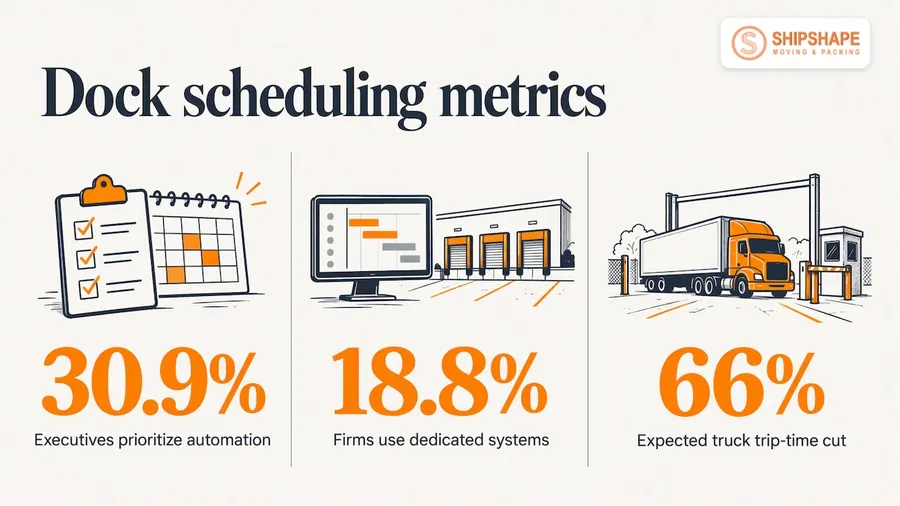
The goal is simple: fewer trucks waiting, fewer idle crews, no pile-ups at the door. Warehouses typically do this with appointment software where carriers book slots online. Adoption is still uneven. A 2026 industry survey found that 30.9% of supply chain executives name automated dock scheduling as a top priority, while only 18.8% of surveyed firms use a dedicated system.
The benefits can be large when it works. A truck reservation system planned for the Port of Virginia was expected to cut truck trip time by 66 percent, per a U.S. DOT evaluation. Ports are a different world from an office building, but the principle carries over: when arrivals are spread out on purpose, waiting drops.
Why a move is a small version of the same problem
A moving truck arriving at a commercial building faces the same constraints as a freight carrier: a limited number of dock doors, shared freight elevators, other tenants, and a building that wants control over when heavy traffic happens. The difference is that you, the tenant, are the one who has to book the slot, and nobody will send you a portal link.
Who needs to schedule dock access for a move
Not every move involves a dock. Here is how it usually breaks down.
| Type of move | Dock or loading access usually needed? | Who you book with |
|---|---|---|
| Office in a multi-tenant tower | Yes, often dock plus freight elevator | Property or building management |
| Retail unit in a shopping center | Often a rear service door or shared dock | Center management or landlord |
| Medical or dental clinic | Frequently, with tight timing | Building management |
| Large apartment complex | Sometimes a service entrance or loading bay | HOA or property manager |
| Single-family home | Rarely | Usually no booking, just street parking |
| Warehouse to warehouse | Yes, dock doors at both ends | Facility dock office |
For residential moves in a house, scheduling is just picking a date. For commercial moves, the building often dictates the date, the hours and the rules.
How to book a dock slot for your move, step by step
- Confirm your move date range first. Buildings book up, especially around month ends when leases turn over. Know two or three acceptable dates before you call.
- Contact building management at both addresses. Ask who handles dock and freight elevator reservations. Do the origin and the destination in the same week so the windows can line up.
- Ask for the rules in writing. Typical questions: What hours is the dock available? Is there an after-hours or weekend option, and is there a fee? How long can a truck stay? What is the maximum truck height and length the dock accepts?
- Ask what insurance paperwork the building requires. Many commercial buildings want proof of insurance from the moving company before releasing the dock or elevator. Ask for the exact wording or form so your mover can match it.
- Reserve the freight elevator separately if there is one. The dock and the elevator are often two bookings. A dock slot without an elevator slot leaves the crew waiting.
- Send the confirmed windows to your mover. Include the dock number or location, the elevator window, the contact person on site, and any protection requirements such as floor covering or wall padding.
- Reconfirm two days before. Property staff change, and a booking made three weeks ago is easy to lose.
Questions to ask the building manager
- Can the dock be held for a single block of time, or is it first come, first served?
- Is there a dock master or security on duty during the window?
- Are there blackout times, such as deliveries for other tenants or a restaurant on the ground floor?
- If we run over, what happens to the next booking?
- Where should the truck wait if the dock is occupied?
That last question matters more than it sounds. A truck circling the block or idling in a no-stopping zone is paid time with nothing moving.
What dock access does to your moving cost
Movers who bill by the hour feel dock conditions directly. Every minute a crew waits for an elevator or carries items across a long lobby is a minute on the clock. Our local moves are billed by the hour (2 movers $190/hr, 3 movers $260/hr or 4 movers $330/hr, plus an $80 truck fee, with a $620 minimum), so the difference between a smooth dock and a messy one is real money.
Here is how loading access tends to change hours:
| Condition | Effect on a move |
|---|---|
| Dock reserved, truck backs in at the booked time | Crew starts loading immediately |
| Dock shared with other tenants, no reservation | Waiting, and a start time you cannot predict |
| Freight elevator booked with a defined window | Predictable pace between floors |
| Elevator shared or unbooked | Stop-and-go trips, longer day |
| Street loading only, far from the door | Longer carries, more trips |
| Dock height does not fit the truck | Ramps and slower handling |
The exact hours depend on volume, distance and furniture type, so any number we gave you here would be a guess. What we can say is that reserved, documented access is the cheapest improvement you can make before move day.
Why a written estimate should reflect your dock
Tell your mover about the dock when you request a quote. A not-to-exceed quote only means something if it was built on the real conditions. If you say "ground floor, direct access" and the reality is a shared dock two buildings away, the quote and the day will not match.
What if there is no loading dock?
Many Bay Area buildings, especially older ones in Oakland, Berkeley and San Francisco, have no dock at all. You still need to plan the truck's position.
In San Francisco, the city's transportation agency describes curb zone types, including white general loading zones with a five-minute limit and yellow commercial loading zones for trucks with commercial plates. A five-minute white zone will not carry a full office move, so for a bigger job ask the city or your building whether a temporary reserved space is possible. Rules vary by city, so check with the relevant local transportation office for your address rather than assuming what applies in San Francisco applies in Berkeley or Oakland.
When street loading is the only option:
- Ask your mover to arrive early enough to claim legal space where permitted.
- Keep the building entrance clear of other vehicles on move day.
- Plan for longer carries and tell your mover so the crew size matches.
- Consider a smaller crew over a longer window if the street is tight.
Planning a business move around operating hours
Offices, clinics and stores can rarely afford to close during the day. After-hours moves solve that, but they also change dock scheduling: many buildings restrict deliveries during business hours and open the dock only in the evening or on weekends. That works in your favor, since a quiet dock is a fast dock.
A workable sequence for an after-hours office move:
- Book the evening or weekend dock and elevator window at both ends.
- Have employees pack and label their own desk contents before the crew arrives.
- Post the destination floor plan so the crew places furniture without stopping to ask.
- Stage items on the floor near the elevator, in the order they will load.
- Walk the destination with the crew lead before unloading starts.
The commercial moves and office relocations pages explain how we plan these jobs around your operating hours.
A warning from the port world: scheduling alone does not fix congestion
The U.S. Department of Agriculture's summary of terminal gate appointment systems at the Port of Los Angeles makes a point that applies to buildings too. Appointment systems depend on every party taking part, and a system put in place in isolation can shift congestion to another time or place instead of removing it.
Translated to your move: a dock reservation helps only if everything around it lines up. The elevator is booked, the movers know the window, your staff are packed, and the destination is ready to receive. If one piece is missing, the delay simply moves downstream.
The EPA's guidance on port gate management adds that long truck queues add emissions, noise and traffic. That is also why many property managers are strict about dock windows: idling trucks bother other tenants and neighbors.
If you manage a dock yourself
Some readers searching this topic run a warehouse or a building dock and need a system, not a mover. A few points from the research are worth keeping in mind.
- Carrier adoption beats features. Supply Chain Research notes that even the most feature-rich tools fail if carriers will not use the booking portal. Test that portal early.
- Visibility matters most. In the 2026 industry survey, 59.1% of supply chain leaders named it the most critical feature.
- Standalone versus embedded. The same survey notes that complex yards often suit specialist tools, while moderate needs are usually better served by a module inside an existing warehouse or transportation system.
- Build costs are high. If you are weighing a new dock instead of better scheduling, one contractor puts equipment and installation at $15,000 to $50,000 per position, with concrete work adding $35,000 to $65,000 per bay, in 2026 market data. Squeezing more from an existing dock through scheduling is often the cheaper first step.
For a small tenant, none of that software is needed. A shared calendar and a clear phone call to property management go a long way.
Our perspective on dock access
We have found that most move-day stress comes from things no one wrote down. The truck was fine, the crew was ready, but nobody knew the dock closed at 6 p.m., or that the freight elevator needed a separate booking, or that the loading door was around the back.
Our approach is built around clear communication from the first call to the final box. In practice, that means we ask about loading access early: where the truck will park, how far the carry is, whether there is an elevator, and what the building requires. Those answers shape the crew size and the schedule, and they let us give you a written estimate that reflects the real site rather than an idealized one.
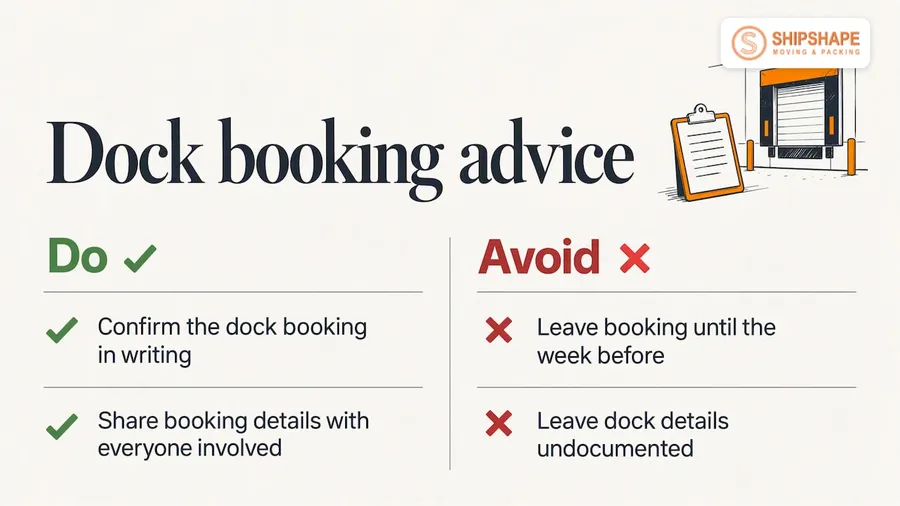
Our advice for any commercial move is the same. Treat the dock booking like you treat the lease: confirm it in writing, share it with everyone involved, and do not leave it until the week before. A forty-minute phone call with a property manager a month ahead can save hours on the day.
How we can help with your move
ShipShape Moving is a licensed moving company founded in Berkeley in 2020, serving Berkeley, San Francisco and the surrounding Bay Area, including local moves around Oakland. We handle office relocations and apartment moves, commercial jobs planned around your operating hours, professional packing and labeling, and white glove handling for valuables. Local moves are billed by the hour: 2 movers $190/hr, 3 movers $260/hr or 4 movers $330/hr, plus an $80 truck fee, with a $620 minimum, and we provide written not-to-exceed quotes.
If you already know your dock or elevator window, send it with your request and we will plan the crew around it. You can start from our local moves page. For more preparation advice, see our moving tips.
Move-day dock checklist
- Dock and freight elevator booked at both addresses, with dates and times confirmed in writing
- Building insurance requirements sent to your mover
- Truck size confirmed against dock height and clearance limits
- On-site contact named at both ends, with a mobile number
- Route from dock to suite cleared and protected as the building requires
- Items labeled by room or desk, with a floor plan at the destination
- Backup plan if the dock is occupied: where the truck waits and who calls whom
- Reconfirmation call made 48 hours before
FAQ
What is loading dock scheduling?
It is the practice of assigning trucks specific arrival windows at a dock so that doors, labor and equipment are not overbooked. Warehouses often use appointment software, while a building hosting a move usually handles it with a simple reservation from property management.
How far ahead should I reserve a loading dock for a move?
Book as soon as your move date is firm, and ideally several weeks ahead for a commercial building. Popular dates, such as the end of the month, fill up, and some buildings require a set notice period. Ask management for their lead time when you first call.
Do I need to schedule a dock for a home move?
Usually not. Single-family moves rely on street or driveway parking. Large apartment buildings and condo complexes are the exception, since they often have a service entrance, loading bay or elevator that must be reserved with the property manager.
How much does it cost to build a loading dock?
It varies widely by site. One 2026 contractor estimate puts equipment and installation at $15,000 to $50,000 per position, with concrete work adding $35,000 to $65,000 per bay. Hillside walls or dewatering can push costs higher.
Does bad dock access make my move more expensive?
Often, yes, when the move is billed by the hour. Waiting for an elevator, a blocked dock or a long carry all add paid time. Sharing the access details with your mover before the quote helps the estimate match the real day.
Sources
- The State of Dock & Yard Management 2026
- Yard Management & Dock Scheduling, Supply Chain Research
- Truck reservation system at the Port of Virginia, ITS Deployment Evaluation
- Integrating Terminal Gate Appointment Systems at the Port of Los Angeles, USDA
- Port Gate Management Strategies, US EPA
- Loading and Short-Term Parking, SFMTA
- Concrete Loading Dock Construction, KAR Concrete