Long Distance Move Planning: A Timeline That Works
Start planning a long distance move about two to three months out. Decide your budget and how you will move, collect at least three written estimates, verify the mover, thin out your belongings, then pack, label and confirm the details in the final weeks. This guide walks through each step in order, so you always know what to do next, whether you are leaving the Bay Area or moving into it.
Key Takeaways
- Begin two to three months before the move date. Estimates, mover vetting and decluttering all take longer than people expect.
- Get at least three written estimates based on an in-home or video survey, and confirm each mover is registered with the federal government before you pay a deposit.
- Declutter first. Fewer, lighter items usually mean a smaller bill on a long haul.
- Keep documents, medications, chargers and valuables with you in an essentials bag, not on the truck.
- On arrival, film every room, check the delivery against your inventory and note damage on the paperwork before you sign.
Table of Contents
- When to Start and What to Do Month by Month
- Set a Budget Before You Collect Quotes
- Choose How You Will Move: Truck, Container or Full-Service Mover
- Compare Estimates and Check the Mover
- Declutter Before You Pack
- Pack, Label and Build an Essentials Bag
- Plan the Trip: Moving Day, Travel, Kids, Pets and Cars
- Update Your Address and Accounts
- Perspective: What We Have Learned About Long Distance Moves
- Arrival Day: Check Everything Before You Sign
- How We Help With Long Distance Moves
- FAQ
- Sources
When to Start and What to Do Month by Month
There is no single magic number, but most long distance moves go smoothly when planning starts eight to twelve weeks ahead. That gives you time to compare movers, sort belongings, handle address changes and still have breathing room if your new lease or closing date shifts. Summer, month ends and weekends are the busiest stretches for movers, so if your dates are flexible, a midweek or off-season slot gives you more choice.
Here is a practical timeline.
| When | What to do |
|---|---|
| 8 to 12 weeks out | Set a budget, pick your moving method, request estimates, start decluttering |
| 6 to 8 weeks out | Verify and book your mover, schedule vehicle transport if needed, plan travel and lodging |
| 4 to 6 weeks out | Begin packing rarely used rooms, label by room and contents, arrange school and medical records |
| 2 to 3 weeks out | Submit your mail forwarding, transfer utilities, confirm arrival windows and payment method |
| Final week | Pack the essentials bag, defrost the freezer, photograph valuables, confirm the crew and address details |
| Moving day | Walk the home with the crew lead, review the inventory, keep paperwork accessible |
| After arrival | Film rooms, check the delivery, note damage, unpack priority rooms, update addresses |
The rest of this guide follows that order.
Set a Budget Before You Collect Quotes
Long distance moves are priced on how much you ship, how far it travels and which services you add. Weight or volume drives the base charge, and extras such as packing, stairs, long carries from the truck to the door, or storage add to it. That is why two households moving the same distance can receive very different quotes.
A useful budget has four lines:
- The move itself: the mover’s quote, ideally written and in full.
- Packing and materials: whether you pack yourself or hire help.
- Your own travel: fuel or flights, hotel nights, meals on the road.
- A cushion: set aside extra for things that surface late, such as new-home deposits, utility connection fees or a second vehicle shipment.
If you want to see how local pricing is structured as a comparison point, our local moves are billed at $190 to $200 per hour plus an $80 one-off truck fee, with the crew size and complexity of the job shaping the total. Long distance work is priced differently, by the details of the shipment and route, so we quote it after we understand your inventory. You can read about how we handle these jobs on our long-distance moving page.
Choose How You Will Move: Truck, Container or Full-Service Mover
Most people choose between three paths: driving a rental truck yourself, loading a portable storage container that a company transports, or hiring a full-service mover. Each trades money against time, effort and risk.
| Factor | Rental truck | Portable container | Full-service mover |
|---|---|---|---|
| Who loads | You and helpers | You and helpers | Professional crew |
| Who drives | You | The container company | The mover |
| Physical effort | Highest | High | Lowest |
| Best for | Small loads, tight budgets, flexible schedules | Gaps between move-out and move-in | Whole-home moves, long distances, families, valuables |
| Main risk | Fatigue, damage from poor loading, mountain driving with a big truck | Loading it yourself, delivery windows | Choosing an unvetted company |
The honest question is not only which is cheapest on paper, but what your time and your belongings are worth. A cross-country drive in a loaded truck means several days of driving, fuel, lodging and the work of loading and unloading at both ends. If you are moving a full household, furniture, a piano, art or anything fragile, a crew that does this every day is usually the most predictable option. That is the service we built our residential movers and large home moving work around.
Compare Estimates and Check the Mover
This is the step that protects you most. Federal guidance for consumers is to get estimates from at least three movers, compare both costs and services, make sure each estimate is written and signed by the mover, and never sign blank documents, as described in the FMCSA’s moving brochure. The same guidance explains that interstate movers must be registered with FMCSA, carry a USDOT number, and give you the booklet “Your Rights and Responsibilities When You Move.”
What a good estimate process looks like
- A survey of your belongings. An in-home or live video walkthrough produces a far more accurate number than a phone call or a web form. Show the mover everything, including the garage, the storage unit and the closet you forgot.
- Written, itemized terms. The estimate should state what is included, what is extra and how the final charge is calculated.
- The estimate type. FMCSA explains how estimating charges work for interstate moves, including the difference between binding and non-binding estimates. Ask each company which one you are getting. We provide written not-to-exceed quotes, so you know the ceiling before the truck is loaded.
- Like-for-like comparison. Line up the same inventory, dates, packing level and insurance across all three quotes. The lowest number often leaves something out.
For a deeper walkthrough, see our guide on how to choose a moving company.
Verify before you pay a deposit
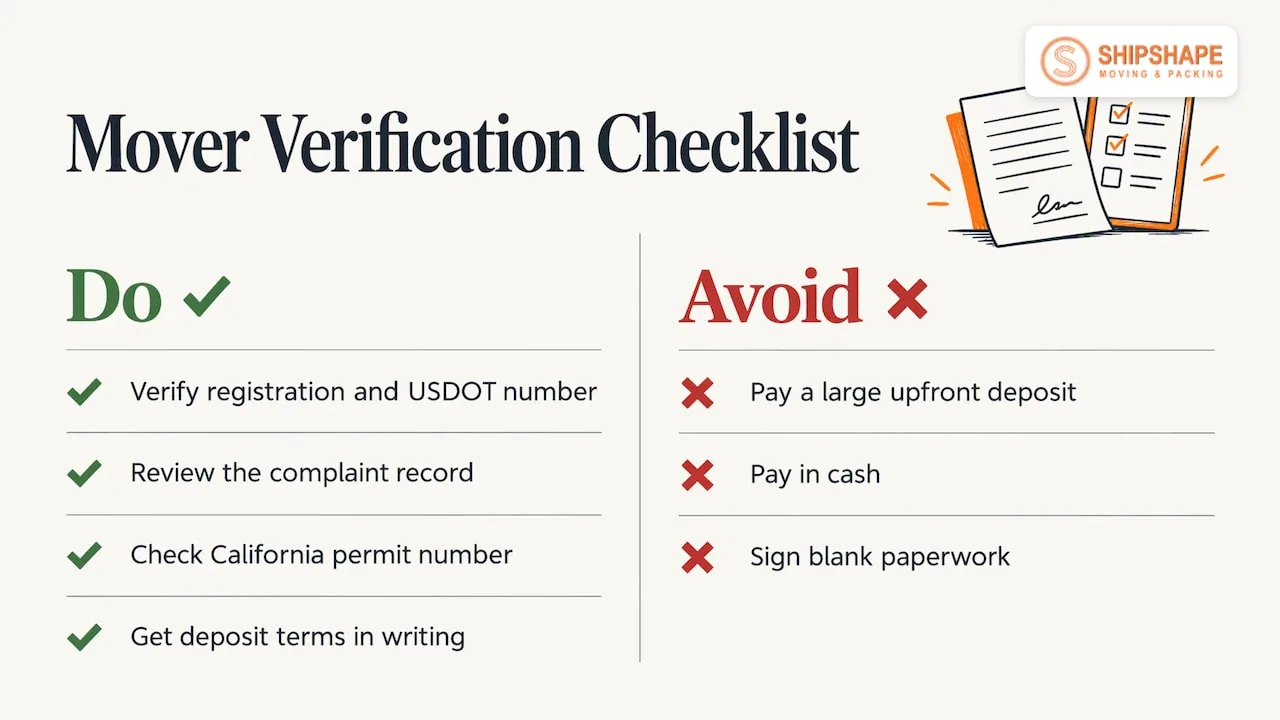
Use the FMCSA search tool for registered movers to confirm the company is registered and has a USDOT number, then review its complaint record on the same Protect Your Move site. For moves that start and end inside California, state-level registration is a separate requirement, so ask any California mover for its permit number and check it.
The Federal Trade Commission lists warning signs of moving scams: demands for a large upfront deposit, requests for cash payment and requests to sign blank paperwork. A reputable mover will explain any deposit, which is sometimes used to hold a date, and put it in writing.
Insurance is its own topic, because the coverage a mover includes by default is often limited. Our explainer on moving company insurance covers how to ask about it, and if you own antiques, read how to pack, protect and insure them.
Declutter Before You Pack
On a long haul, every item you ship adds to the shipment’s weight or space, which feeds directly into the price. Decluttering early is the single most effective way to cut cost and effort.
A simple approach is three piles:
- Keep and move: things you use, love or cannot replace.
- Sell, donate or recycle: duplicates, outgrown clothes, unused gadgets, furniture that will not suit the new space.
- Leave behind on purpose: bulky, low-value items that cost more to ship than to replace, such as old particleboard shelving or worn mattresses.
Big items matter more than small boxes. A sofa, a dresser or a treadmill takes up more truck space than a dozen boxes of books, so measure your new rooms and decide on large furniture first. If you are moving into a smaller home, that measurement can save you from paying to move a piece that will not fit.
Do this sorting room by room, starting with the places you use least: attic, garage, basement, guest room. Schedule donation pickups and any sales so the last week is not spent on a curb full of leftovers.
Pack, Label and Build an Essentials Bag
Pack non-essentials weeks ahead and label every box clearly by room and contents. A label that says “Kitchen: pots, baking sheets” saves hours at the other end compared with “Misc.” Number your boxes and keep a simple inventory list, because it helps you check the delivery later.
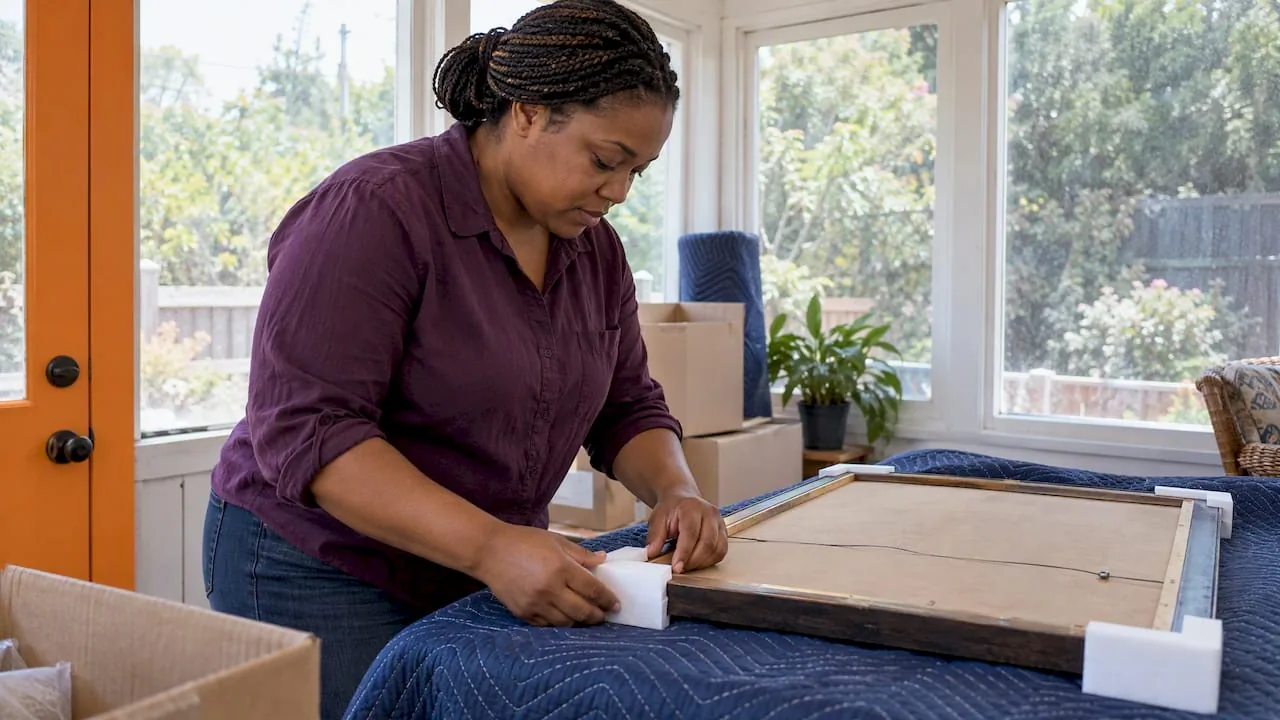
If you would rather not pack at all, or only want help with the fragile things, we offer professional packing services. Careful packing and labeling is part of how we help prevent surprises when it is time to unpack. Some items deserve special attention, such as flat-screen TVs, artwork and heirlooms. For those, our white glove handling is designed for valuables that need extra care.
Our moving tips and tricks page has more packing methods by room.
What goes in your essentials bag
Keep this with you, never on the truck:
- Passports, IDs, leases, closing paperwork and the mover’s contract
- Medications and a basic first-aid kit
- Phone, laptops, chargers and a power strip
- Jewelry and other small valuables
- A change of clothes, toiletries and towels for the first night
- Basic tools, scissors, tape, trash bags, paper plates and cleaning wipes
- Pet food, bowls and medication for any animals
Long distance deliveries can arrive days after you do, so the bag should cover at least two or three nights.
Plan the Trip: Moving Day, Travel, Kids, Pets and Cars
Moving day. Confirm the arrival window with your mover a week ahead and again the day before. Long distance carriers often give a window rather than an exact time, so keep your phone on. Reserve elevators and parking permits at both ends if you live in a building or a dense city. If you are leaving San Francisco, our guide on preparing for moving day in San Francisco covers permits, street access and building rules that apply to any big-city departure.
Your own travel. Plan the route, book hotels in advance for drives longer than a day or two, and build in a spare day. If you are flying, ship what you can and carry what you need.
Children. Tell kids the plan early, pack a bag of their favorite things, and request school records. Keep a few familiar items within reach for the first night.
Pets. Book pet-friendly lodging, bring vaccination records and a carrier or crate, and talk to your vet about travel and any health certificates required by the destination. Animals do not belong on a moving truck, so they travel with you.
Vehicles. You can drive, hire a shipper or use a drive-away service. According to one industry guide, open-air transport, enclosed transport and drive-away services are the usual options, with open-air generally the least costly and enclosed offered for higher-value cars. Get quotes in writing, since vehicle prices change with distance and season.
Update Your Address and Accounts
The U.S. Postal Service lets you file a permanent change of address starting 90 days before the move and up to 30 days after. USAGov notes that the official USPS change costs $1.10 and warns that look-alike third-party sites can charge far more, so go directly to usps.com or a local Post Office.
Also update, ideally two to three weeks out: your bank and credit cards, insurance policies, employer payroll, subscriptions, voter registration and driver’s license. Schedule utilities to be turned off at the old home the day after your belongings leave, and on at the new one the day before you arrive.
Perspective: What We Have Learned About Long Distance Moves
Most of the stress we see in long distance moves does not come from the miles. It comes from surprises: a price that changed, a box nobody can find, a delivery window nobody explained.
That is why we put so much weight on communication. We want you to hear from us at every step, from the first call to the final box. A written not-to-exceed quote, a clear walkthrough of what is and is not included, and a crew lead who tells you what is happening on the day are the basics of how we work.
Our crews are trained in careful packing and handling, and we label everything so the unpacking side goes quickly. If you have valuables, a collection or a home full of furniture, tell us early. It lets us plan the right crew, materials and handling before the day arrives.
Our advice: start earlier than feels necessary, ask every mover the same questions, and choose the company that answers them most plainly.
Dennis
Arrival Day: Check Everything Before You Sign
What you do in the first hour at the new home matters for any damage claim and for your peace of mind.
- Film every room before anything comes in. Empty rooms, floors, walls and appliances. If you rent, send existing damage to your landlord.
- Check power, water and heating. Do it before the crew leaves so any problem is raised while everyone is still there.
- Match the delivery to your inventory. Tick off numbered boxes and large pieces as they come off the truck.
- Note damage on the paperwork before signing. Photograph it as well, and keep copies of every document.
- Unpack priority rooms first. Make the beds, then the kitchen and bathroom, and leave the rest for the weekend.
After that, register your vehicle and update your driver’s license under your new state’s rules, find your doctor and pharmacy, and meet the neighbors. A new home feels like home faster when the basics are settled.
How We Help With Long Distance Moves
ShipShape Moving is a licensed moving company based in Berkeley, serving Berkeley, Oakland, San Francisco and the wider Bay Area, with long-distance relocations for families, students, businesses and collectors. We offer residential and large home moves, packing and labeling, and white glove handling, and our Google rating is 5.0 across 332 reviews.
If you are planning a move out of or into the Bay Area, tell us your timeline and what you are moving, and we will put a written quote together.

Start with our long distance moving service, or go to ShipShape Moving to request your quote.
FAQ
How far in advance should I plan a long distance move?
Aim for two to three months. That window lets you gather three written estimates, verify the mover, declutter and pack without rushing. If you must move sooner, prioritize estimates and mover verification first, because those decisions carry the most risk.
What affects the cost of a long distance move?
The main factors are the weight or volume of your belongings, the distance, the time of year and the services you add, such as packing or storage. Stairs, long carries and bulky items can also change the price. Decluttering before the survey is the easiest way to lower the total.
Is it better to use a container or a moving company?
A container suits people who want to load at their own pace and are comfortable doing the heavy lifting. A full-service mover suits whole-home moves, long distances and valuable or fragile items, because trained crews handle loading, transport and unloading. Compare written quotes for both using the same inventory and dates.
How do I know a moving company is legitimate?
For interstate moves, look the company up in the FMCSA registered mover search and confirm it has a USDOT number, then check its complaint history. Be cautious of anyone who demands a large upfront deposit, asks for cash only or asks you to sign blank paperwork.
What should I keep with me instead of putting it on the truck?
Carry identification, leases and closing documents, medications, electronics and chargers, jewelry, and a few days of clothes and toiletries. Keep your mover’s contract and inventory in the same bag, so they are on hand at delivery.
Sources
- FMCSA: Move? brochure
- FMCSA: Estimating charges
- FMCSA: Search for a registered mover
- FTC: Avoid scams when you hire a moving company
- USPS: Change of Address, the basics
- USAGov: How to change your address
- BoxBuddy: Long-distance moving checklist