Long-Distance vs. Local Move: How They Differ and Which You Need
A local move is billed by the hour, usually finishes in a day and stays within one metro area. A long-distance move is priced by shipment weight or volume and mileage, takes days, and is often regulated by the federal government. The usual dividing line is about 100 miles or a state border, but the label matters less than what it does to your price, your schedule and your legal protections. Here is how to tell which one you are planning and how to prepare for it.
Key Takeaways
- Most movers treat anything over roughly 100 miles as long distance, and a move across state lines is interstate even when the miles are few.
- Local moves are typically billed by crew size and time. Long-distance moves are priced on weight or volume, distance and service fees.
- Interstate movers must give you a written estimate and a bill of lading. In California, in-state movers need a state permit.
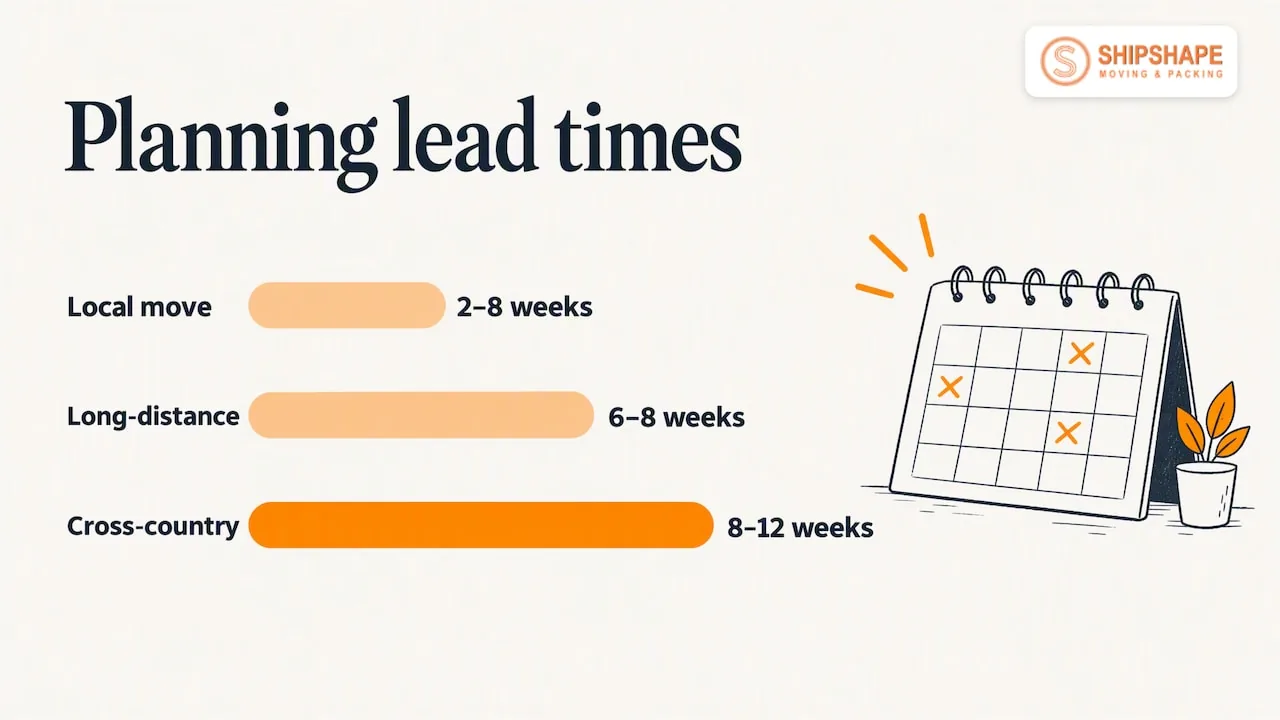
- Book earlier for distance: general guidance is 2 to 8 weeks for local moves and 6 to 8 weeks for long-distance.
- Decluttering pays off most on a long-distance move, because every pound you ship can change the price.
Table of Contents
- What Counts as a Local Move and What Counts as Long Distance
- How Pricing Works for Each Type
- Side-by-Side Comparison
- Rules and Protections: Who Regulates Your Mover
- Timelines and Planning: What Changes
- Which Type Fits Your Situation
- Ways to Lower Cost and Stress on Either Move
- How to Decide in Four Questions
- Our Perspective
- Moving With ShipShape
- FAQ
- Sources
What Counts as a Local Move and What Counts as Long Distance
There is no single definition, and that is why quotes can confuse people. Two yardsticks are in use.
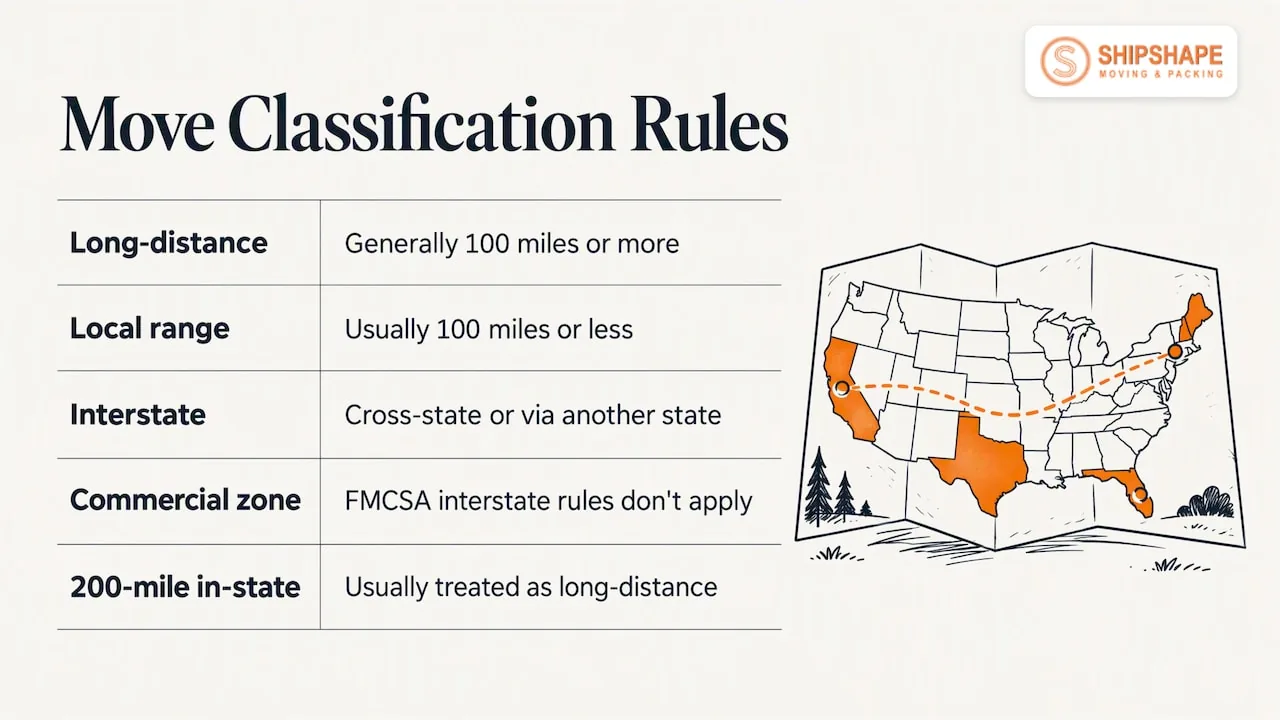
Mileage. NerdWallet reports that a long-distance move generally spans 100 miles or more. A local move is usually one within state lines and up to about two hours of driving, or roughly 100 miles or less.
State lines. Federal rules draw the line differently. The FMCSA describes an interstate move as transporting goods from one state to another, including a trip between two points in one state that passes through another state. A short hop from one side of a state border to the other can therefore be interstate, while a 300-mile trip from Berkeley to San Diego is an in-state move.
There is one more wrinkle. FMCSA’s interstate household goods rules do not apply to moves that happen entirely inside a single commercial zone, which is generally a local metropolitan area. So a move from Berkeley to San Francisco is local on every measure. A move from the Bay Area to Sacramento or Los Angeles is long distance by mileage but still within California. A move to Portland or Austin is long distance by both tests.
A 200-mile move is the one people ask about most. It is past the usual local range, so expect a mover to treat it as long distance and quote accordingly, even though you never leave the state.
How Pricing Works for Each Type
The biggest practical difference is the way the bill is built.
Local moves: you pay for time
Local moves are usually billed at an hourly rate based on the number of movers and the time the job takes. That makes the bill depend on how efficiently the crew works. Three things drive the hours:
- How much you own and how well it is packed.
- Access: stairs, elevators, long carries from the door to the truck, parking distance and building rules.
- Drive time between the two addresses.
At ShipShape Moving, our published local rate is $190-200 per hour, plus a one-time $80 truck fee. The rate reflects crew size and the complexity of the job, and we provide a written not-to-exceed quote so you know the ceiling before moving day. Our local moving page explains how that works for Berkeley, Oakland, San Francisco and the surrounding Bay Area.
Long-distance moves: you pay for the shipment
Long-distance pricing shifts from labor time to the size of the load. U.S. News notes that these moves are calculated on weight or volume, distance and flat-rate service fees. A heavier load going farther costs more, and the drive itself is part of the product. That is why two households in the same size apartment can get very different long-distance numbers if one owns a piano and a workshop of tools.
Other factors that move the total, according to the same source, include optional services such as packing or storage, and the time of year and day of the week. Summer weekends and month-end dates are the busiest, which is why our guide on the best day to move is worth reading before you pick a date.
Extra charges to ask about
Both types can carry add-ons. Ask any mover, in writing, about:
- Stairs, long carries and elevator reservations.
- Shuttle service if a full-size truck cannot reach your street.
- Fuel, tolls and storage on long-distance jobs.
- Packing materials and labor.
- Fees for bulky or specialty items.
The goal is a quote where every line is spelled out, so the final invoice contains no surprises.
Side-by-Side Comparison
| Factor | Local move | Long-distance move |
|---|---|---|
| Typical distance | Within a metro area, about 100 miles or less | More than about 100 miles, or across state lines |
| How it is priced | Hourly, by crew size, plus truck fee | Shipment weight or volume, mileage and service fees |
| Duration | Usually one day | Several days to a couple of weeks door to door |
| Delivery | Same day, crew stays with your goods | Often a delivery window rather than a set arrival time |
| Planning lead time | About 2 to 8 weeks | About 6 to 8 weeks, longer for cross-country |
| Oversight | State level (in California, the CPUC) | FMCSA for interstate moves |
| What shapes the bill | Hours and access | Weight, distance and extras |
Rules and Protections: Who Regulates Your Mover
Who oversees your mover depends on where the goods travel, and it affects what you can demand.
Interstate moves. Under federal household-goods consumer rules, movers must provide written estimates and prepare a bill of lading. For a non-binding estimate, the mover cannot legally require you to pay more than 110 percent of the original estimate at delivery. Read the document you sign and ask which type of estimate you are getting.
In-state moves in California. The California Public Utilities Commission has jurisdiction over moves that begin and end in California. Any mover performing that work must hold an active CPUC permit and have liability and cargo insurance on file. Ask for the permit number and check it before you pay a deposit.
For a deeper walk through vetting a company, see our guide to comparing three estimates and checking FMCSA. To understand what coverage actually pays out if something breaks, read moving company insurance explained.
Timelines and Planning: What Changes
A local move is a single-day event for most households. The same crew loads, drives and unloads, and you see everything arrive. Many local jobs can be booked with fairly short notice, though NerdWallet’s general range is 2 to 8 weeks for local moves.
A long-distance move has more moving parts. Your belongings may travel for several days, and the arrival is typically a window of dates instead of one hour. General guidance is 6 to 8 weeks of lead time for long-distance moves and 8 to 12 weeks for cross-country moves over 1,000 miles. You also have to think about the gap between your lease or closing dates and the delivery window, and what you will need in hand during that gap.
If your move is local and tied to a short lease turnover, our 8-week apartment moving checklist lays out what to do and when.
Which Type Fits Your Situation
Families and larger homes
For a family moving across town, the local model works in your favor: hours are the main variable, and a well-prepared household finishes faster. Pack early, label by room and clear pathways. If your home is large or has many levels, our large home moving service is built around that complexity. For a move out of the area, a weight-based quote is the norm, and the work you do beforehand matters more.
Apartment renters and students
Students and renters tend to have a smaller load, so a local move can be quick. Elevator reservations and parking at both ends are the usual hold-ups. For a campus-to-campus move over long distances, the smaller weight helps, so keep only what you will use.
Businesses
Offices, retail shops and clinics care less about the mileage label and more about downtime. After-hours and weekend scheduling keeps staff working. Building rules, such as loading dock windows, need coordination, which we cover in loading dock scheduling for a move. Our commercial moves are planned around your operating hours.
Collectors and owners of fragile items
Artwork, antiques, instruments and electronics change the equation more than distance does. Over a long haul, every item faces more handling and more hours in a truck. Custom packing, labeling and careful loading matter on both types of move, and white glove handling exists for exactly these pieces.
Ways to Lower Cost and Stress on Either Move
- Make a checklist and start early. NerdWallet’s moving guidance recommends planning ahead with a checklist and keeping important documents, medications and valuables with you instead of on the truck.
- Declutter first. For long-distance work, cutting weight can significantly lower the price. On a local move it saves hours. Either way, sell, donate or discard before the crew arrives.
- Pack for the type of move. Local boxes ride a short trip. Long-distance boxes are stacked with a full truckload for days, so sturdier packing and clear labels pay off. If you would rather not do it yourself, we offer professional packing.
- Prepare access. Reserve elevators, arrange parking, and measure tight stairwells and doors.
- Pick the date deliberately. Mid-month and midweek dates are often easier to book. See our notes on choosing the best day to move.
- Get everything in writing. Estimate type, extra charges, insurance valuation and delivery window should all be on paper.
Our moving tips and tricks page collects more of this.
How to Decide in Four Questions
- Do the two addresses sit in the same metro area? If yes, treat it as local and expect hourly pricing.
- Do they sit more than about 100 miles apart or in different states? Then plan for weight-based pricing, a longer timeline and a delivery window.
- Is your inventory heavy or fragile? Weight raises a long-distance bill, and fragile items call for upgraded packing either way.
- How flexible are your dates? Flexibility lowers stress and can help with scheduling on both kinds of move.
Our Perspective
Most people ask us whether a move is local or long distance as if the answer settles everything. It settles the pricing method, but it does not settle whether the day goes well. That comes down to communication, preparation and the crew.
On a local move, we believe the best protection is a clear, written not-to-exceed quote and a crew that has seen your access challenges in advance. We want you to know what the day will look like from the first call to the final box, and we keep you informed at each step.
On a long-distance move, the same principles apply with more at stake. Careful packing and labeling prevent surprises when you unpack hundreds of miles away, and a crew that handles your items with attention to detail is the difference between a smooth arrival and a frustrating one. That is where we put our effort: clear, upfront communication and meticulous handling, whether you are a family, a student, a business or a collector.
If you are unsure which category your move falls into, call us. We would rather spend ten minutes sorting it out than have you receive a quote that does not match your situation.
Dennis
Moving With ShipShape
ShipShape Moving is a licensed moving company based in Berkeley, serving Berkeley, Oakland, San Francisco and the surrounding Bay Area. We handle local residential moves, apartment and large-home moves, office and retail moves scheduled around your hours, and long-distance relocations. Our local rate is $190-200 per hour, with a one-time $80 truck fee, and you get a written not-to-exceed quote before the day. Customers have given us a 5.0 Google rating across 332 reviews.
Ready to plan a move around the Bay Area? Request a quote on our home page, or see our long-distance moving and residential movers pages for what each service includes. Long-distance pricing is quoted per job, so tell us your origin, destination and inventory.
FAQ
What is considered a long-distance move?
Most movers call a move long distance when it is about 100 miles or more, and federal rules treat any move across state lines as interstate. So a 40-mile move into another state is interstate, and a 300-mile move within California is long distance by mileage. Ask your mover which definition they use for your quote.
Is a local move always cheaper than a long-distance move?
Usually, because you are paying for hours of labor instead of a heavy shipment traveling far. But a large home with difficult access can take many hours, so it pays to compare written quotes. Costs depend on distance, the amount of belongings, extra services and timing.
How far in advance should I book?
General guidance is 2 to 8 weeks for a local move, 6 to 8 weeks for long distance, and 8 to 12 weeks for cross-country moves over 1,000 miles. Peak dates such as summer weekends and month-end fill first, so book sooner if your date is fixed.
Are local movers regulated differently from interstate movers?
Yes. Interstate movers fall under FMCSA household-goods rules, including written estimates and a bill of lading. In California, movers doing in-state work must hold a CPUC permit and carry insurance. Check the permit or registration before you book.
What can I do to keep a long-distance quote down?
Reduce weight and volume before the survey: sell or donate what you no longer use. Be accurate about your inventory, pick flexible dates and ask for every possible extra charge in writing.
Sources
- How Much Does It Cost to Move? NerdWallet
- How to Move, NerdWallet
- Compare Moving Quotes Online, U.S. News Real Estate
- Glossary, FMCSA
- General Requirements (Subpart A), FMCSA
- Summary of Transportation of Household Goods Requirements, FMCSA
- Household Goods Carriers Unit, CPUC