Mover Deposit Rules in California: What to Know
California does not hand you one simple deposit cap to quote to a mover. Your protection comes from a few layers: a licensed mover, a written estimate with a not-to-exceed price, a receipt for every dollar you pay, and, on interstate moves, federal limits on what a mover can demand at delivery. A deposit is normal, but a large one, or one paid by digital transfer to a company you cannot verify, is the pattern to avoid. Here is how deposits work, what to ask for in writing, and what to do if one goes wrong.
Key Takeaways
- Moves within California are regulated by the state’s Bureau of Household Goods and Services; interstate moves also fall under federal FMCSA rules.
- Consumer Reports suggests a legitimate mover should not ask for more than 20 percent of the estimated cost as a deposit, and many ask for nothing until delivery.
- Always get a receipt for any deposit, and confirm the company you paid is the company that will show up.
- Pay deposits by credit card when you can, so you keep the option to dispute a charge.
- Get the deposit, the balance and the cancellation terms written into the estimate before you pay anything.
Table of Contents
- Who sets the rules: state or federal
- How big a deposit can a mover ask for?
- What the estimate should say about the deposit and balance
- Limits at delivery for interstate moves
- Can you get a deposit back after canceling?
- Deposit red flags that signal a moving scam
- Pay in a way that protects you
- What to do if a mover keeps your deposit or demands more
- How to check a mover before you pay
- Our perspective on deposits
- Planning a Bay Area move with clear pricing
- FAQ
- Sources
Who sets the rules: state or federal
The answer depends on where you are moving.
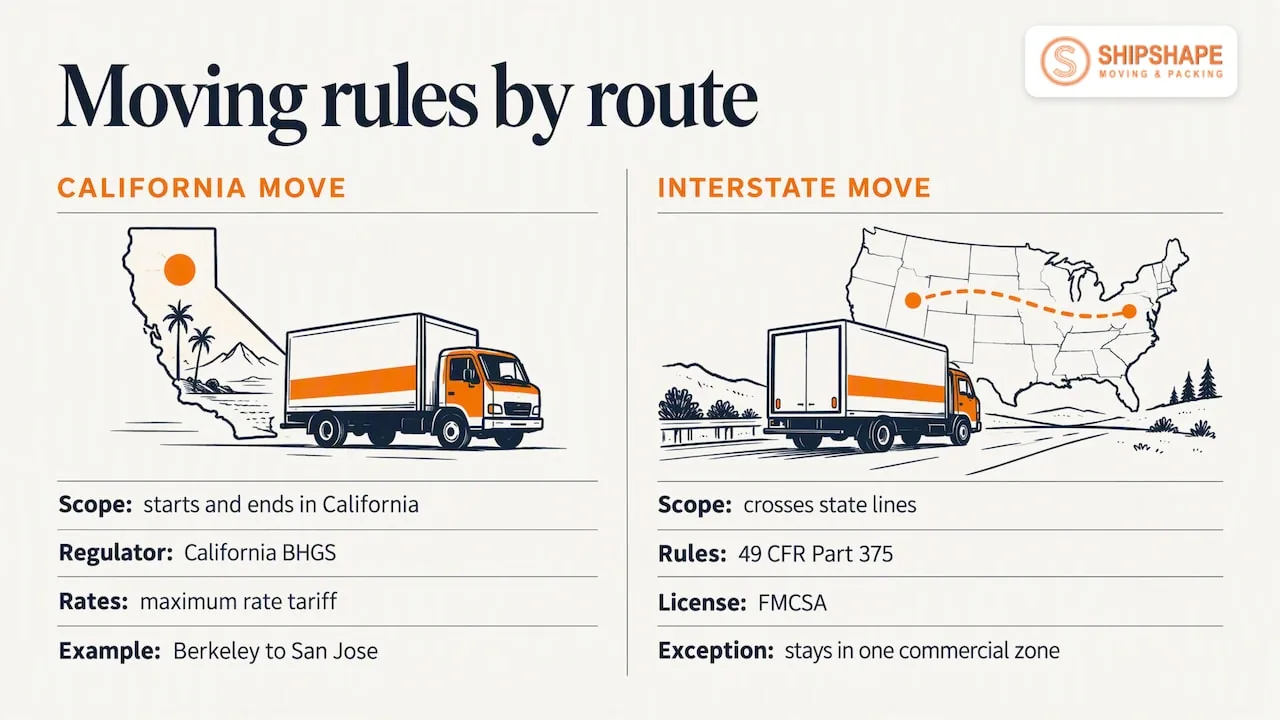
For moves that start and end in California, household goods movers are licensed and regulated by the Department of Consumer Affairs’ Bureau of Household Goods and Services (BHGS). The Bureau investigates violations of the state’s household moving laws and its maximum rate tariff, and that includes companies paid to move household goods.
For moves across state lines, federal regulations under 49 CFR Part 375 apply when a mover transports household goods by motor vehicle in interstate commerce. Interstate movers must also be licensed by the Federal Motor Carrier Safety Administration. One exception: those federal rules do not apply to an interstate move that stays entirely within a single commercial zone, generally the local metropolitan area of a city or town.
In practice, a move from Berkeley to San Jose follows California rules. A move from Oakland to Portland follows federal ones, and the California agency still matters if the mover is based here. Check which one you are in before you compare quotes, because the way the price is calculated differs too.
How California prices a move, and why it matters for deposits
The Bureau explains that for moves within California, the mover must sign the estimate. Moves of less than 100 miles can be charged by the hour, while moves over 100 miles must be charged by weight and mileage. For moves into and out of California, both you and the mover sign the estimate.
This matters because a deposit is only a piece of the price. If you do not know whether you are paying by the hour or by weight, you cannot judge whether a requested deposit is reasonable.
How big a deposit can a mover ask for?
The short version: there is a guideline, and a lot of movers ask for less.
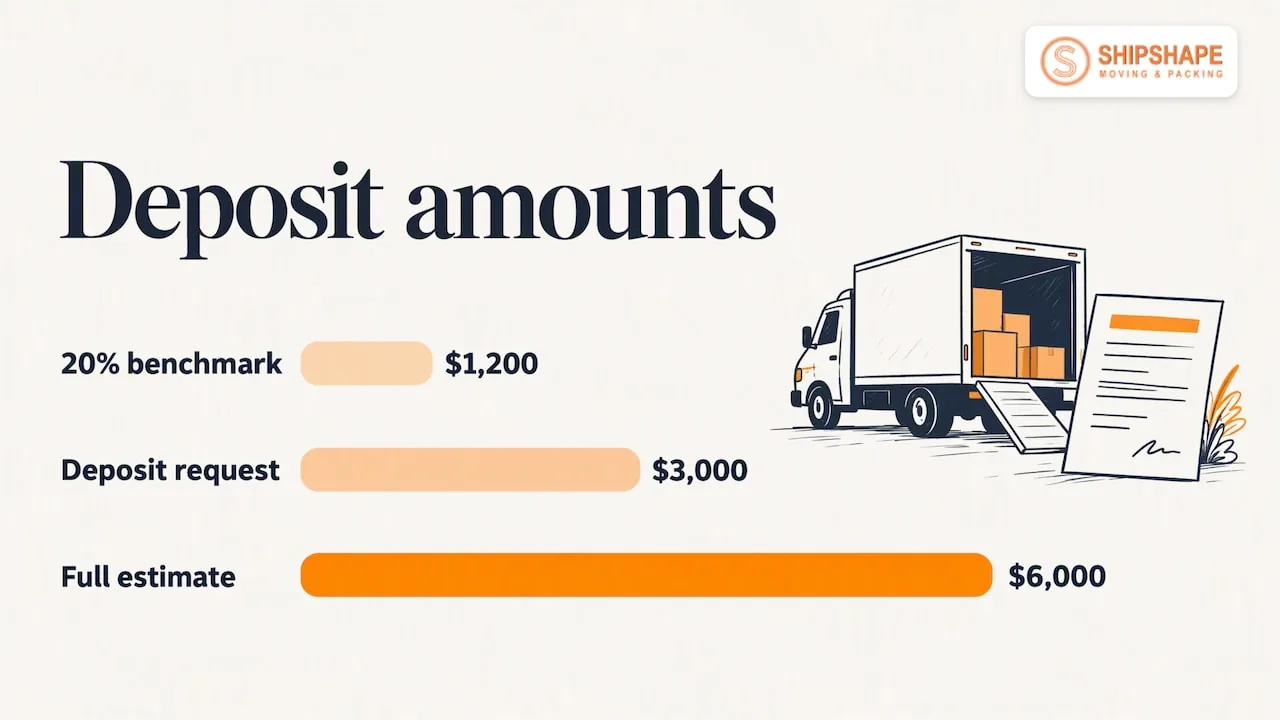
Consumer Reports advises that while some companies require a deposit, a legitimate mover should not demand more than 20 percent of the estimated cost, and many do not require any payment until delivery. Treat that as a benchmark for a reasonable request, not as a statute you can cite to a mover.
Here is what that looks like on a sample estimate. Say a long-distance quote comes to $6,000. Twenty percent is $1,200. A request for $3,000 up front, or for the whole amount before the truck arrives, is the kind of ask that deserves hard questions.
For hourly local moves, deposits are often smaller and tied to holding a date and a crew. The right question is always the same: what does the deposit secure, and what happens to it if plans change?
What the Bureau tells consumers about deposits
The Bureau’s consumer guide gives two direct tips. First, get a receipt for any deposit you make. Second, watch for hidden language showing that the company you paid is different from the mover you believe you hired, and be wary of companies that require a large deposit or an electronic or digital transfer deposit.
That second tip explains a common trap. Some companies take a booking as a lead-gen operation and hand the job to a third party. If the name on your receipt is not the name on the truck, ask why before you pay.
What the estimate should say about the deposit and balance
The deposit is only safe when the paperwork around it is clear. Before you pay, look for these items in the written estimate or service agreement, and ask for any that are missing:
- The mover’s legal name and permit number. Match them to the company on the receipt and on the truck.
- The pricing method. Hourly for California moves under 100 miles, or weight and mileage for longer ones, per the Bureau’s guidance above.
- A not-to-exceed price. A written cap protects you from a final bill that drifts upward.
- The deposit amount and what it secures. A date, a crew, a truck, or a share of the total.
- Whether the deposit counts toward the final bill. It should be credited, and the estimate should say so.
- The balance and when it is due. Many reputable movers collect at delivery.
- Cancellation and rescheduling terms. How much notice you need to give, and whether the deposit is refundable, partly refundable or held.
- Accepted payment methods. Including whether a card is accepted.
- Additional services. Stairs, long carries, packing and similar items should be priced or require a written change order before they are added.
A useful habit: after the call, ask the mover to email the full estimate and read it at home. If the number or the terms differ from what you heard, you want to find out before the deposit leaves your account.
Limits at delivery for interstate moves
Federal rules cap what a mover can demand when your things arrive. According to the FMCSA’s guide to your rights, a mover cannot require more than 100 percent of a binding estimate or 110 percent of a non-binding estimate at delivery, plus applicable charges for additional services and impracticable operations.
The same guide says that if a mover fails to relinquish your goods after you offer to pay 110 percent of a non-binding estimate plus authorized additional charges, that counts as a failure to transport with “reasonable dispatch.” In plain terms, the mover cannot hold your belongings hostage for more than the rules allow.
These are federal rules for interstate moves. For a move inside California, read your written estimate and the Bureau’s consumer guide to see how the state treats your situation.
Can you get a deposit back after canceling?
It depends on the terms you signed, which is exactly why they need to be in writing.
For household goods brokers, federal rules require that the broker provide its policies on deposits, cancellations and refunds. If you booked through a broker rather than directly with a mover, ask for that policy before you pay. The same rule requires a household goods broker to maintain a $25,000 bond or trust fund to pay carriers or shippers if it fails to arrange authorized transportation.
When you are weighing a cancellation policy, ask these questions:
- Is the deposit refundable if I cancel a week before? A month before?
- What if the mover cancels or cannot staff the date?
- If I reschedule, does the deposit transfer?
- Is any part of the deposit a non-refundable booking fee, and is that stated separately?
A fair policy gives you a clear window in which you get your money back, and it commits the mover to refund you if the mover is the one who cancels.
Deposit red flags that signal a moving scam
Consumer Reports lists two warning signs that apply directly to deposits: lowball quotes followed by demands for much more money, and large deposits followed by a mover who never shows up.
Add these checks from the Bureau’s guidance and common sense:
- The company wants a large deposit by wire, app or other electronic transfer.
- The quote arrives by phone or email with no inspection, and it is far below every other estimate.
- The company cannot give you a permit number or the name on the receipt differs from the name of the mover.
- You are pressured to pay today to “lock in” a rate.
- The estimate is blank, unsigned, or vague about the total.
The cleanest defense is to collect three written estimates, compare them line by line, and eliminate any that are dramatically lower than the others. Our guide to comparing three estimates and checking FMCSA walks through the process.
Pay in a way that protects you
Use a credit card for the deposit if the mover accepts one. Consumer Reports notes that paying by card may let you contest the charge if there is wrongdoing or a dispute. A check or card payment also leaves a record, while cash and transfers can leave you with nothing but a promise.
Whatever method you use, keep a folder with the estimate, the signed agreement, the receipt and every email. If a problem comes up later, that folder is your case.
What to do if a mover keeps your deposit or demands more
Start with the paper trail. Write to the company, cite the estimate and receipt, and say what you expect: a refund, a rescheduled date or the agreed price.
If that fails, you have outside options:
- Within California: the Bureau of Household Goods and Services investigates violations of California’s household moving laws, so file a complaint with it. The Bureau’s consumer guide is the place to start.
- Card dispute: if you paid by credit card, ask your card issuer about disputing the charge.
- Interstate moves: you may request arbitration or pursue a lawsuit, and arbitration is not required. Federal rules also let you decline arbitration and pursue legal action under 49 U.S.C. 14706.
- Report federal violations: if an interstate mover fails to deliver goods after collecting the required percentage of the estimate, that violates federal regulations and can be reported to the FMCSA at 1-888-DOT-SAFT.
An attorney or a local legal aid office can help if a sizable amount is at stake.
How to check a mover before you pay
Take ten minutes before you send any money:
- Ask for the company’s California household mover permit number and confirm it with the Bureau of Household Goods and Services.
- For a move out of state, confirm the company is registered with the FMCSA. Interstate movers must be licensed by the agency.
- Read recent reviews and look for patterns, such as surprise fees or no-shows.
- Ask whether the company uses its own crews and trucks, or subcontracts the job.
- Confirm the insurance and liability coverage. Our explainer on moving company insurance covers what the terms mean.
Our perspective on deposits
We have watched people get burned by deposits, and almost every case starts with the same thing: a number discussed on the phone that never made it onto paper. Moving is stressful enough without wondering whether the money you sent will turn into a truck on your date.
Our approach is simple. We give written not-to-exceed quotes, so you know the ceiling before work starts. On some jobs we require a deposit to secure the moving date, and when we do, we explain what it covers and how it fits into the final bill. We would rather answer ten questions up front than have you discover a surprise on moving day.
Our advice to anyone hiring a mover, us included: ask for everything in writing, get a receipt, and be suspicious of any company that rushes you to pay. Clear communication from the first call to the final box is the standard we hold ourselves to, and it is the standard you should expect from whoever you hire.
Dennis
Planning a Bay Area move with clear pricing
If you are moving in Berkeley, Oakland, San Francisco or elsewhere in the Bay Area, our local moves are listed at $190-200 per hour, with a one-off truck fee of $80, both as published on our website. We put the details in a written not-to-exceed quote so you can see the full picture before you commit.

We also handle residential moves, large homes, packing, office and commercial relocations, and long-distance moves. Planning a San Francisco move day? Our guide to preparing for moving day in San Francisco helps with the logistics.
FAQ
Is a deposit required to hire a moving company in California?
Not always. Some movers require one to hold a date, and many collect nothing until delivery, according to Consumer Reports. If a company asks for one, get the amount, purpose and refund terms in writing.
How much deposit is too much?
Consumer Reports suggests a legitimate mover should not ask for more than 20 percent of the estimated cost. The California Bureau of Household Goods and Services also advises being wary of companies that require a large deposit. If a request is far above that, get other estimates.
Should I get a receipt for my deposit?
Yes. The Bureau’s consumer guide tells you to get a receipt for any deposit and to check that the company you paid is the mover you hired. Keep the receipt with your signed estimate.
What if my mover cancels after I paid a deposit?
Start by asking for a refund in writing, citing your estimate and receipt. If you paid by credit card, you can ask your card issuer about a dispute, and you can file a complaint with the California Bureau of Household Goods and Services. Interstate cases can also be reported to the FMCSA.
Can I pay a deposit by credit card?
Ask the mover. If a card is accepted, use it, because a card payment may let you contest the charge in a dispute. Be wary of any company that insists on an electronic transfer only.
Sources
- Household Goods Carriers, Caltrans
- Consumer Guide to Household Moving, California BHGS
- How to Choose a Reliable Moving Company, Consumer Reports
- General Requirements (Subpart A), FMCSA
- Your Rights and Responsibilities When You Move, FMCSA
- Brokers of Household Goods, Federal Register
- Appendix A to Part 375, eCFR
- Questions About How to Protect Yourself From Fraud, FMCSA