Moving Antiques: How to Pack, Protect and Insure Them
Moving antiques safely comes down to four things: documenting each piece before anything is touched, packing and carrying it the way a conservator would, choosing the right liability coverage in writing, and giving the job to a crew that treats it as specialty work. Get those four right and most of the risk goes away. Skip one and a family heirloom can end up with a few dollars of compensation.
This guide walks through each step. It is written for people moving a dining table, a clock, a cabinet or a whole collection, whether it is one of our Oakland moving crews carrying it across town or a truck taking it across the country.
TL;DR
- Photograph and list every antique before the move, and tell your mover about high-value pieces in writing, not just out loud.
- Standard "Released Value" coverage pays only 60 cents per pound per article. For antiques, ask about Full Value Protection or separate insurance.
- Carry furniture by its strongest structural parts, skip gloves, measure every doorway first, and never store pieces in a garage, attic or basement.
- Keep very small, very valuable items (jewelry, coins, small collections) with you rather than on the truck.
- ShipShape Moving handles white glove moves and careful packing across the Bay Area and long distance, with written not-to-exceed quotes.
Table of Contents
- Why antiques need a different kind of move
- Step 1: Document everything before you pack
- Step 2: Understand what your coverage really pays
- Step 3: Decide what should not go on the truck
- Step 4: Plan the route before anyone lifts anything
- Step 5: Pack and carry antiques the right way
- Step 6: Protect antiques from the environment
- What professional antique moving costs
- What makes a good antique mover
- Our perspective: slow down at the start, not the end
- Moving antiques with ShipShape
- Why smaller antiques are in demand, and why it matters for your move
- FAQ
- Sources
Why antiques need a different kind of move
A sofa from a big-box store can take a scuff. A 120-year-old oak sideboard cannot. Antiques carry old joinery, brittle veneer, original finishes and glue that has aged for decades. A bump that would be nothing on modern furniture can crack a leg or lift a veneer edge for good, and a repair can reduce the value of the piece as well as its originality.
Conservators at the Smithsonian's Museum Conservation Institute make the same point in their furniture conservation guidance: most damage happens during the act of moving, and moves are often done under deadlines that encourage careless handling. They also note that prevention is far cheaper than restoration after the fact.
So the goal is not to move fast. It is to remove surprises before the truck arrives.
Step 1: Document everything before you pack
Start a simple inventory a few weeks out. For every antique, record:
- A description (maker, style, approximate age, materials, dimensions)
- Close-up photos of the whole piece from every side, plus existing scratches, chips, cracks, loose joints and repairs
- Any paperwork: appraisal, receipt, provenance notes, family history
- Your estimate of its replacement value
The Smithsonian's Hometown Treasures toolkit suggests asking basic questions of any heirloom: is it one of a kind, can it be replaced, where did it come from, how old is it. Your answers help you decide how much protection each piece deserves.
Date-stamped photos are your best evidence if a claim ever becomes necessary. California's consumer guide for people hiring household goods carriers also explains that an inventory is a list of items and their current condition, and that you can request one when the carrier arrives to pick up your goods. Ask for it, and read it before you sign.
Consider an appraisal for the big pieces
If a piece is worth thousands of dollars, a professional appraisal turns your estimate into a number an insurer or a mover has to take seriously. It also tells you whether you are dealing with a piece that needs crating or one that needs good blankets and a careful crew.
Step 2: Understand what your coverage really pays
This is where antique owners get hurt most often, so read it twice.
For interstate moves, federal rules require movers to offer two levels of liability. According to the FMCSA's guide to valuation:
| Coverage | What it means | Cost |
|---|---|---|
| Released Value | Compensation capped at 60 cents per pound per article | Free |
| Full Value Protection | Mover is liable for the replacement value of lost or damaged items | May carry an additional fee |
The same guide gives a blunt example: a 10-pound antique worth $1,000 would be compensated just $6.00 under Released Value. Weight, not worth, drives the payout. A delicate, light, expensive piece is the worst fit for the free option.
Disclose items of extraordinary value in writing
The FMCSA's liability page explains that items worth more than $100 per pound count as extraordinary value and must be listed on a high value inventory form before the move. If they are not, the mover's liability can be limited to 60 cents per pound even when the item is worth thousands. Verbal mentions are not enough. Make sure those pieces appear on the bill of lading or a separate inventory document.
Moving within California? The California Public Utilities Commission publishes its own consumer information for household goods moves, and it is worth reading before you hire anyone. Whatever the route, ask your mover to explain in plain terms what each coverage option pays, in writing, and compare it to your inventory values. If the numbers do not match, talk to your insurance agent about a rider for the pieces that matter most.
Step 3: Decide what should not go on the truck
The FMCSA's consumer advisory on loss and damage recommends that you personally carry small, high-value items such as jewelry, coins and collections instead of including them in a general household goods shipment. If they must travel with a mover, it suggests separate specialized shipping with dedicated insurance, because standard valuation may not reflect true replacement or sentimental value.
In practice, that means:
- Pocket watches, silver flatware, small bronzes, coin and stamp collections: in your car, in your own hands
- Documents and provenance papers: with you, in a folder
- Large furniture, mirrors, clocks and case pieces: with professionals, with the right coverage
Also clear out anything hazardous. Movers are generally barred from carrying hazardous materials such as paint thinners, aerosols and fireworks, and California guidance is clear that these cannot be shipped. Furniture polish, solvents and cleaning products tucked inside a cabinet are the usual culprits. Empty drawers and cabinets of them first, and ask your mover for its restricted-items list.
Step 4: Plan the route before anyone lifts anything
Most antique damage is not a dramatic drop. It is a tight turn, a doorframe, a rushed stair. The UNESCO and Smithsonian handbook on handling collections advises planning the entire route in advance: check the width of doorways and corridors and the height of steps, clear obstacles, and gather equipment such as dollies with large rubber or pneumatic tires before you start. Never force an object into a space or onto a transport device.
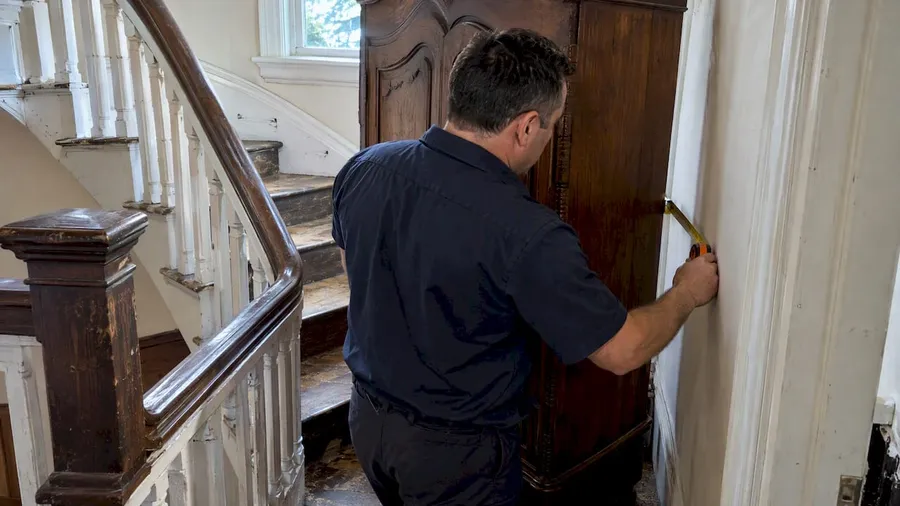
Measure the piece and measure every opening it has to pass, at both ends. This matters in the Bay Area in particular. Victorian flats in San Francisco and Berkeley often have steep, narrow stairs and tight landings, and many Oakland apartment buildings have small elevators and limited loading zones. Our guide to preparing for moving day in San Francisco covers parking and building logistics worth sorting out ahead of time.
If a tall armoire will not make a turn, tell the movers before moving day. Some pieces come apart safely at original joints. Others should never be disassembled, and that is a judgment call for someone who has handled similar furniture.
Step 5: Pack and carry antiques the right way
Handling furniture
A few rules from museum practice apply to any household:
- Skip the gloves. The Smithsonian's toolkit advises against wearing gloves when handling antique furniture, since they reduce grip and raise the risk of a drop. Use clean, dry hands instead.
- Lift from strong structure. Never carry a piece by its back, handrail or legs. Support it from solid structural parts, such as the seat rail of a chair or the apron of a table, as the same toolkit explains.
- Never drag. Lift and carry, with enough people for the weight.
- Keep pieces off the floor. Large furniture belongs on a dolly or in a protective frame, according to the UNESCO handbook.
Wrapping and padding
Use clean padding against the finish, and avoid anything sticky. Tape should never touch old wood, veneer or gilding. Remove drawers, shelves and glass panels from case pieces, wrap them separately, and label each so they go back where they came from. Secure doors and drawers without taping them shut against the finish. Keep hardware, keys and small parts in labeled bags taped to a safe spot inside the move, not to the piece itself.
Mirrors, clocks, china and glass
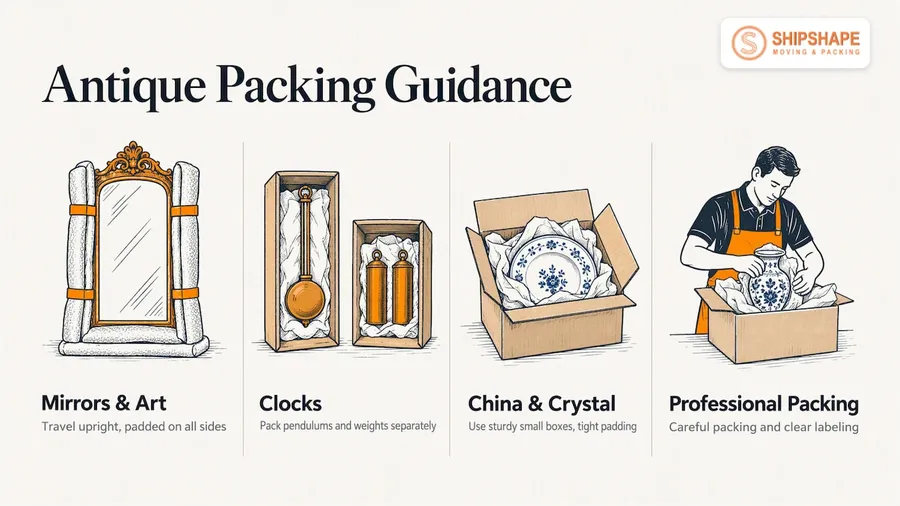
These are the most breakable categories. Mirrors and framed art travel upright and padded on all sides. Clocks need pendulums and weights removed and packed separately. China and crystal want sturdy small boxes, tight padding and nothing stacked on top. If you are not sure how to pack something, that is the signal to hand it to a crew that packs every day. Our professional packing service exists for exactly this, with careful packing and clear labeling so unpacking is simple.
Step 6: Protect antiques from the environment
The move itself is only part of the story. The Smithsonian's conservators recommend a stable environment for historic furniture, with steady temperature and humidity, and they warn against storing valuable antiques in basements, attics or garages, where there is no climate control and a high risk of water, moisture or pests. They also caution against placing pieces near radiators and windows, and against using polishes or oils, since many traditional products damage finishes over time. A soft, clean cloth is enough for dusting.
That matters if your move involves a gap between homes. A pod in the sun or a garage in an inland summer is a bad place for a veneered cabinet. If you need storage, ask for an indoor, climate-controlled space and have your inventory photos ready when the pieces go in.
What professional antique moving costs
Costs vary widely with weight, access, packing needs and distance. Any figure you see online is a general benchmark, not a quote for your home. Treat it as a reason to get a written estimate, not as a price.
For local Bay Area moves, ShipShape Moving bills by the hour: 2 movers $190/hr, 3 movers $260/hr or 4 movers $330/hr, plus an $80 truck fee, with a $620 minimum. Hours depend on crew size, the number of stairs and how much careful wrapping your pieces need. Packing and white glove handling are quoted for your specific job. We give written not-to-exceed quotes, so you know the ceiling before moving day.
What makes a good antique mover
When you interview any mover, ask:
- Are you licensed, and can I see proof? Licensing is the baseline, not a bonus.
- Who will actually be on my crew, and have they moved furniture like mine?
- What coverage do you offer, and exactly what does it pay for a piece worth $X?
- Will you give me a written quote with a not-to-exceed amount?
- How do you pad, wrap and secure fragile and veneered pieces?
- How do you handle stairs, elevators and tight access at both addresses?
- Can I see the inventory and condition report at pickup and delivery?
Answers should be specific. Vague reassurance is a warning sign.
Our perspective: slow down at the start, not the end
We have moved enough homes in Berkeley, Oakland and San Francisco to know where antique damage really begins: in the days before the truck shows up. Customers who photograph their pieces, tell us what matters most and let us see the stairs and doorways in advance almost always have a calmer move than customers who surprise us on the day.
Our approach is built on clear communication from the first call to the final box. For antiques, that means we want to hear about the grandfather clock, the inherited china cabinet and the piece with the loose leg early, so we can send the right crew size, bring the right padding and plan the carry. It also means careful packing and labeling, which prevents the "where did the glass shelf go" scramble on the other end.
Our advice is simple. Do not put your most irreplaceable small items on any truck, ours included; carry them. Put the larger pieces in the hands of people who are paid to be careful, and get the coverage in writing. Our guide to moving company insurance explains each option. A move done without rushing costs less than a restoration.
Moving antiques with ShipShape
If you are moving a home with antiques in it, our white glove handling is built for valuables and collections, and our residential movers cover houses and apartments across the Bay Area. Heading out of state? See our long-distance moving service. Customers rate us 5.0 on Google. Tell us what you are moving and we will put together a written quote on the ShipShape Moving site.
Why smaller antiques are in demand, and why it matters for your move
If you are moving because you are downsizing, the market may work in your favor. One 2026 market analysis reports that antiques were up 39.9% in the first half of the year compared to 2025, with strong demand for Mid-Century Modern, Art Deco and Americana pieces, and for smaller pieces that suit modern homes over oversized dining sets and breakfronts. If you are deciding what to take, sell or give away, the same document trail you built for the move (photos, provenance, appraisal) also helps you sell. A move is a sensible moment to decide which pieces are worth the cost of carrying and which are not.
FAQ
What is the best way to move antique furniture?
Document its condition, measure the route, and pad it with clean material that never sticks to the finish. Carry it by its strongest structural parts, not by legs, backs or handrails, and keep it off the floor on a dolly. For valuable pieces, use trained movers and confirm your coverage in writing first.
Do movers cover antiques if they get damaged?
It depends on the coverage. Under Released Value, which is free, compensation is capped at 60 cents per pound per article, so a light but valuable piece pays almost nothing. Full Value Protection makes the mover liable for replacement value and may cost extra. Items of extraordinary value must be listed in writing before the move.
Should I move small valuables like jewelry or coins myself?
Yes, in most cases. The FMCSA advises consumers to personally transport small, high-value items rather than include them in a household goods shipment. If they must ship, use separate specialized shipping with dedicated insurance.
Can I store antiques in a garage or basement between homes?
It is a poor idea. Conservators warn that basements, attics and garages lack climate control and expose furniture to moisture, water and pests. Choose indoor, climate-controlled storage and keep your condition photos on hand.
Sources
- FMCSA: Understanding Valuation and Insurance Options
- FMCSA: Liability & Protection
- FMCSA: Consumer Advisory, Loss and Damage Countermeasures
- CPUC: Important Information for People Moving Household Goods
- Museum Conservation Institute: furniture conservation paper
- Smithsonian: Hometown Treasures Toolkit for Individuals
- UNESCO and MCI: Handling of collections in storage
- Reliclens: most valuable antique categories