Moving Company Insurance: What Covers Your Belongings
The insurance a moving company carries and the protection you get on your belongings are two different things. A mover's liability and cargo policies exist to satisfy licensing rules and cover accidents. What you can actually recover if your sofa is gouged or your television cracks depends on the valuation coverage in your contract, and sometimes on a separate policy you buy. This guide explains each layer, what California requires of movers, and what to get in writing before moving day.
TL;DR
- A certificate of insurance proves the mover is covered for its own business risks. It does not promise replacement value for your furniture, electronics or art.
- Interstate movers must offer two levels of liability: Full Value Protection and Released Value. Released Value is free but pays 60 cents per pound per article.
- California requires permitted household movers to carry public liability, property damage and cargo insurance, but those minimums are licensing floors, not a guarantee that you are made whole.
- Check your own homeowners or renters policy before you move, and list damage on the delivery paperwork before the truck leaves.
Table of Contents
- Moving company insurance vs. valuation: the distinction that matters
- Released Value vs. Full Value Protection
- How California changes the picture
- Your own homeowners or renters policy
- When third-party moving insurance makes sense
- Insurance for office, clinic and retail moves
- Our perspective: protection is a conversation, not a form
- Six questions to ask before you sign
- If something is damaged: a simple claims routine
- How ShipShape Moving approaches coverage
- FAQ
- Sources
Moving company insurance vs. valuation: the distinction that matters
People use "insurance" for everything here, and that is where the confusion starts. There are three separate things.
- The mover's business insurance. Liability coverage for injuries, damage to property such as a building or a neighbor's car, and workers' compensation for the crew. It protects the company and third parties. FMCSA explains that this business liability coverage is not the same as valuation protection on your shipment.
- Valuation coverage. The level of the mover's liability for your goods, set in your contract. FMCSA describes it as contractual liability rather than ordinary insurance regulated under state insurance law.
- Third-party insurance. An optional, state-regulated policy bought separately, sometimes offered through the mover, that can sit on top of the basic valuation.
So when you ask, "Are my belongings insured?", the better question is: who pays, for which stage of the move, under what deductible, and with what paperwork? Compare the remedy (repair, replacement or a weight-based payout), not the name of the plan.
Released Value vs. Full Value Protection
These are the two options federal rules require interstate household-goods movers to offer. Here is how they compare.
| Released Value | Full Value Protection | |
|---|---|---|
| Cost | No charge | Priced by the mover; varies with declared value and deductible |
| What you receive | Payment by weight, 60 cents per pound per article | Repair, replacement or replacement value, subject to the plan's terms |
| Best for | Low-value, easily replaced items | Anything you could not comfortably replace out of pocket |
| Watch out for | Tiny payouts on heavy, valuable items | Deductibles, exclusions, and items you failed to list |
FMCSA's own example shows how lopsided Released Value can be: a 25-pound television would yield $15. A flat-screen worth hundreds of dollars is paid at a weight rate, because the rate ignores what the item is worth.
Full Value Protection costs money, and the price varies by mover, declared shipment value and deductible. FMCSA's illustration is roughly $250 for a $25,000 shipment, with a clear warning that real pricing will differ. Treat that as an order of magnitude, not a quote.
Extraordinary-value items
FMCSA flags articles worth more than $100 per pound, such as jewelry, antiques, rugs, furs, china and software, as a contractual trap. Listing them on the shipping documents is not a formality: it can decide whether Full Value Protection applies to them. If you own a collection, a piece of art or an heirloom, name it on paper, with a value, before the move starts. Better still, carry the smallest and most valuable pieces yourself.
How California changes the picture
If you are moving within California, state rules sit alongside federal ones, and the answer is not identical to an interstate move.
What the state requires of movers
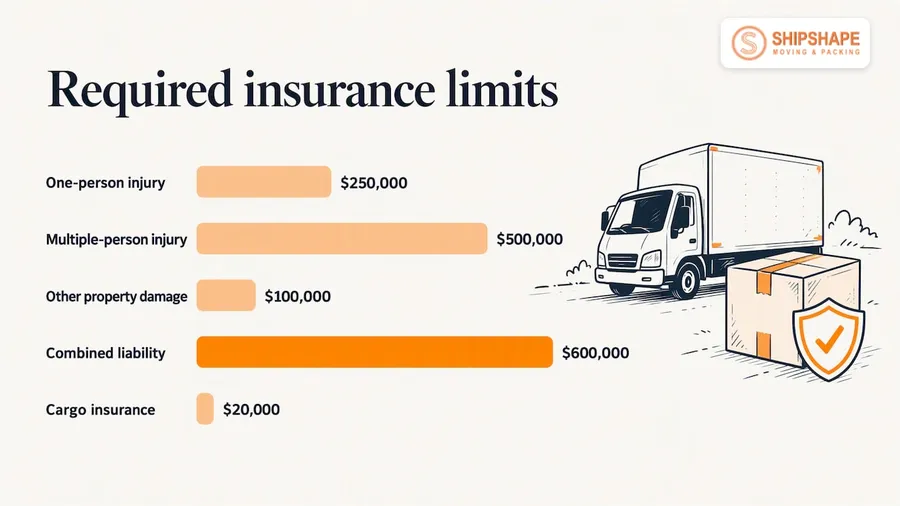
The Bureau of Household Goods and Services (BHGS) licenses household movers. Its law book requires permitted movers to maintain public liability and property damage protection of at least:
- $250,000 for bodily injury or death of one person
- $500,000 for more than one person in an accident
- $100,000 for property damage other than the goods being transported
- $600,000 combined bodily injury and property damage
The same law requires $20,000 in cargo insurance, subject to a statutory lesser-amount exception, plus evidence of compliance for as long as the permit is active.
Notice what each line covers. Public liability responds to injuries and third-party damage. Cargo insurance responds to goods in the truck. A large general-liability certificate says little about whether your shipment is protected, so ask the mover to identify the limit and the claim process that apply to transported goods.
Basic protection on an in-state move
California materials describe basic protection as 60 cents per pound per article. The 2026 state maximum rate tariff also uses a declared-value framework, with an automatic $20,000 value unless the shipper expressly declares otherwise. That is why you should read the declaration-of-value section of your agreement line by line instead of assuming the interstate rule carries over unchanged.
Check the permit first
The California Public Utilities Commission's consumer guidance says to avoid movers who do not show a license number. For an interstate move, verify the mover's USDOT registration and insurance information through FMCSA before booking.
Your own homeowners or renters policy
Your existing policy may help, but only partly. The NAIC advises that homeowners or renters coverage may offer limited protection in transit and that your deductible can apply. Don't assume. Call your agent before the move and ask:
- Are my belongings covered while being loaded, in the truck, in storage and while being unloaded?
- Does the deductible apply to a moving claim?
- How do I coordinate the old and new addresses so there is no gap in coverage?
- Does the policy change if a professional crew packs for me, or if I pack myself?
Not every insurer or agent is licensed in every state, so a cross-country move is worth a call even if you are happy with your carrier.
When third-party moving insurance makes sense
Some movers sell or arrange separate insurance. FMCSA notes that a mover may offer or procure it after you select Released Value, and that it is optional and state-regulated. It can make sense when:
- you have a few high-value pieces and the mover's valuation does not fit them well;
- you want a different deductible than the mover's plan carries;
- your own policy excludes transit or has a high deductible.
Be skeptical of anyone selling a "protection plan" that looks like insurance but is not licensed. The NAIC warns that unauthorized sellers may take payment without providing protection, and that a state insurance department may not be able to help you afterward. Ask who the insurer is, and check that the seller is licensed in your state.
Insurance for office, clinic and retail moves
Business moves have different exposure: the building, the elevators, the staff, the IT equipment, the files. Before an after-hours move, request a certificate of insurance and confirm what it covers. The NAIC's guidance points to a checklist: the worksite, employees, vehicles, subcontractors and the specific handling operation. If a server rack or a medical device is involved, ask how that item is valued and what the claim process looks like. Your building manager will usually want the certificate too, so request it early.
Our perspective: protection is a conversation, not a form
We see the same pattern again and again. A customer hears "we're fully insured" and relaxes. Then a claim turns out to depend on which valuation they chose, what they listed, and whether they packed the box themselves.
We think the best protection is mostly prevention, and we build our work around it. That starts with clear communication from the first call to the final box, so you know who is responsible for what before anyone lifts anything. It continues with careful packing and labeling, which lowers the chance of damage and makes it easier to show a box's condition. For valuables we offer white glove handling (our guide to moving antiques covers the details), because a fragile or irreplaceable item is better handled gently than claimed afterward.
Our advice to any customer, ours or someone else's: ask for the coverage options in writing, read the valuation section, list your highest-value items, and call your own insurer. A mover who is happy to walk you through that is a mover who expects to do the job right.
Six questions to ask before you sign
- What are the valuation options for my move, and what does each pay for a damaged item?
- Can I see proof of liability insurance and workers' compensation?
- What is the cargo coverage limit, and does it apply to my shipment?
- What is the deductible, and what does Full Value Protection cost for my declared value?
- How do I file a claim, and who do I send it to?
- Will the crew pack, and what happens to a claim on items I pack myself?
Get answers on paper. The FMCSA also cautions that packing your own boxes can make it harder to establish what was inside and its condition, so photograph contents and consider professional packing for fragile or high-value items.
If something is damaged: a simple claims routine
Filing a claim is far easier if you set it up at delivery.
- Inspect at the door. Check items as they come off the truck, not days later.
- Write it down before the truck leaves. List damage or missing items on the delivery paperwork and have the mover acknowledge the list.
- Photograph everything. Damage, packaging and the item's surroundings.
- File in writing. California's tariff states that a claim need not be voluntarily paid unless filed in writing. Follow the filing instructions in your agreement.
- Watch the deadline. FMCSA materials state that an interstate claim must be filed within 9 months of delivery. The mover must acknowledge it, then pay or deny it, within the federal timeframe. Interstate movers must also give you dispute-settlement information.
- Notify your own insurer if the loss falls under your policy and your deductible makes sense.
How ShipShape Moving approaches coverage
We are a licensed mover founded in Berkeley in 2020, working across Berkeley, San Francisco, the wider Bay Area and local moves around Oakland, with local, apartment, large home, office and long-distance moves. We provide written not-to-exceed quotes, so the cost of the job is clear before the crew arrives. Local moves are billed by the hour: 2 movers $190/hr, 3 movers $260/hr or 4 movers $330/hr, plus an $80 truck fee, with a $620 minimum. Our customers have given us a 5.0 rating on Google.
If you have a piano, art, antiques or a collection, ask about our white glove handling. If you are moving a family home, our residential team can walk you through the process. For after-hours office, retail or clinic moves, see our commercial moving services. Tell us what matters most when you call, and we will explain the coverage options for your move before you commit.
FAQ
Does a moving company's insurance cover my belongings?
Not automatically. Business liability and cargo policies satisfy licensing rules and cover the mover's risks, while your recovery depends on the valuation level in your contract. Ask the mover to explain the limit that applies to your shipment in writing.
Is Released Value enough for a local move?
Only if everything you own is cheap to replace. Basic protection pays by weight, at 60 cents per pound per article in the examples FMCSA and California describe. A heavy item such as a television or a piece of furniture can pay out far less than it costs. California's tariff also has a declared-value framework, so read that section of your agreement.
Is Full Value Protection worth the cost?
For most households with furniture, electronics or art, it is worth pricing. It shifts the remedy to repair or replacement instead of a per-pound payout. Cost depends on the mover, your declared value and the deductible, so ask for a written number before you decide.
Will my renters or homeowners insurance cover a move?
Possibly, but the protection in transit can be limited and your deductible may apply. Ask your insurer whether coverage extends to loading, transit, storage and unloading, and tell them about your new address before moving day.
How do I check that a California mover is properly licensed?
Look for the mover's California permit number on its ads, website and contract, and confirm it with the license search on the Bureau of Household Goods and Services website. For interstate moves, also verify the USDOT registration through FMCSA.
Sources
- FMCSA: Liability and protection
- FMCSA: How do I insure my belongings during a move?
- FMCSA: Before requesting services from any mover
- California BHGS: Household Movers Act laws and regulations
- California BHGS: 2026 maximum rates and rules tariff
- CPUC: Important information for people moving household goods
- NAIC: Insurance considerations when leaving home
- NAIC: Moving places, changing spaces