UC Berkeley Move-In Checklist for Students and Families
A good UC Berkeley move-in comes down to four things: your assigned time slot, your credentials on your phone, a car that never leaves the unloading zone, and a packing list that leaves out what the room already has. The rest of this checklist walks through each one, then covers what changes if you are moving into an off-campus apartment instead of a residence hall.
One note on dates. The 2026 dates below are the most recent published ones, and they are a guide to the pattern, not a promise for next year. Housing posts new dates and slots every summer, so confirm yours in the Housing Portal.
TL;DR
- Move in only during the time slot you are assigned in the Housing Portal. New undergraduates moved in August 17 to 19, 2026, continuing undergraduates on August 23, and graduate housing opened August 15.
- Bring a valid photo ID, your move-in barcode or QR code, and your time-slot confirmation. Screenshot them before you leave home.
- Unloading zones allow 20 minutes, and the driver stays with the car. Print your free two-hour parking permit beforehand.
- Residence hall rooms are furnished. Pack light, then buy what you actually need after you arrive.
- Moving into an apartment is a different job with no campus slot system. Book help early and keep the lease paperwork and photos organized. Our apartment moving checklist walks through the full eight weeks.
Table of Contents
- Before you leave home: the paperwork and credentials
- Know the dates and the rules for your group
- Move-in day logistics: the unloading zone
- What to bring to a residence hall (and what to leave home)
- Moving into University Village or other unfurnished housing
- If you are moving into an off-campus apartment
- Perspective: why we tell students to move less
- When it makes sense to hire movers
- Move-out: what to plan from day one
- Final checklist for the week of move-in
- FAQ
- Sources
Before you leave home: the paperwork and credentials
Most move-in day stress is avoidable with ten minutes of preparation the night before. Berkeley Housing is strict about the process because the campus is dense and the curb space is limited.
Your checklist for the phone and the folder:
- Government-issued photo ID. A driver's license, state ID or passport that has not expired. Housing requires it at check-in.
- Move-in barcode or QR code. Take a screenshot or print it. You need it for building access, and cell service in a crowded unloading zone is not something to count on.
- Time-slot confirmation. You select your slot in the Housing Portal once your assignment is made. Slots are tied to your building, and Housing expects you to keep to them.
- Parking permit. Housing emails it in advance. Print it and fill it out before arriving so you can use the free two-hour parking after unloading.
- The right map. Housing publishes a PDF map for each hall and apartment complex. It shows temporary street closures and unloading zones that GPS apps do not.
If your arrival will be late, Housing has a late move-in notification form. Fill it out with your expected date, and plan to arrive during front desk hours.
Know the dates and the rules for your group
Berkeley does not run one move-in day. The rules depend on whether you are a new undergraduate, a continuing student or a graduate student.
| Group | Fall 2026 move-in | What to know |
|---|---|---|
| New undergraduates (first-year and transfer) | August 17 to 19 | Timed so you can attend Golden Bear Orientation; you get a specific date and time |
| Continuing undergraduates | August 23 | Also assigned a slot in the Housing Portal |
| Graduate students | Starting August 15 | You can move in after the start date, not before; rent is pro-rated |
| Family student housing | On or after your contract start date | Rent follows your agreement start date even if you arrive later |
Sources for the table: undergraduate move-in, graduate move-in and family student housing move-in.
Out-of-state families sometimes get confused when a move-in date is a few days earlier than the housing contract start for certain units. Do not guess. Read your own assignment in the portal and, if the dates look inconsistent, ask Housing before you book flights or a truck.
Move-in day logistics: the unloading zone
The campus runs move-in as a high-turnover operation, and understanding the model saves you from the most common mistakes.
- Arrive at the start of your slot, not an hour early. Housing asks you to park in the designated temporary unloading zone, where staff greet you and help you check in.
- You have 20 minutes. Each unit has a marked zone where you can stop for up to 20 minutes. The driver stays with the vehicle at all times.
- Move the car afterward. Once you have unloaded, relocate to longer-term parking. Your printed permit covers free two-hour parking. Exceeding the unloading time or leaving a car unattended can bring citations or towing.
- Limit the crew. Housing limits help to the student plus a maximum of two helpers. That policy exists because the high-rise buildings, such as Units 1, 2 and 3, depend on a limited number of elevators.
- Do not ship ahead. Housing does not accept packages sent before your move-in date, and it does not give third-party shipping companies access to student spaces. Everything arrives with you, in your slot.
- Parents do not stay overnight. Supporters cannot stay in campus housing on move-in day.
A practical way to use the 20 minutes: stage everything in the trunk in the order it comes out. Put bedding and the "first night" bag on top, heavy boxes next, and keep the pieces that go in the same room together. Two helpers and the student can empty an SUV in a couple of trips if nothing is buried.
Where the car goes afterward
Parking near campus is the part families underestimate. Plan the second stop before you arrive: where the car goes once it is empty, who moves it, and how the driver rejoins the group. Near campus, check Housing's maps and the garage details listed for your unit before you drive in.
What to bring to a residence hall (and what to leave home)
Residence hall rooms come furnished. Each room has a desk, bed, drawers and shelf space for each student, plus a MicroChill refrigerator and microwave combo. That means the biggest packing mistake is bringing furniture or storage you do not need.
Pack
- Bedding sized for the bed Housing lists for your hall, a mattress pad and a few towels
- Laptop, chargers, a power strip and any required documents
- Weather-ready clothes: Berkeley mornings are cool and fog is common, so layers beat bulky coats
- A basic toiletry and medicine kit, with prescriptions in original containers
- Laundry supplies, including HE liquid detergent. Housing notes that pod-style detergents do not dissolve well in the residence hall machines and recommends liquid.
- Shower shoes, a bag for the shower and a small laundry hamper
- A bike lock, if you plan to bike
Wait on
- Bulky organizers and extra storage containers. Housing suggests moving in first and seeing what you actually need.
- Furniture of any kind
- Duplicates of kitchen items if your hall has no kitchen
For a deeper packing list written for students, the Berkeley Life move-in guide goes through what to bring in more detail than most checklists.
Label everything
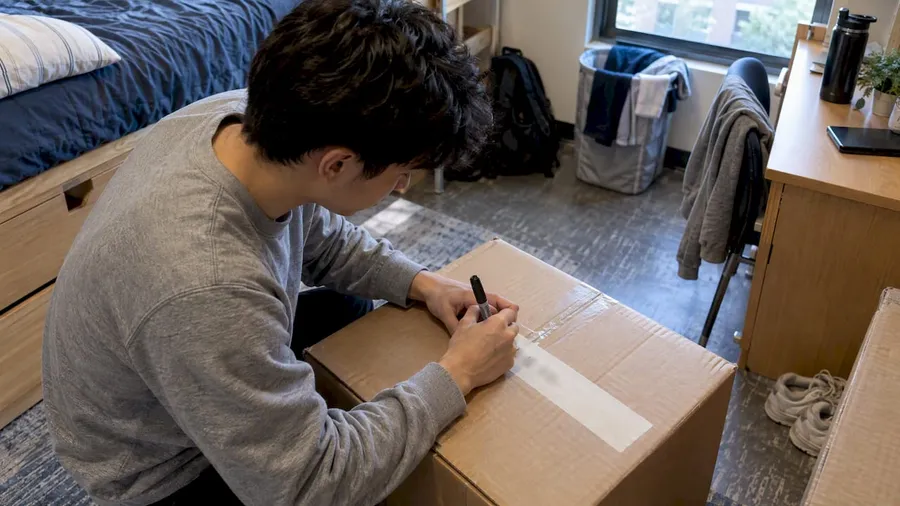
Write your name, building and room on each box, plus a one-word room contents label. It costs nothing, and it keeps the 20-minute window from turning into a hunt for the box with the sheets. It also helps a friend or relative who is carrying for you and does not know which bag is which.
Moving into University Village or other unfurnished housing
Most campus housing is furnished, but University Village, the family housing, is unfurnished. That changes the math for a family move. You can bring furniture, buy it or lease it.
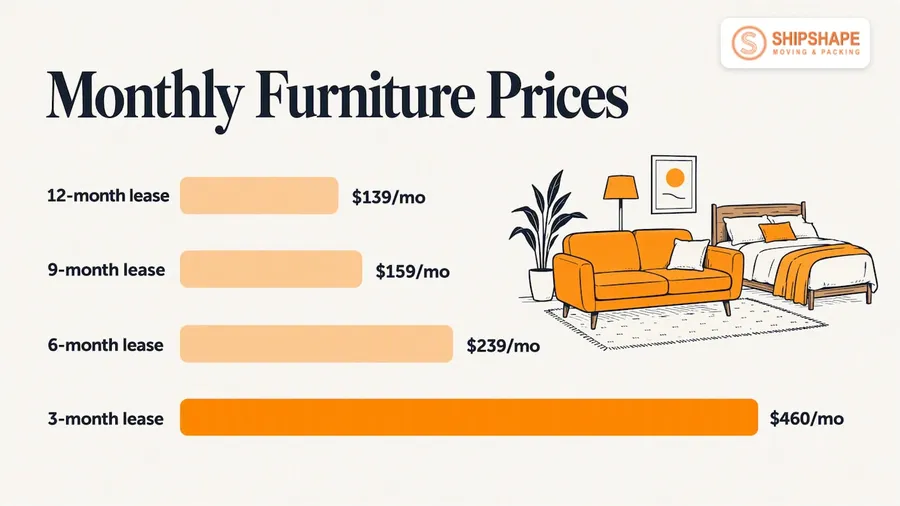
Housing points families to CORT for leased furniture packages. Packages start at $139 a month on a 12-month lease. Shorter terms cost more per month: $159 for nine months, $239 for six and $460 for three. Delivery and setup are door to door and can be coordinated 48 business hours ahead.
Leasing makes sense when your stay is one or two years, you are coming from out of state, or the move would otherwise mean hauling a sofa and a bed frame up through a crowded neighborhood. If you are keeping a household's worth of belongings, a long-distance move with professional crews may be the better option than leasing.
If you are moving into an off-campus apartment
Many Berkeley students, especially after the first year, rent apartments. There is no time-slot system, no campus unloading zone and no helper cap. That freedom is also the problem. You are responsible for the truck, the curb, the stairs and the timing, and August is the busiest moving month in a college town.
An apartment move checklist:
- Confirm the lease start date and key pickup time in writing.
- Measure the doors, stairwells and elevator if you are bringing a couch, desk or mattress.
- Reserve your move date early. Everyone in a college town moves on the same few days around the start of the lease cycle.
- Handle the parking. Find out where a truck can legally stop and for how long, and whether the building has a loading area. Cities have their own rules, and Oakland, for instance, has a moving permit guide if you are moving across the bay. For local moves around Oakland, the same parking homework applies.
- Photograph the unit before moving belongings in. A written move-in condition checklist is common for rentals, and your own dated photos are the backup.
- Pack by room and label by room. Put the kitchen essentials, bedding and bathroom items in marked boxes so the first night is easy.
- Set up utilities and internet before arrival.
We have written more about living in Berkeley and the cost of living in Berkeley if you are weighing neighborhoods before signing a lease.
Perspective: why we tell students to move less
We are a Berkeley-based moving company, and the most useful advice we give students is not to hire us for everything. A residence hall move is a car-load job, run on the university's timetable, and the university does not let outside shippers into student spaces. Families should plan it themselves, with the checklist above.
Where we come in is the apartment, the long-distance relocation and the move that is too big for a car. In those cases, the thing that goes wrong is rarely the lifting. It is a surprise: a missing elevator reservation, a box nobody can identify at midnight, a price that grew after the truck left. So we focus on clear communication from the first call to the final box, careful packing and labeling, and a written not-to-exceed quote so you know the ceiling before the day starts.
Our advice to any parent: spend your effort on the unglamorous prep. Screenshot the codes, print the permit, label the boxes. Then let the student unpack in the room they will live in, and resist buying organizers until the first week shows what is missing.
When it makes sense to hire movers
Professional help is not for every student move. It tends to pay off in these situations:
- Apartment moves with a bed, desk, couch or bookshelves
- Moves across the Bay Area or across the state, where one trip in a family car will not cover it
- Valuables and collections, such as instruments, art, lab equipment or a record collection, that need careful handling
- Tight schedules, where a lease turns over at noon and the next tenant arrives that afternoon
- Families relocating a whole household to Berkeley for a graduate program or a faculty position
Our local moves are billed by the hour: 2 movers $190/hr, 3 movers $260/hr or 4 movers $330/hr, plus an $80 truck fee, with a $620 minimum, and we provide a written not-to-exceed quote. Rates for other services are quoted per job. We handle residential and apartment moves, packing and labeling, white glove handling for valuables, and long-distance moves when a student or family is relocating to or from out of state. Our Google rating is 5.0. If you want a quote, start with our Berkeley page.
Move-out: what to plan from day one
The same discipline that makes move-in easy applies at the end. In spring 2026, all residents had to vacate by 10 a.m. on Sunday, May 17, and Housing recommended avoiding the morning of Commencement on May 16. Fines and conduct violations were possible for staying past the deadline. Dates change by year, so check the current Housing move-out page.
A move-out checklist:
- Check your deadline and your key return location and time.
- Decide where your belongings go: home, a summer sublet, storage or a new apartment.
- Pack the room over several days, not one night.
- Donate or sell what will not fit. Do not leave it behind.
- Book movers or a truck early if you are going to an apartment or across the state, because commencement week fills up.
- Clean the room and take dated photos before handing back keys.
If you are going straight from a residence hall to a summer or fall apartment, our apartment and local move crews can pick up from a lease address and plan around a short gap.
Final checklist for the week of move-in
One week before
- Check your time slot, building and map in the Housing Portal
- Confirm who your two helpers are and how they are getting there
- Order what you need to have delivered to a home address, not to the hall
Two days before
- Screenshot your barcode and slot confirmation
- Print the parking permit
- Pack the car in reverse order of unloading
Day of
- Bring ID, charger and a water bottle
- Arrive at the start of your slot
- Unload within 20 minutes, then move the car
- Check the room and report anything broken to the front desk
First week
- Buy what you actually need
- Learn the laundry room and bring liquid detergent
- Update your address wherever you need to
FAQ
Can I ship boxes to my UC Berkeley residence hall before move-in?
No. Housing does not accept packages before your assigned move-in date. It also does not give third-party shipping companies direct access to student spaces, so plan to bring your belongings with you.
How many people can help me move in?
The student plus a maximum of two helpers. The limit protects the elevators in the larger buildings. Parents also cannot stay overnight in campus housing on move-in day.
How long can I leave my car in the unloading zone?
Twenty minutes, with the driver staying in the vehicle. After that you move to longer-term parking, using the free two-hour permit Housing emails you. Overstaying or leaving the car unattended can bring a citation or a tow.
Do I need to bring furniture?
Not for a residence hall, where each room has a bed, desk, drawers and shelves. University Village is unfurnished, and Housing points residents to leased furniture packages from $139 a month on a 12-month lease.
When should I book movers for an off-campus apartment?
As soon as you have a lease start date. August and the end of spring term are the busiest times in Berkeley, and early booking gives you more choice of date and time.
Sources
- Undergraduate Student Move-In, Berkeley Housing
- Undergraduate Student Move-In FAQs, Berkeley Housing
- Late move-in FAQs, Berkeley Housing
- Graduate Student Move-In, Berkeley Housing
- Family Student Housing Move-In, Berkeley Housing
- Move-In Parking & Directions, Berkeley Housing
- Move-In Checklist, Berkeley Housing
- CORT Furniture Leasing, Berkeley Housing
- Move-Out, Berkeley Housing
- Move-In Checklist, Berkeley Life
Recommended
- Blog: Moving Tips & Guides
- Cost of Living in Berkeley, CA
- Berkeley, CA Guide: Weather, Crime & Living
- Things to Do in Berkeley, CA