Apartment Moving Checklist: 8 Weeks to Moving Day

The easiest apartment move starts about eight weeks out and works backward from one fixed date: your lease end. This checklist walks you through each stage, from giving notice and booking movers to the first night in your new place, with the apartment-specific traps (elevators, parking, deposits, building rules) that general moving lists skip.
TL;DR
- Start eight weeks before your move, and 10 to 12 weeks out for a long-distance move or a summer move.
- Read your lease for the notice period, send written notice, and confirm your mover's date and cost in writing.
- Change your address only through the official USPS site, and update the IRS if you have a refund coming.
- Pack a first-night box, photograph both apartments, and never sign blank moving paperwork.
- Return keys with written confirmation and leave a forwarding address so your deposit finds you.
Table of Contents
- The apartment moving timeline at a glance
- Eight weeks out: lock the date and read the lease
- Six to seven weeks out: choose movers and declutter
- Four to five weeks out: logistics and access
- Two to three weeks out: pack, label and handle paperwork
- Moving week: the final stretch
- Moving day: how to stay in control
- Handing over the old apartment
- Settling into the new place
- Perspective: what we see on real apartment moves
- Moving an apartment around the Bay Area with ShipShape
- FAQ
- Sources
The apartment moving timeline at a glance
Most checklists agree on the shape of the process. Opendoor's moving guide recommends starting eight weeks out, and 10 to 12 weeks for long-distance moves or peak summer months. That gives you time to compare options, set a realistic budget and avoid a compressed scramble.
| When | Focus | Key tasks |
|---|---|---|
| 8 weeks out | Dates and budget | Read the lease, choose the move date, measure, set a budget |
| 6 to 7 weeks out | Movers and decluttering | Vet and book movers, sort what to sell, donate or toss |
| 4 to 5 weeks out | Logistics | Reserve the elevator, line up utilities, start packing off-season items |
| 2 to 3 weeks out | Packing and paperwork | Pack room by room, submit address changes, schedule cleaning |
| Moving week | Final prep | Confirm the crew, pack the essentials box, defrost the freezer |
| Moving day | Execution | Walk through, review paperwork, watch the load |
| After the move | Settling in | Photograph damage, test utilities, unpack the essentials first |
The rest of this guide takes each stage in turn. If your lease ends in Oakland, our 30-day Oakland move-out timeline is a tighter version of the same plan, and our Oakland moving crews handle those moves every week.
Eight weeks out: lock the date and read the lease
Start with the lease, not the boxes. Lemonade's renter checklist suggests beginning about two months out: choose your move-in date, measure the new apartment and its access points, set a budget, and research licensed and insured movers.
From your current lease, pull out:
- The notice period and how it must be delivered. Many leases ask for written notice, often 30 to 60 days, but yours is what counts. Send written notice as soon as your date is confirmed and keep a copy.
- Move-out conditions. Cleaning requirements, carpet or wall-repair expectations, and how keys and fobs are returned.
- Your end date versus the new start date. A gap of even a few days can mean paying two rents or storing furniture. An overlap of a weekend makes a move much calmer.
From the new building, confirm the practical details before you sign or at least before you book movers. Allstate's list of questions to ask a landlord includes lease length, payment procedures, pet and guest policies, emergency maintenance, which utilities are included in rent, nearby planned construction, and the landlord's notice period for entering your unit.
Then add the questions that matter to a move specifically:
- Is there a freight elevator, and does it need to be reserved?
- Are there move-in hours or days when moves are not allowed?
- Does the building require a certificate of insurance from your mover?
- Where can a truck legally park, and do you need a street permit?
- How many stairs or how long a carry is there from truck to door?
Tell your movers the answers. Stairs, long carries and tight parking change the time a crew needs, and hourly billing follows the time.
Six to seven weeks out: choose movers and declutter
Vet the movers
Get written confirmation of the date and the cost from whoever you hire. A verbal number is not a quote.
In California, household movers working within the state must be licensed by the state's Bureau of Household Goods and Services, and the Bureau offers a license search for verifying a mover before you hire. For moves across state lines, the FMCSA advises consumers to verify a mover's registration and USDOT number on its website or by calling 1-800-832-5660.
Two more federal facts help you read an interstate estimate. Interstate movers must give a written estimate based on a physical or virtual survey of your household goods, not a verbal figure. And with a non-binding estimate, a mover cannot legally demand more than 110 percent of the original estimate at delivery.
How movers bill varies. At ShipShape Moving, local moves are billed by the hour for the crew: 2 movers $190/hr, 3 movers $260/hr or 4 movers $330/hr, plus an $80 truck fee, with a $620 minimum. We give written not-to-exceed quotes, so you know the ceiling before moving day. Packing, long-distance moves and other services are quoted individually. Our apartment moving services page explains how we plan a typical apartment job.
Declutter before you pay to move it
With hourly billing, every box you do not need is time and money. At about six weeks out, Lemonade suggests sorting belongings into items to sell and items to donate, arranging disposal or donation pickup, and documenting what you are keeping. Do it room by room, starting with closets and storage, where the least-used things hide.
A simple rule: if you have not used something in a year, and it is not sentimental or seasonal, it goes. Furniture that will not fit through the new door or up the new stairwell goes too. This is where your measurements from week eight pay off.
Four to five weeks out: logistics and access
This is the stage most apartment checklists compress into a line. It deserves attention because buildings, not boxes, cause most day-of problems.
- Reserve the elevator or loading zone at both ends, for the full time window your movers need.
- Line up utilities for the new place: electricity, gas, internet, and trash or water if not included. Ask the landlord exactly which are included in the rent. Schedule shutoff at the old place for the day after you hand back the keys, not before.
- Book time off if your move falls on a weekday. Our guide to the best day to move explains why a mid-week date often helps.
- Start packing what you will not need soon: off-season clothes, books, decor, spare linens, kitchen gadgets.
If your move is within the Bay Area, parking and access are especially tight. Our guide to preparing for moving day in San Francisco covers the permit and truck-placement details.
Two to three weeks out: pack, label and handle paperwork
Pack and label so unpacking is easy
Pack non-essentials first and label boxes by room, so movers carry each one to the right place without asking. Add a second marker: a bold "OPEN FIRST" on anything you need on day one. A few habits that save the most time:
- Use small boxes for books and heavy items, and large boxes only for light things like linens.
- Fill gaps with paper or towels so nothing shifts.
- Write contents on the side, not only the top, because boxes get stacked.
- Keep screws and hardware for disassembled furniture in labeled bags taped to the piece.
- Photograph how your TV and media cables are connected before unplugging.
If you would rather not do it yourself, our professional packing services cover careful packing and labeling, which is also the simplest way to protect fragile or valuable items.
Change your address the official way
USPS says you can submit a change of address up to 90 days before your move date and up to 30 days after, and it recommends notifying mailers at least two weeks ahead and including the apartment number in the complete address.
Use the official site only. USPS lists a $1.25 identity-verification fee for an online change of address, and USAGov points to USPS.com/move and warns that scam sites charge much more for the same service.
Also update, in this order of priority:
- Your employer and payroll
- Banks, credit cards and insurance (including renters insurance)
- Your driver's license or state ID, and vehicle registration
- Subscriptions, pharmacies and medical offices
If you have filed a tax return and expect a refund, send the IRS Form 8822 and change your address with USPS too, or your refund check may be returned.
Moving week: the final stretch
- Confirm date, arrival window and total with your movers in writing.
- Defrost and clean the refrigerator a day or two ahead.
- Disconnect and drain washing machines if you own one.
- Set aside valuables, documents, medications, chargers and keys. These ride with you, not on the truck.
- Photograph the old apartment thoroughly (more on that below).
Pack the first-night essentials box
Lemonade recommends an essentials box for the first 24 hours with a toothbrush, toothpaste, phone charger, toilet paper, a change of clothes, a laptop and its charger. We would add:
- Bedsheets, a pillow and a towel
- Shower curtain and soap
- Basic tools: screwdriver, tape, box cutter
- Paper plates, a mug, a few snacks and a water bottle
- Trash bags and cleaning wipes
Carry this box in your own car, or mark it so the crew puts it somewhere obvious.
Moving day: how to stay in control
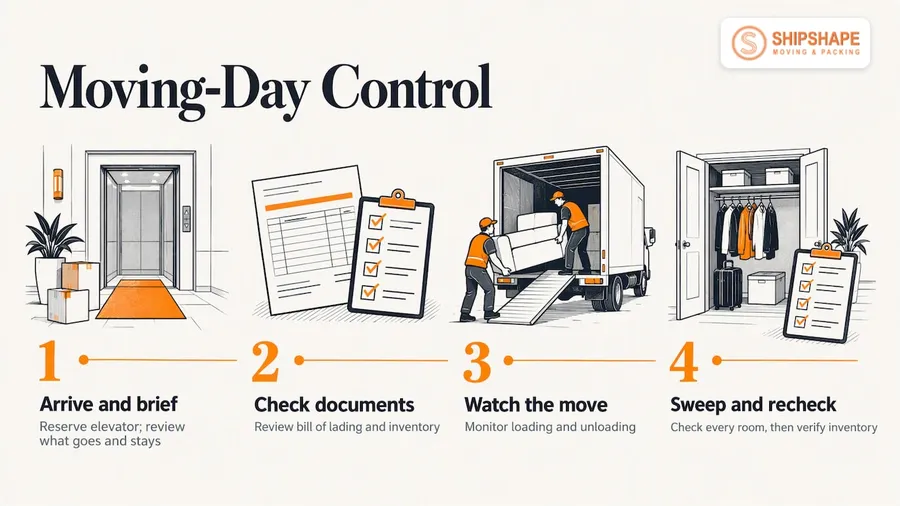
Be there early, with the elevator reserved and the doors propped. Walk the crew lead through the apartment before anything moves: what goes, what stays, which items are fragile, which pieces need special handling.
The FMCSA's consumer guidance is clear on paperwork: never sign blank documents, and review each section of the bill of lading and inventory list for accuracy before signing. It also advises watching the loading and unloading of your goods, and if you cannot be there, asking someone you know to act on your behalf.
Before the truck leaves, do a last sweep: closets, cabinets, balcony, storage unit, behind doors, and the oven and dishwasher. Then check the inventory again.
One coverage note for longer moves. For interstate moves, the FMCSA suggests considering Full Value Protection, since the default Released Value covers only up to 60 cents per pound per item. A 20-pound speaker, in other words, would be reimbursed at $12. If you are moving across the country, see our long-distance moving page.
Handing over the old apartment
Your deposit depends on this stage, so treat it as its own project.
- Clean to the lease standard. Mop and vacuum floors, wipe appliances, clean bathrooms, wash windows and check blinds, and patch small nail holes if your lease expects it.
- Photograph or video everything once the unit is empty: walls, floors, closets, inside cabinets, appliances, with lights on and off. Date-stamped files are best.
- Return all keys, fobs and parking passes and get written confirmation that you did.
- Leave a forwarding address in writing so the deposit and any final statement reach you.
- Ask for a joint walkthrough with the landlord or manager when possible, and keep any notes they sign.
Deposit timing rules differ by state, so check your own state's landlord-tenant law and your lease. Keep your photos and the written key confirmation until the deposit is back in your hands.
Settling into the new place
Before you unpack a single box, spend 30 minutes on the unit. The Zillow walkthrough checklist suggests checking entrances, locks, doors, appliances, outlets, water pressure, HVAC, windows, lighting, noise, and smoke and carbon-monoxide detectors, and photographing potential repair issues.
A legal aid moving-in checklist from Massachusetts Legal Help gives the same core advice that applies anywhere: walk through with the landlord, list existing problems in writing and keep a copy, and take pictures. Send the list to the landlord or manager by email so there is a timestamp, and check your lease for how quickly condition reports are due.
Then:
- Test the heat or AC, hot water, stove, faucets and every smoke detector.
- Confirm the internet and electricity are on.
- Unpack the bedroom and bathroom first, the kitchen second.
- Flatten boxes and ask your movers or building about recycling.
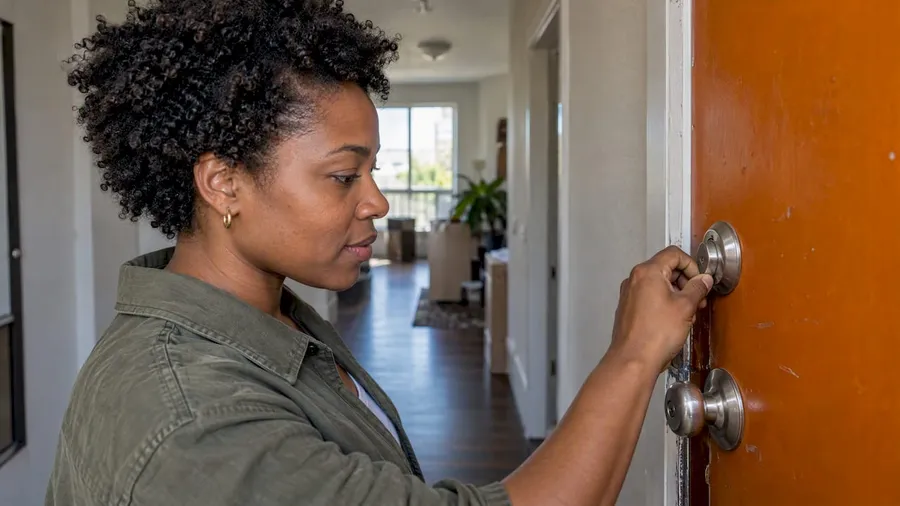
- Replace or re-key locks if the lease allows it, or ask management about the last lock change.
Perspective: what we see on real apartment moves
We move apartments across Berkeley, Oakland, San Francisco and the wider Bay Area, and the pattern is consistent. The moves that go smoothly are not the ones with the most packing done. They are the ones where the access questions were answered early: which elevator, which hours, where the truck parks, how far the carry is.
The second pattern is communication. When a client tells us about the stairs, the piano, the awkward sofa or the narrow hallway on the first call, we can staff the crew and price the job properly. When they do not, the day drifts, and everybody feels it. That is why we keep clients informed from the first call to the final box, and why our quotes are written and not-to-exceed.
Our last tip is about the checklist itself: do not try to do everything. If a job is stressing you, such as packing the kitchen or wrapping artwork, that is the task to hand off.
Moving an apartment around the Bay Area with ShipShape
If you are moving within Berkeley, Oakland, San Francisco or nearby, we can take the physical side of this checklist off your hands: crew, truck, careful handling, packing and labeling, and white glove handling for valuables. Local moves are billed by the hour (2 movers $190/hr, 3 movers $260/hr or 4 movers $330/hr, plus an $80 truck fee, with a $620 minimum), and we provide a written not-to-exceed quote. See our apartment moving services or start with the quote page to request a quote. Customers have rated us 5.0 on Google.
FAQ
How early should I start an apartment moving checklist?
Eight weeks out is a good starting point for most apartment moves. For long-distance moves or the busy summer months, start 10 to 12 weeks ahead. If you have less time, the order stays the same: lease notice, movers, packing, address changes.
What should I do first when moving out of an apartment?
Read your lease for the notice period and move-out conditions, then send written notice as soon as your date is firm. Next, confirm your new move-in date and book movers in writing. Everything else follows from those two dates.
What goes in a first-night box?
Pack what you need for the first 24 hours: toothbrush, toothpaste, phone and laptop chargers, toilet paper, a change of clothes, sheets, a towel, basic tools and a few snacks. Keep it with you rather than on the truck.
How do I change my address without being overcharged?
Use the official USPS site at USPS.com/move, where USPS lists a $1.25 identity-verification fee. Lookalike sites charge much more. You can file up to 90 days before your move or up to 30 days after.
Should I photograph my apartment before leaving?
Yes. Take photos or video of every room after it is cleaned and empty, and again when you arrive at the new unit before unpacking. Keep them with your written key-return confirmation and any condition list you sent to the landlord.
Sources
- The Complete Moving Checklist, Opendoor
- Your Ultimate Apartment Moving Checklist, Lemonade
- 12 Questions to Ask Before Signing a Lease, Allstate
- Apartment Walkthrough Checklist, Zillow
- Frequently Asked Questions, FMCSA
- Tips for a Successful Move, FMCSA
- How to change your address, USAGov
- Undelivered and unclaimed tax refund checks, USAGov
- Change of Address: The Basics, USPS
- Moving In Checklist, Massachusetts Legal Help