Best Day to Move: What Actually Saves Money and Stress

For most households, the best day to move is a Tuesday, Wednesday or Thursday in the middle of the month, outside the busy summer season. Those days tend to carry lower rates, more open calendars and fewer surcharges. In the Bay Area, though, the best day is also the one where your truck has a legal place to park, so the calendar is only half the decision.
Below we cover how weekdays, weekends, month-end and holidays change what you pay, what "peak season" really means, and how permits and parking in Berkeley, Oakland, San Francisco and Alameda can overrule a perfect date on paper.
TL;DR
- Mid-week (Tuesday to Thursday), mid-month moves are the safest bet for lower cost and easy scheduling. Fridays, weekends and the 1st and last day of the month are the most in demand.
- Federal peak season for household goods runs May through September, so October through April is usually gentler on price.
- Federal holidays can trigger higher rates and labor minimums, so read your mover's holiday terms before you book one.
- In San Francisco, apply for temporary No Parking signs at least 5 business days ahead. A cheap day with no truck space is not a cheap day.
- Whatever day you pick, get the pickup and delivery dates in writing.
Table of Contents
- Why weekdays beat weekends
- The calendar beyond the weekday
- Bay Area reality: the best day is the day you can park
- Business and after-hours moves
- Long-distance moves: dates are windows, not promises
- What about a lucky day?
- A simple way to choose your date
- Perspective: what we see on the ground
- How we price a move, and where the day matters
- Special cases
- FAQ
- Sources
Why weekdays beat weekends
Moving is a demand business. Most people want to move on a Saturday, Sunday or Friday because they are off work, and movers know it. Crews are fully booked, the best time slots disappear first, and pricing reflects that.
The way this shows up on paper is in the mover's tariff, the set of rates and rules a company publishes. One regulated moving tariff separates weekday rates (Monday to Thursday) from weekend rates (Friday to Sunday), and applies higher hourly rates and sometimes higher labor minimums on weekends and federal holidays. Your mover's terms will differ, but the pattern is common: the same crew, the same truck and the same boxes can cost more simply because of the weekday printed on the calendar.
Tuesday and Wednesday are the sweet spots. The same tariff guidance points to mid-week, off-season moves as the ones with the best odds of scheduling flexibility and the fewest peak or holiday surcharges. Monday can be fine, but it picks up weekend overflow and people finishing a lease. Thursday is a good backup, and sits just before the Friday rush.
Day-by-day snapshot
| Day | Demand | What to expect |
|---|---|---|
| Monday | Moderate | Often available, but leftover weekend and lease-end moves can crowd it |
| Tuesday | Low | Best availability and the most choice of start time |
| Wednesday | Low | Same as Tuesday, and good for a mid-week closing or key handover |
| Thursday | Low to moderate | Still a weekday tier, but fills up as people aim for a Friday finish |
| Friday | High | Popular because people take the day off; weekend rates may apply |
| Saturday | Very high | Hardest to book, and the slowest to get a truck parked |
| Sunday | High | Weekend pricing, fewer rest days before work |
This table is a general guide to how demand behaves, not a price list. Ask any mover which tier your date falls into before you commit.
The calendar beyond the weekday
Time of year
Federal guidance defines peak season for household goods moves as May through September, when movers often charge higher line-haul rates. That makes October through April the cheaper stretch, particularly for long-distance moves.
Local Bay Area demand follows school and lease cycles too. Summer is crowded because families move between school years and students move between campuses. If your dates are flexible, avoiding late spring through early fall is the biggest single lever you have.
Time of month
Many leases begin and end on the first of the month, which makes the 1st and the last two or three days of the month the most crowded of all. If your lease or closing allows it, aim for the 10th through the 20th. You will have more choice of crew and arrival window, and nobody is fighting for the elevator.
If your lease forces a month-end move, book earlier than you think you need to, and ask for the first slot of the morning. First-slot moves are the least likely to be pushed back by an earlier job running long.
Federal holidays
Holidays are a different animal. The same published tariff treats federal holidays like weekends for rate purposes, and some providers enforce a 4-hour labor minimum on holiday moves. For a small apartment that might take 2 hours, that rule turns a short job into a four-hour bill. Ask for your mover's holiday terms in writing before you book a long weekend.
Time of day
Start early. Morning starts give you more daylight and a cushion if something runs over, and some companies price early starts lower. A 7 or 8 a.m. start also means the truck is parked before the street fills up. Late afternoon starts are where moves go wrong: tired crews, traffic, a building's freight elevator closing, and a bed that goes together in the dark.
Bay Area reality: the best day is the day you can park
This is where national advice falls short. A Tuesday move is a bad Tuesday move if the truck is circling for a space two blocks away, because crews bill for time, and every extra carry adds minutes.
San Francisco. The SFMTA provides temporary tow-away signs for moving vans, and applications must be in at least 5 business days before your move. Start times for posted restrictions fall between 7 a.m. and 10 p.m. If your preferred Wednesday is 3 business days out, it is no longer a realistic Wednesday. The city also keeps a parking hub where you can start the temporary No Parking sign request.
Alameda. The city's Public Works page says No Parking sign applications must be received at least 2 business days before you intend to post. Sign pickup and verification take time, so applying a week and a half ahead is a safer buffer.
Oakland. Oakland's truck parking rules prohibit parking trucks in residential districts citywide, except where signs allow it, with separate rules in West Oakland. Our own guide to Oakland moving permits and No Parking signs walks through what to file and when, and our page on moving within Oakland covers how we plan those jobs. If you are planning a move into the city, our Oakland neighborhood guide helps you weigh the street-by-street differences.
Berkeley and others. Rules vary by street and city, so check with the city's public works or parking office before you set the date. Casual street parking on moving day is a gamble that often ends in tickets, long carries and extra labor hours.
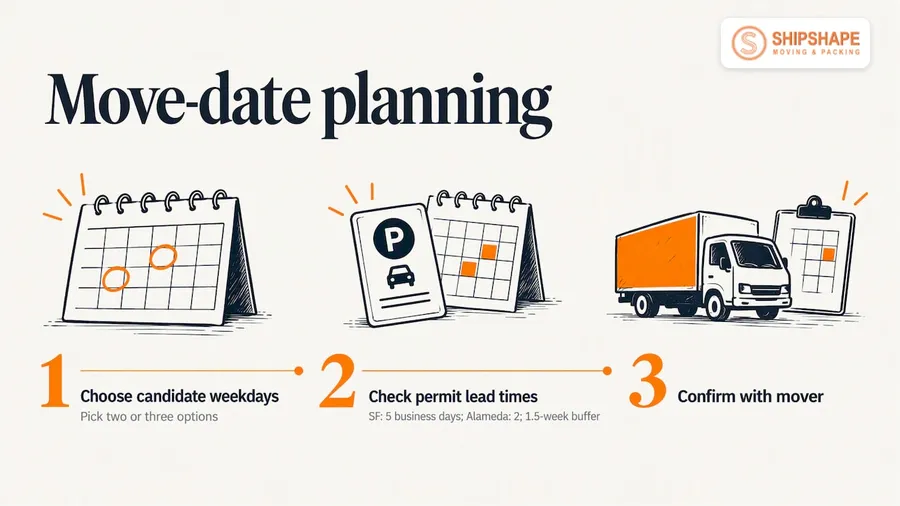
The practical order is: pick two or three candidate weekdays, check permit lead times, then confirm the date with your mover. If you are moving in San Francisco specifically, our moving day preparation guide for San Francisco covers building rules, elevators and loading zones.
Business and after-hours moves
For an office, clinic or shop, the best day is often a Friday evening or a weekend, because the goal is to be set up before Monday morning rather than to save on the hourly rate. Your downtime costs more than the weekend premium does.

The same parking logic applies: in dense downtowns, evening and weekend enforcement hours differ from weekdays, and building management may limit freight elevator access. Line up elevator reservations, certificates of insurance and signage together. We plan commercial moves around your operating hours, so you can see the options on our commercial moving page or our office relocation page.
Long-distance moves: dates are windows, not promises
With a cross-country move, the "day" you pick for pickup is only part of the story. Federal guidance for household goods moves says the most stress-free approach is a clear, written date for pickup and delivery in your bill of lading, rather than an open-ended "as soon as possible."
Also know the term "delivery spread," the range of days during which your shipment may arrive. If you are not available during that whole window, or the contract is unclear, your belongings can end up in storage in transit at your expense. The FMCSA rights and responsibilities handbook explains your responsibilities as a shipper. Ask whether your contract has a guaranteed service date or relies on reasonable dispatch.
If dates change later, your mover may issue a written change to the order for service. Do not rely on a phone call. Our long-distance moving page explains how we handle dates on those jobs.
What about a lucky day?
Plenty of people have a personal or traditional favorite day to move. There is no price or logistics case for a lucky day, but Thursday happens to be a perfectly good weekday for other reasons. If a date matters to you for tradition, just book early enough that the mover has room to say yes.
A simple way to choose your date
- List your hard limits. Lease end, closing date, school start, job start.
- Move away from the edges. If you can, avoid the 1st and the last days of the month, Fridays, weekends and holidays.
- Pick two or three Tuesday to Thursday candidates. Mid-month if you can.
- Check parking and permits. Count back from the move date: 5 business days for San Francisco, more for safety elsewhere.
- Ask for a written, not-to-exceed quote. Confirm which day-of-week rate applies.
- Lock the date in writing, including start time and any deposit terms.
Perspective: what we see on the ground
We would like to say a particular weekday is magic, but what we see in Berkeley, Oakland and San Francisco is that the cheap day only helps if everything else is ready. A mid-week date with a posted No Parking sign, a reserved freight elevator and boxes already labeled beats a weekend date where the crew spends the first hour hunting for a space.
Our advice has three parts. First, move on a weekday if your schedule allows. Second, treat the permit as part of the booking, not an afterthought. Third, tell us about stairs, elevators and parking limits at the first call, because those details change how many hours the job takes more than the weekday does. We would rather quote honestly up front and keep you informed at each step than surprise you on the day.
How we price a move, and where the day matters
Our local moves are billed by the hour: 2 movers $190/hr, 3 movers $260/hr or 4 movers $330/hr, plus an $80 truck fee, with a $620 minimum. Your final price depends on crew size, how complex the move is, hours worked and extras such as packing, and we provide a written not-to-exceed quote. The day you pick affects availability first, which is why a mid-week slot is often the easiest to secure.
If you are comparing dates, request a quote for a local move and tell us your two or three candidates. We will help you see which one makes the most sense for your building, your street and your budget. You can also see our residential moving services or add professional packing to shorten moving day.
Special cases
Students. Campus move-out days cluster tightly around the end of terms, so book early and consider moving a few days before or after the rush. Smaller loads often fit a mid-week morning slot well.
Large homes. More belongings mean a longer day, so a weekday with a first-slot start reduces the risk of finishing after dark. See our large home moving options.
Valuables. If you have art, instruments or collections, pick a day with no time pressure. Rushed handling is the biggest risk, and our white glove service is built around careful, unhurried handling.
Apartments. Check your building's moving hours and elevator booking rules first (our apartment moving checklist covers them), since many buildings allow moves only on weekdays or reserved blocks. Our apartment move-out timeline for Oakland lays out the 30 days before the move. For more general checklists, browse our moving tips.
FAQ
What is the cheapest day of the week to move?
Typically a Tuesday, Wednesday or Thursday, because many movers apply lower weekday tariffs and demand is lower. Friday through Sunday is when weekend rates often kick in. Confirm the tier your date falls into when you get your quote.
Is it cheaper to move at the beginning or end of the month?
No, those are the most expensive and crowded stretches, because many leases start and end then. A date between roughly the 10th and the 20th usually gives you better availability and fewer scheduling squeezes. If you have a month-end lease deadline, book early.
What is the best month to move?
October through April is outside the federal peak season, which runs May through September, so rates and availability are generally friendlier. Summer is busiest because of school breaks and lease cycles. For a Bay Area move, winter dates are easier to book but still need parking permits.
Is it better to move in the morning or the afternoon?
Morning. You get more daylight, a buffer if something runs long, and an easier time parking the truck. Some movers also charge less for early starts, so ask when you request your quote.
How far ahead should I book a mover?
For a mid-week, off-season move, a couple of weeks is often enough, but for a month-end, weekend or summer date, book as early as you can. Permits may need to be applied for 5 business days or more before the move, so work backward from that date.
Sources
- FMCSA: General Requirements (Subpart A)
- FMCSA: Pickup of My Shipment of Household Goods (Subpart E)
- FMCSA: Your Rights and Responsibilities When You Move (2022 booklet)
- FMCSA: Your Rights and Responsibilities When You Move (handbook)
- Regulated moving services tariff, schedule of charges
- SFMTA: Temporary Signage
- SF.gov: Parking
- City of Alameda: Public Works Permits
- City of Oakland: Truck Parking Rules