When to Book Movers: A Timeline by Move Type and Season

Book local movers four to eight weeks before your move date, and long-distance movers eight to twelve weeks ahead. Add more lead time if you’re moving in summer, on a weekend, or at the end of the month. If your move is small, midweek and in the off-season, a week or two can be enough. The rest of this guide explains how to pick the right number for your situation, what late booking costs, and how to get a written quote in time.
TL;DR
- Local move: aim for four to eight weeks out. Off-season, midweek moves can sometimes be booked with one to two weeks’ notice.
- Long-distance move: start calling eight to twelve weeks ahead, earlier in summer.
- Weekends, the last days of the month and May through September fill first. Book at the early end of the range for those dates.
- Big homes, valuables, elevator reservations and office moves need more lead time, not less.
- In California, the quote you get must be in writing after an inspection, so build time for a walkthrough into your timeline.
Table of Contents
- The short answer: how far ahead to book
- Why the date you pick matters as much as how early you call
- Local moves vs. long-distance moves
- What to do before you book: the California quote process
- Special situations that need more lead time
- What happens when you book late
- Can you book too early?
- Our perspective: book the date, then the details
- Book your Bay Area move with ShipShape
- A simple booking checklist
- FAQ
- Sources
The short answer: how far ahead to book
Most guides land on a similar range. One national guide recommends four to eight weeks for a local move and eight to twelve weeks for a long-distance move during peak season, and says to aim for the earlier end when your date is a weekend, month-end or otherwise constrained. Another puts local movers at four weeks or more in the May to September period, with one to two weeks’ notice sometimes enough from October through April, and suggests six to eight weeks for cross-country moves.
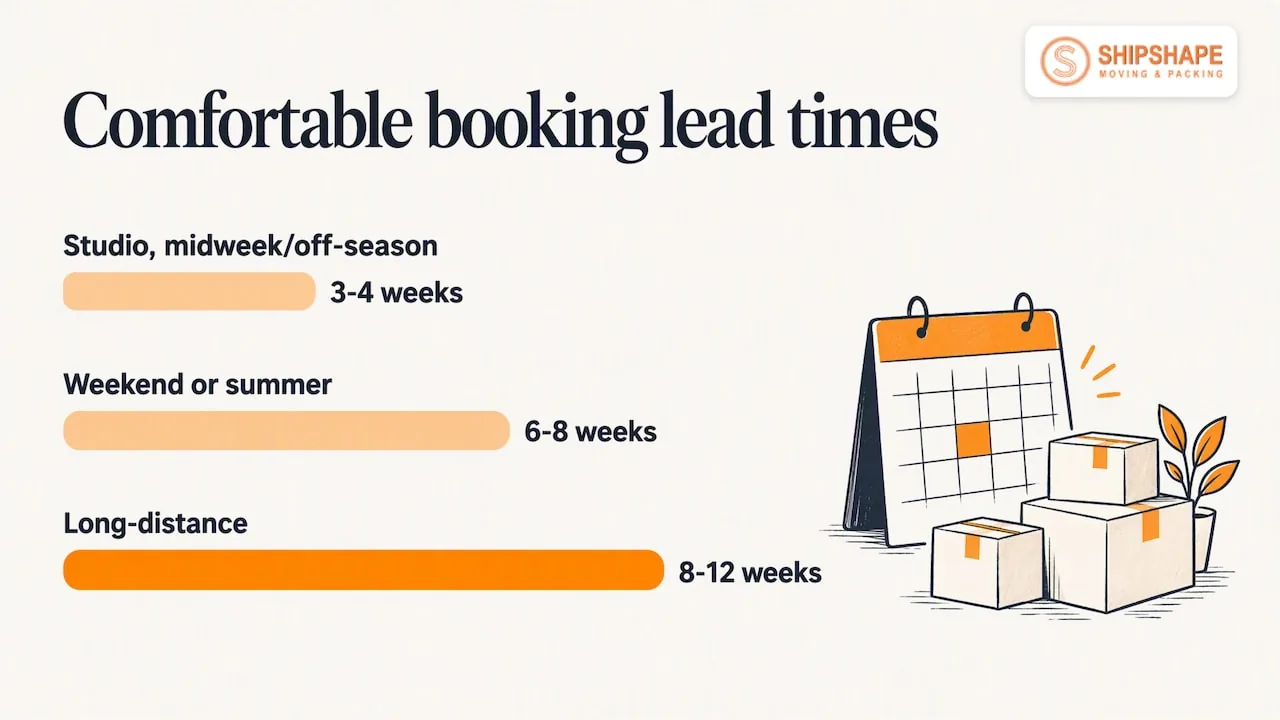
Those numbers differ a little, and that is fine. They are rules of thumb, not guarantees. What decides your real deadline is how many crews and trucks a company has on your date, and how many other people want that same date.
Here is a working timeline you can adapt:
| Your move | Comfortable lead time | Minimum that usually still works |
|---|---|---|
| Studio or one-bedroom, midweek, off-season | 3 to 4 weeks | 1 to 2 weeks |
| Apartment or home, weekend or summer | 6 to 8 weeks | 4 weeks |
| Large home, valuables or special handling | 8 or more weeks | 4 to 6 weeks |
| Office or retail move | 2 to 3 months | Depends on the building and your lease |
| Long-distance or interstate | 8 to 12 weeks | 6 weeks |
The left column is what we would plan for. The right column is what a flexible, lightly loaded move can sometimes get away with, not what we would count on.
Why the date you pick matters as much as how early you call
A move is booked against a calendar, and some days are simply scarcer than others.
Season
May through September is the busy season across most of the country. Families want to move once the school year ends, leases turn over, and the weather is dry. A national business publication notes that October through April moves are generally off-peak with more availability, while weekends and midsummer cost more and are harder to get. In the Bay Area, add graduation season and the fall college move-in rush for students, which squeeze the same crews.
Day of the week and day of the month
Weekends are the first slots to go. So are the last few days of any month, because that’s when many leases end and start. If you can move on a Tuesday or Wednesday in the middle of the month, you have the widest choice of times and crews. If your lease forces a 30th or 31st, treat it as peak season even in January.
Size of the move
A studio and a five-bedroom house are not the same booking. Larger moves need more crew members and bigger trucks, which is more of a company’s capacity committed to one day. Expect to book further out, and expect a longer walkthrough before the quote.
Buildings and access
San Francisco and Oakland moves often hinge on things that have nothing to do with the mover: a freight elevator that must be reserved, a building that only allows moves between certain hours, a street that needs a parking permit, or a long carry from the curb. The same guide says elevator reservations, HOA rules and long carries can limit scheduling, which is a reason to book earlier. Call your building manager the same day you pick a date. Our guide on preparing for moving day in San Francisco covers the building and parking side in more detail.
Local moves vs. long-distance moves
Local moves
A local move is logistically simpler: one crew, one truck or two, and everything arrives the same day. That is why a shorter lead time can work. But the same guide points out that local moves can book up quickly because there are so many of them. For a typical Bay Area apartment or home move, four to six weeks gives you a choice of dates. In summer or on a weekend, push it toward eight.
If you’re moving within Berkeley, Oakland, San Francisco or nearby, see how our local moving service works and what a crew does on the day.
Long-distance moves
Long-distance moves need more coordination: bigger trucks, routing, delivery windows and often a longer gap between loading and unloading. Plan on eight to twelve weeks, and closer to twelve if you’re moving in summer. Interstate moves also involve more paperwork, such as inventory and valuation choices, and more time to compare written quotes. Our long-distance moving page explains how we handle those moves from the Bay Area.
Moving abroad is a different scale. One relocation expert quoted by a business publication recommends starting 12 months ahead for an international move to handle documentation and legal requirements.
What to do before you book: the California quote process
In California, the booking date is not the first step. The quote is. The state’s Bureau of Household Goods and Services says a mover may give you an estimate in writing only after a visual inspection of what you’re moving, and that verbal or internet estimates are illegal and may not be enforceable. It also says a mover must provide a “Not to Exceed” price for household moves, which is the most you can be charged unless you request additional services through a written change order.
That has a practical effect on your timeline. Allow a few days to a week to schedule the walkthrough (in person or by live video, depending on the company), receive the written quote, read it, and sign. If you start the process two weeks before your move, that is a big share of your runway.
The same state page says to verify that a company is authorized to operate, using the license search on the Bureau’s site, and to photograph or video your belongings before the move in case of a dispute. Do both before you pay a deposit.

Special situations that need more lead time
Large homes
Multi-bedroom houses need bigger crews and sometimes more than one truck, and the walkthrough takes longer. We recommend eight weeks or more. Details are on our large home moving page.
Valuables, art and collections
Pianos, fine art, antiques and collections need the right crew and materials, not just any crew. Booking early means we can match the people and packing supplies to the items. See our white glove handling service for what that involves.
Packing
If you want movers to pack, book packing at the same time as the move, and book it for the days before the truck arrives. A full house can take more than one day to pack. Our packing service covers labeling too, which makes unpacking much faster.
Offices, clinics and retail
Business moves usually happen after hours or on weekends to avoid lost revenue, and they depend on building rules, IT cutover, and often a lease end date. Start talking to a mover two to three months before the date, and sooner for a larger floor plate. Our office relocation team plans around your operating hours.
Students
Student moves cluster around the end of the semester and move-in week. If you’re moving between campuses or from a dorm to an apartment, lock in a date as soon as your housing is confirmed, and ask about small-load options.
What happens when you book late
Late booking isn’t impossible, but it narrows your options. A co-founder of a national moving company told a business publication that last-minute jobs can require overtime or extra trucks, with those costs passed on to the customer, and that reserving earlier improves the chance of better pricing and availability.
In practice, booking late tends to mean:
- Fewer dates, and often only weekdays you didn’t plan on.
- Less time to compare more than one written quote.
- Pressure to skip the verification steps, like checking the license.
- Less time to pack, so packing becomes a rush.
If you only have a week or two
- Call several licensed movers the same day and ask for the earliest in-person or video walkthrough.
- Offer flexibility: a weekday, a morning start, a mid-month date.
- Reduce what has to move. Donating or selling furniture you don’t need shortens the job and lowers the hours.
- Ask about packing help for the rooms you can’t finish.
- Keep the Not to Exceed quote in writing, even if the schedule is tight.
Can you book too early?
Not really, with two caveats. There is no penalty for being early in terms of availability, and booking early locks in your date. But a quote reflects a specific inventory and a specific timeframe. If your move is six months away and you’re still buying or selling furniture, or your closing date or lease could shift, the walkthrough may need to be repeated. Ask what the policy is for changing the date, and whether a deposit is refundable or transferable. We occasionally ask for a deposit to secure a date, so ask any company about terms before you pay.
The best moment to book is once these three things are firm: the destination, the approximate date, and the rough list of what is coming with you. If the date might move, book a likely window, tell the mover, and confirm the exact day as soon as you can.
Our perspective: book the date, then the details
Most of the stress we see in moves comes from the same few things: a date picked before anyone checked the building, a quote that changed because the inventory did, or a packing job started too late. None of that is about the movers’ skill on the day. It is about the weeks before.
Our advice is to talk to a mover earlier than feels necessary, but not to rush the quote. Get the walkthrough done, get the Not to Exceed price in writing, and ask what could change it. We keep clients informed from the first call to the final box, because a customer who knows the plan can make good decisions about dates, packing and access. For us, a five-star record across hundreds of reviews comes down to this kind of plain communication, not to anything clever.
If you’re in the Bay Area and you’re debating whether you’re too early, you almost certainly aren’t.
— Dennis
Book your Bay Area move with ShipShape
We’re a licensed moving company based in Berkeley, moving homes, apartments and offices across Berkeley, Oakland, San Francisco and the surrounding Bay Area, as well as long distance. Our local moves are billed at $190 to $200 per hour, plus a one-time $80 truck fee, and we give you a written, not-to-exceed quote so you know the ceiling before moving day. Larger or specialized jobs are quoted after we see what’s involved.

Tell us your date, your addresses and the size of your home or office, and we’ll tell you honestly how soon we can fit you in. Start on our moving services page or request your quote at shipshapemoving.com.
A simple booking checklist
- Eight to twelve weeks out (long distance) or four to eight (local): pick two or three licensed movers and request walkthroughs.
- Check the license of each company with the state’s license search.
- Compare written Not to Exceed quotes, including truck fees, packing, stairs and long carries.
- Reserve the elevator, loading zone or parking permit at both addresses.
- Book the mover and pay any deposit only after reading the agreement. Keep copies of everything you sign.
- Book packing for the days before the move if you want help.
- Two weeks out: confirm the date, arrival window and any changes to your inventory in writing.
- Before the move: photograph or video your belongings and valuables.
FAQ
How far in advance should you schedule local movers?
Four to eight weeks is a safe window for most local moves. In the off-season and on a weekday, one to two weeks can work, but that depends on the day and the company’s schedule. If your date falls on a weekend or the end of a month, aim for the earlier end.
How far in advance should you book long-distance movers?
Start eight to twelve weeks ahead. Long-distance moves need larger trucks and more planning, and summer dates fill first. If you are moving in summer, call closer to twelve weeks out.
Is it too late to book movers a week before my move?
Not necessarily, but your choices shrink. You may pay more for overtime or additional trucks, and the walkthrough and written quote have to happen fast. Call several licensed companies at once, and be flexible on the day and start time.
What is the best time of year to hire movers?
October through April is generally quieter, and midweek, mid-month dates are easier to get than weekends or month-end. Midsummer weekends are the hardest and most expensive. If your schedule allows, a mid-month weekday in fall or winter gives you the most options.
Do I need to sign a contract when I book?
In California, the state says a mover hired three or more days ahead must give you a copy of its moving services agreement and required consumer notices. Read it before signing, confirm the Not to Exceed price, and keep your copies.
Sources
- How far in advance should you book a moving company? (RentCafe)
- How Much Does It Cost to Move? (Zillow)
- How To Hire Movers (Forbes Home)
- Moving Abroad Checklist (Forbes Home)