Artwork Moving Insurance: What Covers Your Art in a Bay Area Move

The coverage that protects a painting during a move is usually not the coverage you already have. A mover’s default protection pays by weight, a home or renters policy has caps on art, and a fine art transit policy is written around an appraised value. For a Bay Area move, the strongest setup combines three things: a licensed mover with trained, full-time crews, a written declaration of what each piece is worth, and, for valuable works, a policy that covers the piece from wall to wall. At ShipShape Moving, our white glove and packing services are built for exactly this kind of handling, and you can get a free quote once you know what you own and what it is worth.
Key Takeaways
- Under the federal rules for interstate moves, basic released-value protection pays 60 cents per pound per article, so a 10-pound item worth $1,000 would pay $6.00. Declare valuable art in writing before pickup.
- Homeowners and renters policies often cap art at low sub-limits and may pay actual cash value, which for a painting can mean the cost of materials rather than the artwork’s worth.
- A fine art transit policy is tied to a recent appraisal or bill of sale and can follow the piece from your wall in Oakland to its new wall.
- Photograph every piece before packing and at delivery. A claim must be in writing, and federal rules give you at least 9 months from delivery to file on an interstate move.
Table of Contents
- What artwork moving insurance actually means
- The federal numbers every art owner should know
- Does your homeowners or renters policy cover art in a move?
- Fine art transit insurance: when it makes sense
- A pre-move plan for art, step by step
- When the art travels long distance
- How ShipShape handles art moves
- Making a claim if something is damaged
- Our perspective on moving art
- FAQ
- Sources
What artwork moving insurance actually means
People use “moving insurance” for three different things, and mixing them up is where gaps appear.
- Mover valuation coverage. This is not insurance in the strict sense. It is the mover’s liability for what it handles, set by the option you choose on the paperwork. This Old House explains that full-value protection can be based on weight or on a complete itemized inventory with agreed market values, which it calls particularly useful for antiques and artwork.
- Your own home or renters policy. It may follow your belongings in transit, with limits and only for covered causes.
- Third-party moving insurance or fine art transit insurance. It is a separate policy. This Old House notes that third-party moving insurance can cost up to 5% of the shipment value and can cover items of extraordinary value like artwork.
For a framed print worth $80, the mover’s coverage and your renters policy are probably plenty. For an original oil, a signed lithograph, a sculpture or a collection, you need to know which of the three applies and what number sits behind it.
The federal numbers every art owner should know
The U.S. Department of Transportation’s consumer rules for household goods moves are published in 49 CFR Appendix A to Part 375. They apply to interstate moves, meaning moves that cross a state line, for example Oakland to Portland. They set out two protection levels:
| Protection level | What the rule says | What it means for art |
|---|---|---|
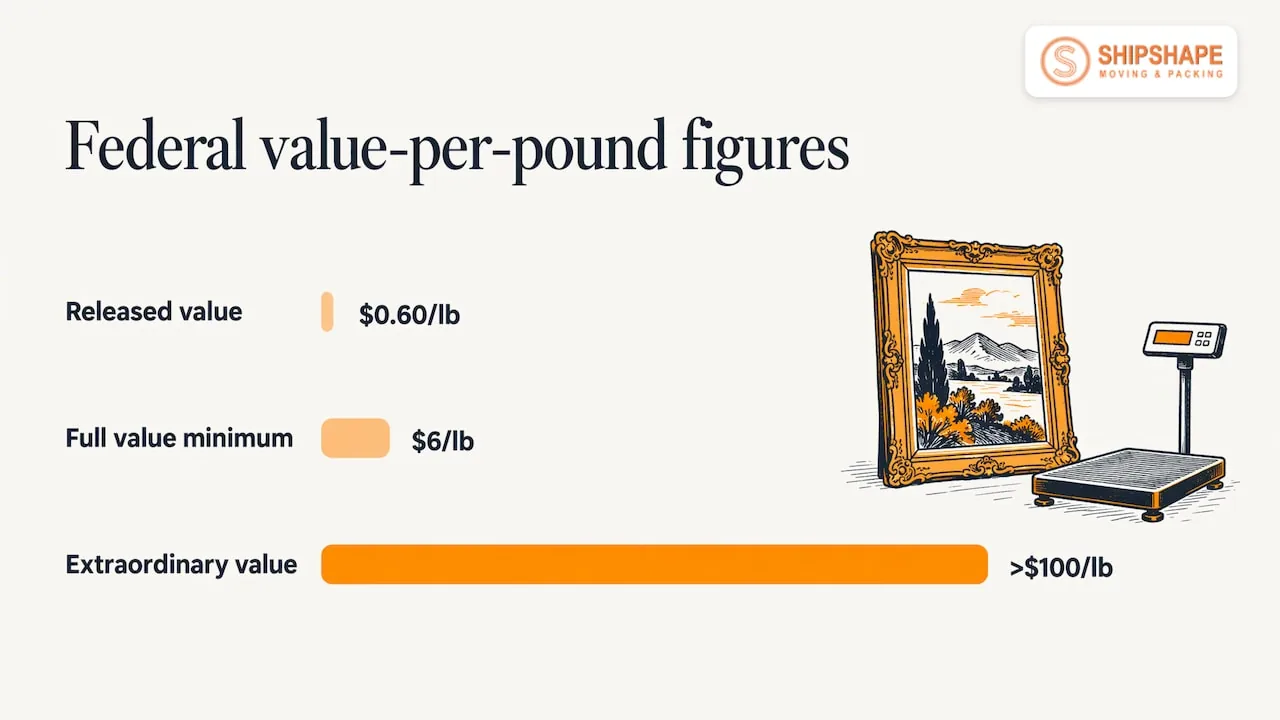
| Released value | Pays no more than 60 cents per pound per article | A 10-pound item worth $1,000 pays $6.00 |
| Full value protection | Minimum valuation is $6.00 per pound times the shipment weight; the mover repairs, replaces or pays for lost or damaged articles | Better, but weight-based figures can still sit far below an artwork’s real value unless you itemize |
The same rules define an “article of extraordinary value” as an item worth more than $100 per pound, with artwork named as an example. Unless you list those articles on the shipping documents, the mover may limit its liability for them, and the declaration is your responsibility. The Surface Transportation Board gives the same example of a 10-pound marble statue paying $6 at the released rate.
The practical takeaway is simple: a painting is light and valuable, so weight-based math never describes it well. Write down each significant piece, its value and the basis for that value before the truck is loaded.
Moves that stay inside California
Most of our local moves between Oakland, Berkeley, San Francisco, San Mateo and San Jose never cross a state line. California regulates household goods carriers through the Bureau of Household Goods and Services. Its Household Movers Act law book, effective January 1, 2026, requires licensed household movers to carry cargo insurance of at least $20,000 and public liability protection, including $100,000 per accident for property damage other than cargo. That is a floor for the carrier’s operation, not a statement about the value of any one piece you own. Ask any mover for its valuation terms in writing, and list your valuable art by name and value.
ShipShape holds California household goods permit MTR 0192323 and USDOT 3549568. You can read more about how these protections work in our guide to moving company insurance.
Does your homeowners or renters policy cover art in a move?
Sometimes, in part. USAA’s guidance says homeowners coverage for property in transit or storage may continue if the policy stays active or has follow-me provisions, subject to limits and covered perils. Renters coverage may also apply, and fine art may need a Valuable Personal Property policy. State Farm adds that homeowners policies may not cover property during a move.
The key questions to put to your insurer or agent:
- What is the art sub-limit? Progressive notes that art and collectibles may face sub-limits under a homeowners policy, and that insuring them for full value usually means a scheduled endorsement or rider, often with photos, descriptions or an appraisal.
- How is a loss paid? Lemonade’s art coverage page explains that basic policies cover paintings, photographs, lithographs and some sculptures at actual cash value, meaning the cost of physical materials rather than the value of the art.
- Does coverage continue in transit? Ask whether it applies while the piece is on a truck, in a hallway or in a temporary location.
- When does each policy start and end? USAA’s sequencing point matters in a relocation: your new renters or homeowners policy should be active before the old one ends, so there is no day when belongings are unprotected.
Renters moving between apartments in Temescal, Lake Merritt, Rockridge or the Berkeley flats often assume a renters policy covers everything. A short call to your insurer to confirm the art limit takes ten minutes and tells you whether you need a rider.
Fine art transit insurance: when it makes sense
Fine art transit insurance is a separate policy built for pieces in motion. The law firm Flaster Greenberg describes it as covering art in transit nail-to-nail or wall-to-wall, newly acquired pieces and pieces in storage while in transit. It also says a recent appraisal is essential because the coverage is tied to it, and that a bill of sale can establish value for a recent purchase.
Consider it when:
- A single piece is worth more than you could comfortably replace.
- Your home policy caps art far below your collection’s value. Artwork Archive reports that for a fully covered move you can expect to pay about 1-5% of the total value of possessions.
- You are relocating into the Bay Area from out of state or across the country with a collection.
- You are moving a collection that has been appraised and itemized.
A licensed insurance agent or broker is the right person to arrange this policy. Bring your appraisals, bills of sale, photos and the move date, and ask for a clearly defined transit limit.
A pre-move plan for art, step by step
1. Inventory and value every piece
List each artwork with the artist, title, medium, dimensions, purchase date and value. Use appraisals for significant pieces and bills of sale for recent purchases. Mark anything that is worth more than $100 per pound, the federal threshold for extraordinary value.
2. Photograph condition
Take clear photos of the front, back, frame corners and any existing flaws, with the date visible in the file. These photos are your baseline if you ever file a claim.
3. Check each layer of coverage
Call your home or renters insurer about transit coverage and art limits. Ask the mover for its valuation options in writing. Decide with an insurance professional whether a transit policy is warranted for your most valuable works.
4. Get the paperwork right
For interstate moves, the bill of lading is the contract. Federal rules say it is issued at least 3 days before pickup, and you should keep it until any claim is settled. List extraordinary-value items on the shipping documents.
5. Pack for the move itself
Framed works, mirrors and canvases need rigid protection and padding, and sculptures need support at their weak points. Our professional packing services are available for this, and our trucks carry moving blankets, stretch wrap, wardrobe boxes, floor and door-frame protection and tools to take apart and reassemble furniture. For older or inherited pieces, see our guide to moving antiques. You will find more in our special items packing category.
6. Plan the route and the building
Bay Area buildings have their own constraints. Oakland hillside homes in Montclair and Piedmont have steep stairs and narrow approaches. Berkeley craftsman houses have tight entries. San Francisco apartments often involve elevators that must be reserved and street parking that must be managed. Tell your mover about these details when you request a quote, so large frames and crates are planned around them.
7. Inspect at delivery
Unwrap and check each piece with the crew present when you can. Photograph any damage right away, note exceptions on the delivery paperwork and contact the carrier, your broker and your insurer promptly, as Flaster Greenberg advises.
When the art travels long distance
A cross-country move adds time in transit, more handling and the interstate rules above. Our long distance moving service covers moves out of and into the Bay Area, and it is worth settling valuation and your art declarations before the date is set. For very large or crated pieces that need freight rather than a household move, specialized furniture shipping is another way to reduce handling risk. The Surface Transportation Board also suggests that customers consider personally transporting the most valuable items such as artwork, so a small signed piece may ride with you in the car.
How ShipShape handles art moves
Our crews are full-time ShipShape employees, never subcontractors, and every mover is background checked before their first job. That matters when someone is carrying your grandmother’s oil painting down a Rockridge staircase. We handle local, apartment, residential, large home, long distance, office and commercial moves, along with packing and white glove handling for valuables.
If you are moving an office, gallery-style lobby art or a retail space, our commercial moves are planned around operating hours.

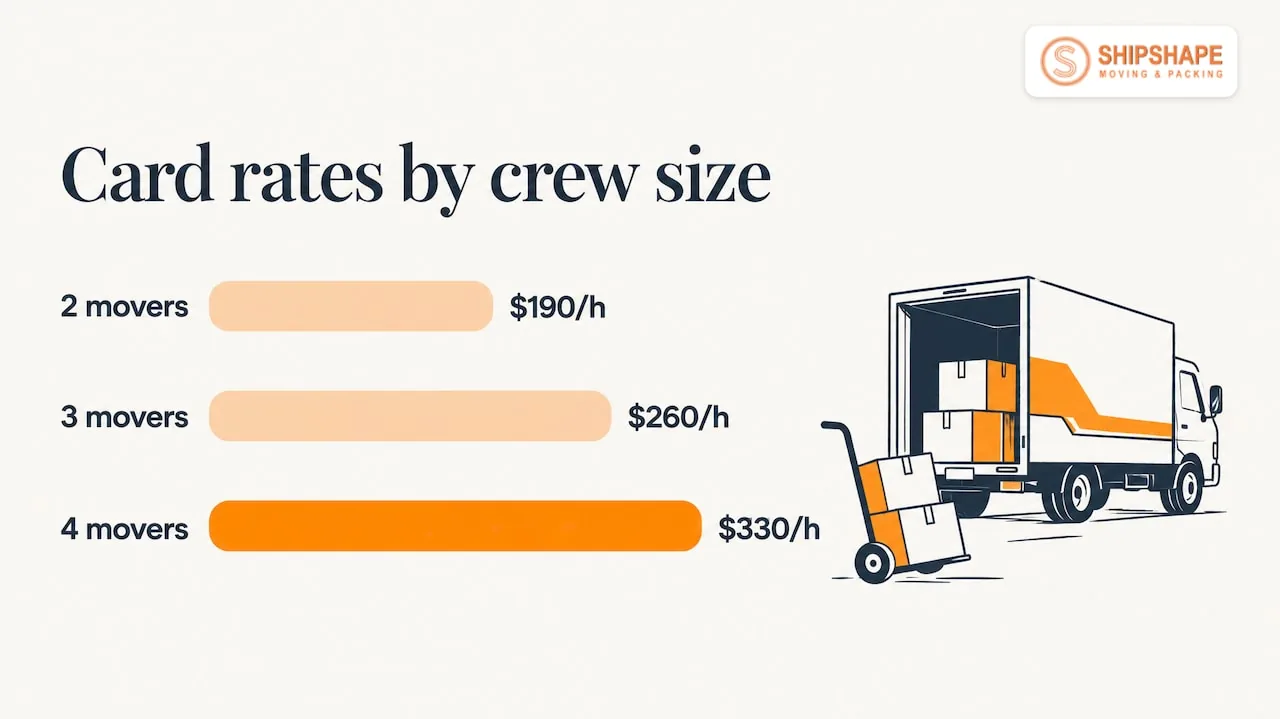
What it costs is published openly: local moves are $190 per hour for 2 movers, $260 per hour for 3 movers and $330 per hour for 4 movers when paying by card, and paying cash is $10 per hour less than the card rate. Every move has a three-hour minimum and a one-time $80 truck fee. We provide written not-to-exceed quotes, so you know the ceiling before moving day. Get a free quote and list your artwork in the request so we can plan crew size and packing around it.
Making a claim if something is damaged
If a piece arrives damaged, move quickly and keep everything in writing.
- Photograph the damage and the packaging before anything is discarded.
- Note the damage on the delivery paperwork.
- Notify the mover and, if you have one, your fine art insurer or broker.
- File a written claim that identifies the shipment, says the mover is liable and requests a specific dollar amount. The Surface Transportation Board says federal law requires the filing period to be at least 9 months from delivery.
For interstate moves, the federal rules also say the mover has 30 days to acknowledge your claim and 120 days to give a disposition, with possible 60-day written extensions. If a claim is complex and the value is high, Flaster Greenberg suggests involving experienced counsel.
Our perspective on moving art
We think art moves go well or badly long before the truck arrives. The result depends on three decisions: how carefully a piece is packed, how clearly its value is written down and who actually carries it.
That last point is why our crews are full-time ShipShape employees and not subcontractors, and why every mover is background checked before their first job. When you hand over something that cannot be replaced, you should know who is in your home.
Our advice is to treat the paperwork as part of the packing. Photograph each piece, keep the appraisal where you can find it, ask your insurer what your policy does in transit and list valuable works with your mover in writing. Then give the work to a crew that handles valuables as a service, not as an afterthought. That is what our white glove and packing services are for.
Our rates are published, our quotes are in writing and we would rather you ask every question before moving day than after it.
Dennis
FAQ
Does my moving company’s coverage protect my artwork?
It depends on the valuation option you choose and on whether you declared the art. On interstate moves, the federal rules set released value at 60 cents per pound per article, with full value protection available at a higher level. List valuable pieces in writing and ask the mover to confirm the terms on your paperwork.
Is art covered by homeowners or renters insurance during a move?
Possibly, up to your policy’s limits and for covered causes only. Many policies cap art or pay actual cash value, so call your insurer before the move and ask about a scheduled rider if your pieces exceed the limit.
How much does fine art transit insurance cost?
Prices vary by policy and by the value of what you insure. As a general reference, Artwork Archive reports that a fully covered move can cost about 1-5% of the value of the possessions covered. A licensed insurance broker can quote your exact situation from your appraisals.
What documents do I need to insure artwork for a move?
Have a recent appraisal for significant works and a bill of sale for recent purchases. Add dated photos of each piece, its dimensions and the move dates, since coverage is tied to the stated value.
How long do I have to file a claim for damaged art?
For interstate moves, federal law gives you at least 9 months from delivery. File in writing, identify the shipment, state the mover’s liability and request a specific dollar amount. Start documenting at delivery, not months later.
Sources
- Do I Need Moving Insurance? - This Old House
- 49 CFR Appendix A to Part 375 - Cornell Legal Information Institute
- Lost or damaged household goods - Surface Transportation Board
- Household Movers Act Laws, Rules, and Regulations - California Bureau of Household Goods and Services
- Is property covered by homeowners insurance during a move? - USAA
- The Ins and Outs of Moving Insurance - State Farm
- Insuring Artwork & Collectibles - Progressive
- Extra Coverage for Your Art, Explained - Lemonade
- What You Should Know About Fine Art Transit Insurance - Flaster Greenberg
- Moving Your Art Collection - Artwork Archive
- Specialized furniture shipping