Binding Not-to-Exceed Estimate: What It Means for You

A binding not-to-exceed estimate is a written price that works as a ceiling: you pay the actual charges if they come in lower, and never more than the written amount for the services listed. Extra items or services change the ceiling only through a written change. In California, the state’s household goods tariff sets this framework for Bay Area movers.
Key Takeaways
- A not-to-exceed price is a cap, not a prediction. The final bill can be lower than the number on the page, but not higher for the work that was written down.
- California’s 2026 Maximum Rate Tariff sets the maximum charge as the lesser of the written amount plus any change orders, or the charges calculated from the agreed rates times actual units of measurement.
- The cap only covers what is written in the estimate. A full inventory, access details and services such as packing need to be on the page before you sign.
- For a Bay Area move with stairs, hills or tight parking, put those details in the estimate so they do not become change orders later.
- ShipShape provides written not-to-exceed quotes, and the next step is a free quote.
Table of Contents
- What “not to exceed” means for your final bill
- How California handles estimates and not-to-exceed prices
- What the estimate should cover
- When the price can change
- A worked example, using hourly rates
- Questions to settle before you sign
- Local details that change the estimate
- Ready to get a written quote
- Our perspective on not-to-exceed pricing
- FAQ
- Sources
What “not to exceed” means for your final bill
Most people shopping for movers run into three phrases: binding, non-binding and not-to-exceed. They describe how firmly a price is tied to the final invoice.
- Binding estimate: a fixed price for the described work. You pay that amount whether the move goes faster or slower than expected.
- Non-binding estimate: the mover’s best guess. The final bill follows actual time or weight and can land above or below the guess.
- Binding not-to-exceed: a hybrid. The written number is the most you can be charged for the listed work. If the move takes less time or involves less volume than planned, you pay the lower actual amount.
The practical difference is the direction the bill can move. With a pure binding estimate, the price is fixed in both directions. With a not-to-exceed price, it can only fall or stay put, as long as the job matches what was written down.
That last condition matters most. The cap protects you against a mover running long, a heavier load than expected or slow loading. It does not cover work you add after you sign. If you decide on moving day to bring the garage, add packing for the kitchen or move a second storage unit’s worth of furniture, the added work is priced separately through a written change.
How California handles estimates and not-to-exceed prices
In California, household goods movers are regulated by the Bureau of Household Goods and Services (BHGS), part of the Department of Consumer Affairs. The Bureau publishes a Maximum Rate Tariff each year that sets the rules and the ceilings for local and in-state moves. ShipShape is licensed under California household goods permit MTR 0192323 from BHGS, and our USDOT number is 3549568.
Three points from the 2026 tariff, effective January 1, 2026, are worth knowing as a customer:
- The cap is the lesser of two numbers. When an estimate is given, the maximum charge is the lesser of the estimate plus any change order charges, or the charges calculated from the rates in your agreement times the actual units of measurement (hours, for most local moves).
- A not-to-exceed price works the same way when no estimate is given. In that case the maximum is the lesser of the Not to Exceed Price on the agreement plus change order charges, or the charges calculated from the quoted rates.
- An estimate must be in writing and follow an inspection. Under Item 108 of the 2026 tariff, an estimate is given only after a visual inspection of the goods, and in writing. If it is issued at least three days before the move, it may exceed the maximum fixed rates plus change orders. If it is given less than three days before the move, the maximum charge cannot exceed the charges calculated at the maximum fixed rate.
Put plainly, the state’s own rules are built around the same logic as a not-to-exceed price: you are charged for what was actually used, up to a stated ceiling, and changes go through change orders. Ask to see the terms “Not to Exceed Price” and “Change Order” on your agreement, because those are the words the tariff uses.
The federal rules you may read about online apply to a different kind of move than the local and in-state moves covered here, so the California tariff is the document that matters for Bay Area movers.
What the estimate should cover
A not-to-exceed price is only as useful as the list of work behind it. Before you sign, the written document should describe the following.
The inventory and the rooms
The estimate should reflect what is actually moving. For a one-bedroom apartment near Lake Merritt, that may be a short list. For a family home in Rockridge, Montclair or the Berkeley hills, it includes the garage, the basement, outdoor furniture, bikes, mattresses and anything stored in an attic. Anything not mentioned is a candidate for a change order later.
Access at both addresses
Bay Area buildings make access matter. Walk-up apartments in Oakland and Berkeley, elevators that have to be reserved, loading zones in San Francisco and steep or narrow hillside streets all affect how long a move takes. Tell your mover about stairs, long carries from the curb, gated parking and building move-in rules. The tariff’s cap logic works in your favor only when the written scope matches the real conditions.
Services beyond loading and unloading
If you want packing, say so at the quote stage. If you want furniture taken apart and put back together, that is handled as part of a booked move, so it should be listed with the move. Wardrobe boxes, specialty items and fragile pieces that need extra care should also be named. White glove handling is a separate service that should be written in if you want it.
The rate, the minimum and the fees
An hourly move has more than one number. Look for the hourly rate by crew size, any minimum number of hours, any truck fee and the payment terms. A not-to-exceed price should add up from those pieces, so you can check the arithmetic yourself.
When the price can change
A ceiling does not freeze everything. It protects you from overruns on the work in the agreement. It does not stop you from changing the job.
The usual triggers for a written change are:
- Items added after the estimate, such as furniture from a second room or a storage space you forgot to mention.
- Services added on the day, such as packing a kitchen you had planned to do yourself.
- A different address or a new access condition, such as a building that turns out to need an elevator reservation or a longer carry.
- A different move date, which can alter crew availability.
The tariff handles these through change orders: the new work is added to the written estimate, and the maximum becomes the estimate plus the change order charges. If something is going to change, ask for the updated number in writing before the crew starts the added work. A change you agree to in a text message or a casual conversation is harder to sort out afterward than one on paper.
The other direction is just as important. If the crew finishes faster than the estimate, a not-to-exceed price means you pay the lower, actual amount. That is the main reason to prefer this structure over a flat fixed price when your move is a typical local one.
A worked example, using hourly rates
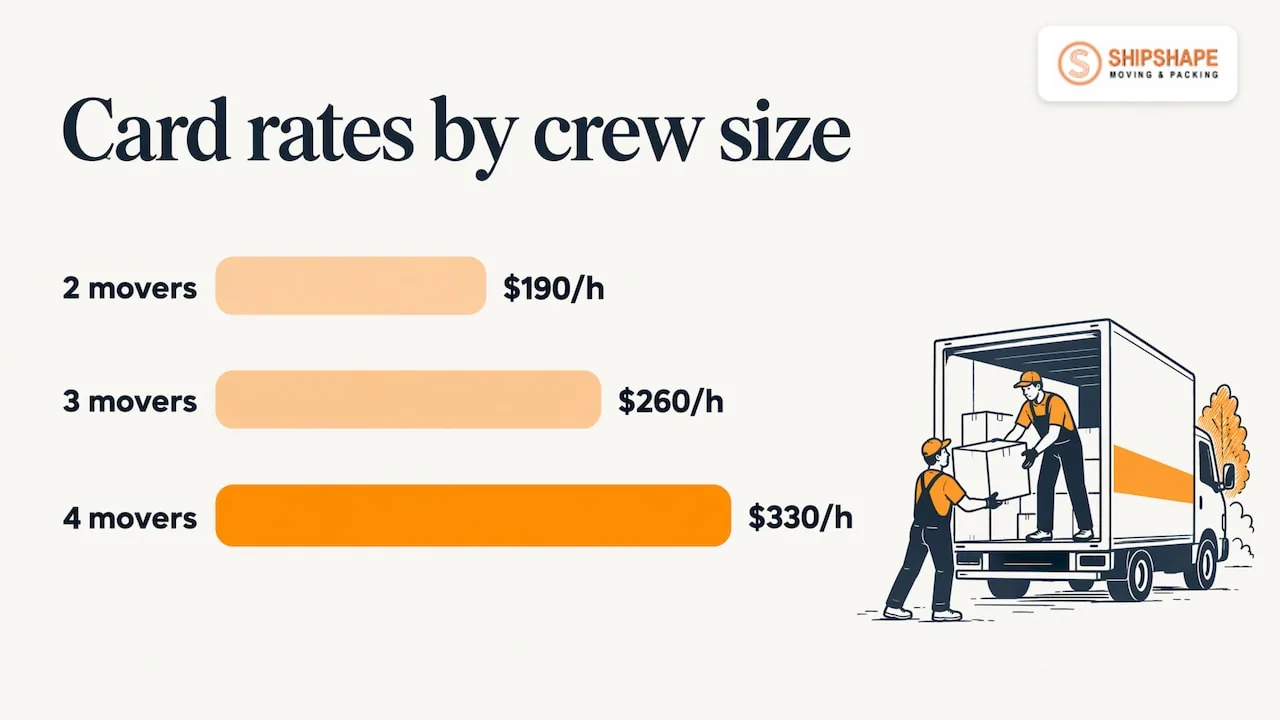
Here is how the pieces fit together using ShipShape’s published hourly rates. For a local move, ShipShape charges $190 per hour for 2 movers, $260 per hour for 3 movers and $330 per hour for 4 movers when you pay by card. Paying cash is $10 per hour less than the card rate. There is a three-hour minimum and a one-time $80 truck fee. For help choosing a crew size, our crew size guide walks through it.
Suppose you are moving a two-bedroom apartment and a written quote is built on a 2-mover crew at $190 per hour, with a stated ceiling based on an expected number of hours plus the $80 truck fee. Three outcomes are possible:
- The crew finishes under the expected hours, but within the three-hour minimum. You pay for the three-hour minimum at the hourly rate, plus the truck fee.
- The crew finishes above the three-hour minimum but below the expected hours. You pay the actual hours at the hourly rate, plus the truck fee, which is less than the ceiling.
- The crew would run beyond the expected hours for the work as written. The ceiling is the most you pay for that listed work.
The example uses our own published rates, so you can check every line against your quote. Your final figures depend on your crew size, the hours and the services you book, and the written quote is where those are set out. For a closer look at how the numbers add up for your neighborhood, see our Oakland moving cost guide and our overview of moving company fees.
Questions to settle before you sign
Use this list when you read a written estimate from any licensed mover. It takes ten minutes and it is where most disputes are avoided.
- Is the price labeled as a not-to-exceed price or a binding estimate? The label tells you whether the number can go down as well as stay put.
- Is the estimate in writing, and does it follow an inspection of your belongings? The 2026 tariff requires both for an estimate.
- Does it list the services you want? Packing, furniture handling, specialty items and any extra stops should be named.
- Does it show the hourly rate, minimum hours and truck fee? You should be able to rebuild the total from the parts.
- How are changes handled? Ask how a change order is written and when you see the new total.
- What is the deposit, if any? Some movers ask for a deposit to hold a date. Our mover deposit rules article covers what to expect in California.
- Is the mover licensed? California movers should hold a household goods permit from BHGS, and you can ask for the permit number. Ours is MTR 0192323.
- Who is doing the work? Ask whether the crew are the mover’s own employees. ShipShape crews are full-time ShipShape employees, never subcontractors, and every mover is background checked before their first job.
If you are comparing quotes, our guide to choosing a moving company shows how to line up three estimates on the same scope. Insurance is a separate question from price, and moving company insurance explains how it works.
Local details that change the estimate
The cap is built from the job as described, so the details of your block matter.
- Oakland: Hillside streets in the Oakland hills, walk-up buildings around Lake Merritt and Temescal, and older homes with narrow stairways all lengthen a carry. A quote that names the stairs and the distance from the truck to the door is more reliable than one that does not.
- Berkeley: Student moves around campus often involve tight loading windows and upper-floor units. Tell the mover the floor, the elevator situation and where the truck can stop.
- San Francisco: Loading zones, building rules and hills shape the day. Ask your building manager what is required for a move-in and put it in the estimate.
- San Mateo, Palo Alto and San Jose: Larger homes mean more rooms, a garage and sometimes a longer drive between stops. List each of them.
Our trucks are 26-foot box trucks, each with a loading ramp and stocked with moving blankets, stretch wrap, dollies, straps, floor and door-frame protection, wardrobe boxes and tools to take apart and reassemble furniture. That equipment is part of the move, not an add-on you need to negotiate.
Ready to get a written quote
We do local, apartment, residential, large home, long distance (within California), office, commercial, packing and white glove moves across Oakland, Berkeley, San Francisco, San Mateo, Palo Alto, San Jose and the wider Bay Area. We provide written not-to-exceed quotes, so you see the ceiling and the pieces behind it before you commit.
Start with a free quote on our home page, and have your addresses, floors, the list of rooms and any packing you want ready. If you are planning an office or retail move, our commercial moves page covers moves planned around operating hours.

Our perspective on not-to-exceed pricing
We think the best estimate is the one a customer can check. A written not-to-exceed quote does that: you can see the hourly rate for the crew size, the three-hour minimum, the one-time $80 truck fee and the services you asked for, and you can add them up yourself.
That is also why we publish our hourly rates: $190 per hour for 2 movers, $260 for 3 movers and $330 for 4 movers by card, with cash $10 per hour less. A price you can read before you call is a price you can plan around.
Our crews are full-time ShipShape employees, and every mover is background checked before their first job. That matters for estimates too. The people who walk through your home to scope the job are part of the same company that does the work, so the quote and the move are built by one team.
Our advice is simple. Describe the move as completely as you can, including stairs, parking and every room, and ask for the quote in writing. A complete description is what makes a ceiling meaningful.
Dennis
FAQ
What is the difference between a binding estimate and a binding not-to-exceed estimate?
A binding estimate fixes the price for the described work. A binding not-to-exceed estimate sets the same figure as a ceiling, so you pay the lower actual charges if the move takes less time. In both cases, the cap covers the work as written and changes go through a written change order.
Is a not-to-exceed estimate the same as a quote?
Not always. A quote can be a rough guess with no ceiling. Look for the words not-to-exceed on the document, and make sure it is in writing. California’s 2026 tariff says an estimate must be given in writing after a visual inspection of the goods.
Can the final bill go above a not-to-exceed price?
For the work written in the estimate, the maximum charge is the lesser of the estimate plus change orders or the charges at the agreed rates times actual units. The bill rises above the original figure only when you add items or services through a written change order.
Do I have to pay a deposit for a local move?
Some movers ask for a deposit to secure a date. ShipShape occasionally requires one, and the amount and terms should be in writing before you pay. Our mover deposit rules article explains what to look for in California.
How do I get a not-to-exceed quote from ShipShape?
Request a free quote and share your addresses, floors, the rooms to be moved and any packing or white glove handling you want. We provide the quote in writing, with the hourly rate, three-hour minimum and $80 truck fee shown.