Change of Address vs. Premium Forwarding: Which to Use
If you are moving for good, file a USPS change of address. If you will be away from your main home for a few weeks or months and want all your mail in one weekly box, Premium Forwarding Service (PFS) is the paid option. USPS itself points people moving permanently to standard forwarding and reserves PFS for temporary relocations, as stated on its Premium Forwarding Services page in 2026. For most Oakland, Berkeley and San Francisco households, the change of address is the right tool.
This guide covers how each one works, what each costs, where each one fails, and how to time the paperwork around moving day. We are a Berkeley moving company, so we also explain where mail forwarding sits in a Bay Area move and where a mover’s job begins and ends.
Key Takeaways
- A permanent change of address forwards eligible mail to your new home for 12 months, according to USPS’s standard forwarding page (2026). Premium Forwarding is a separate, paid, temporary service.
- Neither option updates your bank, employer, DMV or insurer. A change of address only tells the Post Office where you live now.
- Premium Forwarding does not work if a change of address order is active at the same time, per USPS’s PFS terms (2026).
- Many Bay Area apartment buildings use shared mailboxes, which can make Premium Forwarding unavailable. Check this before you plan around it.
- File your change of address a few weeks before your move date, and keep a short list of every sender you need to update yourself.
Table of Contents
- The core difference in plain terms
- What each one costs
- What mail actually gets forwarded
- Who should choose which
- How to time it around moving day
- Mistakes that cost people mail
- Where a mover fits in
- Cost of the move itself
- Our perspective
- FAQ
- Sources
The core difference in plain terms
A change of address is an instruction to the Post Office: send my mail to this new address instead. It comes in two kinds. A permanent order is for a move with no plan to return. A temporary order is for a stay away from home that will end. USPS describes a permanent order as forwarding mail for 12 months and a temporary order as covering 15 days up to 1 year (2026). Mail arrives piece by piece, as your carrier would have delivered it.
Premium Forwarding Service works differently. Your local Post Office packs your residential mail into a box and ships it by Priority Mail on a weekly schedule. USPS says PFS-Residential ships weekly, usually on Wednesday, with a tracking number emailed each week (2026). Think of it as a weekly bundle rather than a daily trickle.
That difference shapes who should use which.
| Change of address | Premium Forwarding (Residential) | |
|---|---|---|
| Built for | Permanent moves, plus temporary stays | Temporary relocations |
| How mail arrives | Piece by piece, as normal delivery | One Priority Mail box a week |
| Length | Permanent: 12 months. Temporary: 15 days to 1 year | 2 weeks to 1 year |
| Cost | Online identity check fee, extensions optional | Enrollment fee plus a weekly charge |
| Can run alongside the other | No | No |
The length figures come from USPS’s standard forwarding page and its PFS terms, both current in 2026.
What each one costs
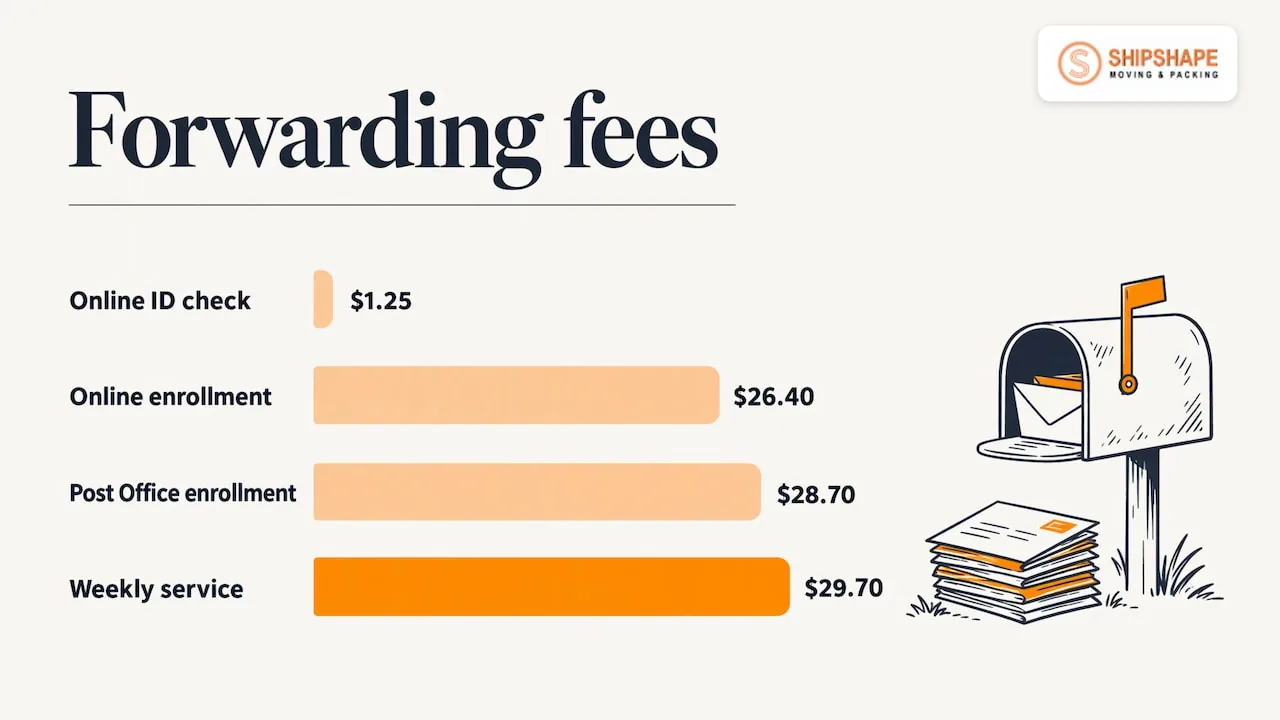
Standard forwarding is close to free. USPS charges a $1.25 identity verification fee for online change of address requests, and the card billing address must match your old or new address (2026). Filing in person at a Post Office with PS Form 3575 is the route if online verification fails, if you file for someone else, or if you need to file in person for another reason USPS lists on that page.
If you need forwarding past the standard period, USPS sells Extended Mail Forwarding. USPS says you can add it when you first file or later by editing the request, that it sends a reminder email when one month of forwarding remains, and that the extension cannot be canceled or refunded (2026). Check that page for the current fee for each length, since USPS updates its prices on a schedule.
Premium Forwarding costs more because it is a different product. USPS lists a non-refundable PFS-Residential enrollment fee of $26.40 online or $28.70 at the Post Office, plus $29.70 for each week of service (2026). A stay of 10 weeks, for example, means the enrollment fee plus ten weekly charges. You can work out your own total by multiplying the weekly charge by the number of weeks and adding the enrollment fee.
PFS pricing is also changing. A Federal Register final rule published November 19, 2026 and effective January 17, 2027 turns the online enrollment fee into an annual fee paid in full and adds an opt-in automatic renewal. If your temporary stay starts in 2027, read USPS’s current page before you sign up.
What mail actually gets forwarded
This is where people get surprised, so it deserves attention.
Under a change of address
Some mail is not forwarded at all. USPS states that government agencies and financial institutions do not forward identity documents such as driver’s licenses and voter registration, nor credit cards, bank statements, insurance or medical information, and that USPS Marketing Mail is forwarded only if the sender paid for it (2026). Your new license, a replacement debit card or a ballot packet can be returned to the sender or never reach you if the sender has your old address on file.
Packages from private carriers are a separate matter. USPS forwarding does not cover packages sent through FedEx, UPS or another shipping service (2024). For those, you need to update the delivery address with the retailer or carrier directly. The guidance on changing a delivery address with couriers shows why speed matters once a parcel is already in transit.
Under Premium Forwarding
PFS-Residential ships all mail regardless of endorsements, but pieces that need a delivery scan or signature, including Priority Mail Express, Return Receipt, Postage Due and Insured Mail, are rerouted separately (2026). In practice, the weekly box holds your ordinary letters, magazines and notices, while signature items travel on their own. Large First-Class Mail, Media Mail and USPS Ground Advantage packages are forwarded automatically for free (2026).
One practical point: the box arrives as packed. You do not choose what goes in it, so plan to sort and discard on arrival.
Who should choose which
You are moving to a new home in the Bay Area
File a permanent change of address. This covers a renter moving from a Temescal apartment to a place near Lake Merritt, a family leaving Rockridge for a larger home in Montclair, or someone moving from San Francisco to the East Bay. Nothing about a permanent move calls for weekly bundling. You want mail at your new door as it comes.
You are in between homes
This happens often in the Bay Area. A lease ends in Berkeley on the 31st, the new place in San Jose is ready on the 15th, and you spend two weeks with family or in a short-term rental. A temporary change of address can cover the gap. Set the start date for the day you leave the old place and the end date for when you have a permanent address, then file a permanent order when you land. Keep one point in mind: USPS says temporary orders cannot be combined to exceed a total of 12 months (2026).
You are away for months and want one weekly box
Premium Forwarding fits this. A homeowner who keeps a house in the Oakland hills but spends several months elsewhere, and who wants mail collected and shipped weekly, matches how USPS designed the service. PFS-Residential runs from a minimum of 2 weeks to a maximum of 1 year, and neither a temporary nor a permanent change of address order may be active at the same time (2026).
You live in a building with shared mailboxes
Check eligibility first. USPS’s PFS-Residential rules limit the service to a household or individual addressee, treat business addressees and centralized delivery points as generally ineligible, and do not let customers with a PO Box as their primary address sign up online (2026). Many multi-unit buildings in San Francisco and Oakland use cluster or centralized boxes, so PFS may not be open to you. A standard change of address is usually the simpler path in that case.
You run an office
Businesses have their own version. USPS Premium Forwarding Service Commercial lets business customers with an active PO Box or street address forward mail to a domestic business address daily, weekly or monthly, with an annual enrollment fee and requests made through the Business Customer Gateway (2026). Residential PFS is not available to business addressees, so an office move needs the commercial route or a business change of address, plus a separate update to your vendors, bank and clients.
How to time it around moving day
Mail forwarding is the part of a move that people start too late. A workable order:
- Three to four weeks out: make your sender list. Banks, credit cards, insurers, your employer, your doctor, subscriptions, voter registration and the DMV all belong on it.
- Two to three weeks out: file the change of address. USPS says to allow at least 7 to 10 business days after approval for the order to take effect (2026). Filing the week of the move is too late to be seamless.
- Before moving day: double-check the new address. A missing unit number, direction or street suffix can cause USPS to flag the order, delaying or returning mail (2026). In Oakland and San Francisco, where apartment numbers and street suffixes are easy to drop, this is the most common slip.
- Within 10 days of moving: update the DMV. California DMV requires you to report a change of address within 10 days of the change (2026).
- In the first month: update each sender on your list directly, and keep the confirmation code USPS emails you. Without that code you cannot modify or cancel online and have to go to a Post Office (2026).
- Before the 12 months end: finish the updates. When forwarding ends, USPS returns mail to the sender for 6 months with a label showing your new address (2026).
If you are planning a rental move in Oakland, our 30-day apartment move-out timeline lays out the rest of the checklist around these mail steps.
Mistakes that cost people mail
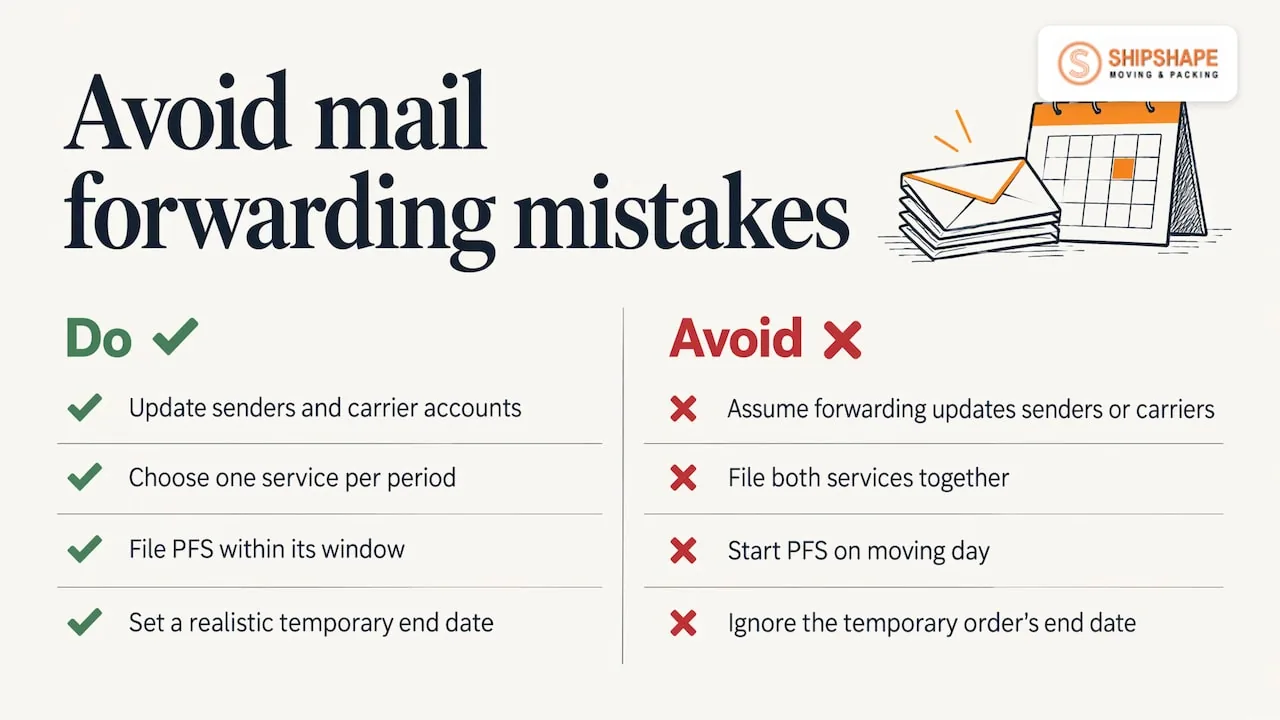
Assuming forwarding replaces updating senders. A change of address only changes your address with the Post Office, so you must notify other senders yourself (2026). Treat the forwarding order as a safety net that expires.
Filing both services. Because PFS cannot run alongside a change of address, picking both leads to a rejected or conflicting request. Choose one for a given period.
Starting PFS too early or too late. The first PFS-Residential request must be created no more than 30 days before the start date and before midnight Central Time the day before it starts (2026). Leaving it to moving day does not work.
Forgetting packages. Online orders placed under your old address and sent by private carriers will not follow you. Update those accounts before you pack.
Ignoring the end date. Temporary orders end on the date you set. If you choose a short window and your move runs late, mail starts landing at the old address again.
Where a mover fits in
Mail forwarding is paperwork, and a mover cannot file it for you. What we can do is keep the physical move from creating mail problems. A move that finishes on schedule means the date you gave USPS is the date you actually move. A packed, labeled home means the box of unopened mail, tax papers and bank envelopes that usually ends up in a random bag is found on the first night.
Our residential movers handle houses and apartments across Oakland, Berkeley, San Francisco and the wider Bay Area, and packing and labeling can pull your files and paperwork into clearly marked boxes so you know where they are. Our crews are full-time ShipShape employees, never subcontractors, and every mover is background checked before their first job. That matters when your boxes hold identity documents and financial mail.
Cost of the move itself
While you budget for forwarding fees, budget for the move too. ShipShape’s published hourly rates by card are $190/hr for 2 movers, $260/hr for 3 movers and $330/hr for 4 movers. Paying cash is $10/hr less than the card rate. A three-hour minimum applies, and there is a one-time $80 truck fee. Our guide on moving company fees explains what drives the hours on a given job.
To see what your move would take, get a free quote. Tell us your move date, so you can match your USPS start date to it.
Our perspective
Mail forwarding looks like a small errand until it goes wrong. The pattern is simple: the Post Office forwards what it can, and everything else depends on whether the sender has your new address. So the order of operations matters more than the choice of service.
For a permanent move, we would file the change of address early, then spend your energy on the senders that matter most: banks, insurers, the DMV and your employer. Premium Forwarding is a specialist tool for people who are away from a primary home for a stretch, and it is worth knowing it exists. But it is not the default for someone unpacking a new apartment in Oakland or Berkeley.
The same logic applies to the move. A move run by full-time, background-checked ShipShape crews, with a three-hour minimum and a written quote, gives you a fixed point to build the rest of the schedule around. When the move date is firm, the USPS date, the utility start dates and the DMV update all fall into place behind it.
Dennis
FAQ
How long does a USPS change of address last?
A permanent change of address forwards mail for 12 months, and a temporary one covers 15 days up to 1 year, according to USPS (2026). After a permanent order ends, USPS returns mail to the sender for 6 months with your new address attached. Extended Mail Forwarding can be added before the order expires.
Can I use Premium Forwarding and a change of address together?
No. USPS’s PFS terms say neither a temporary nor a permanent change of address order may be active at the same time as PFS-Residential (2026). Pick one for each period. If your plans change mid-stay, edit or cancel the first order before starting the other.
Does Premium Forwarding forward packages?
It depends on the item. Large First-Class Mail, Media Mail and USPS Ground Advantage packages are forwarded automatically for free, and Priority Mail Express and signature items are rerouted separately (2026). Packages sent by private carriers are not covered by USPS forwarding, so update those delivery addresses directly.
How soon should I file before moving day?
File two to three weeks ahead. USPS says to allow at least 7 to 10 business days after approval for a change of address to take effect (2026). For PFS, the request must be created no more than 30 days before the start date.
Do I still need to update my bank and the DMV?
Yes. A change of address only tells the Post Office where you live, and banks, insurers and government agencies do not forward sensitive documents (2026). California also requires you to report your new address to the DMV within 10 days (2026).
Sources
- Premium Forwarding Services, USPS
- Standard Forward Mail & Change of Address, USPS
- PFS terms and conditions, USPS
- PFS-Residential online terms, USPS
- Domestic Competitive Products Pricing and Mailing Standards Changes, Federal Register
- Change of address reporting, California DMV
- How To Forward Mail When Moving, U.S. News Real Estate
- USPS Mail Forwarding Not Working? 7 Reasons and Fixes
- How Much Does It Cost to Forward Your Mail?, LegalClarity
- Changing a delivery address with couriers