Office Move Communication: A Plan for Bay Area Teams

Good office move communication means telling employees why you are moving, what changes for them, what they must do and when, then repeating it through one trusted channel until the first week in the new space is over. For Oakland and Bay Area teams, that plan works best when it is shared with your professional crew before moving day.
Key Takeaways
- Start with the reason for the move. Research on U.S. employees found that transparent internal communication lowers uncertainty about change (2020 study).
- Name one source of truth, one point person and a small move committee with a member from each department.
- Label every date as provisional, confirmed or changed, so a corrected date lives in one place.
- Give each employee a short list of exactly what they must do, and give your movers the same schedule, access details and floor plan.
- Keep communicating after the move: confirm building access, ask for feedback in the first week and fix small problems quickly.
Table of Contents
- Why communication decides how an office move feels
- Build the communication plan before you announce anything
- What the first announcement should say
- Matching the message to the channel
- Answering questions without guessing
- Moving day: communication that keeps the day on schedule
- After the move: keep communicating
- How ShipShape fits into your communication plan
- Our perspective on office move communication
- FAQ
- Sources
Why communication decides how an office move feels
An office move changes a commute, a desk, a routine and sometimes a whole team’s habits. When people hear about it late or in pieces, they fill the gaps with rumors.
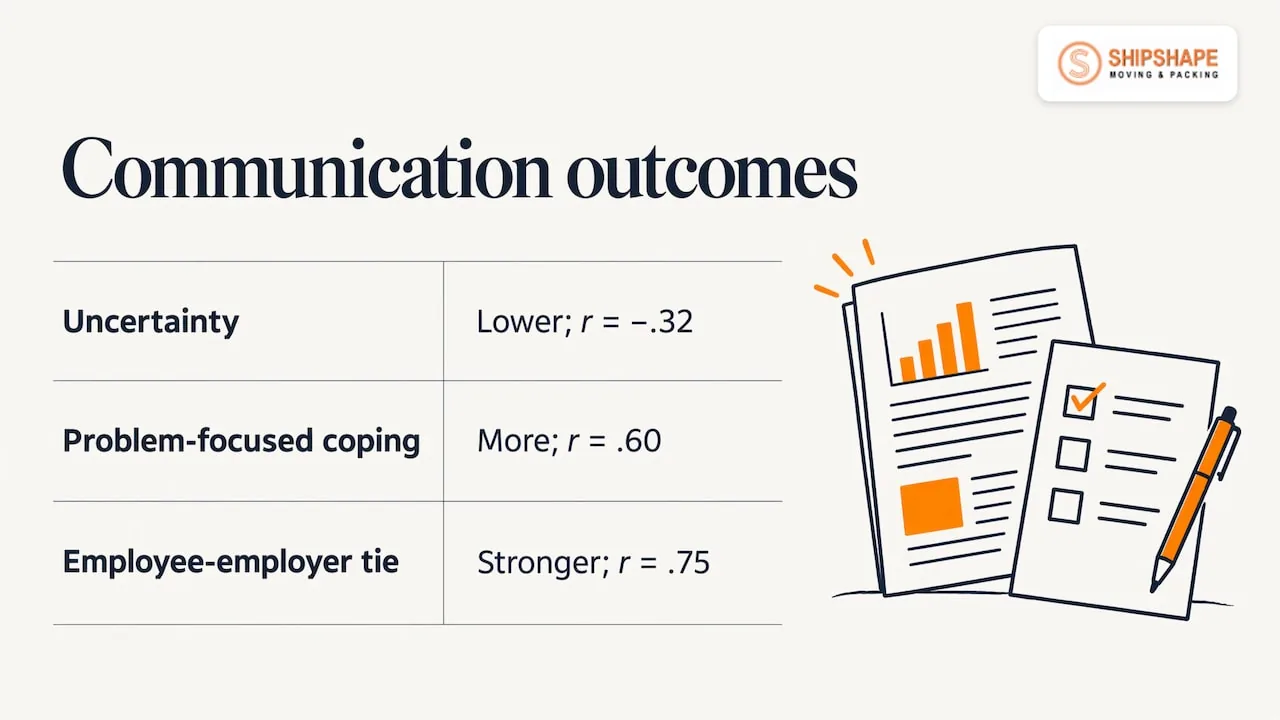
A 2020 study in Public Relations Review surveyed 490 full-time U.S. employees. It found that transparent internal communication was linked to lower uncertainty about organizational change (r = -.32), to more problem-focused coping (r = .60) and to a stronger relationship between employees and their employer (r = .75), all reported in the published study. In plain terms: the more openly a company explains a change, the less anxious people are and the more they work on solving practical problems instead of worrying.
For a Bay Area business, the practical questions are specific. Does the commute from Oakland to a new San Francisco address change by BART or by car? Where do people park? Is the move happening during a work week or over a weekend? Your announcement has to answer those before employees start guessing.
Build the communication plan before you announce anything
Employees notice when a first announcement arrives without a plan behind it. Spend a short planning session settling four things.
Pick a point person and a small committee
One person owns the schedule and the message. A planning committee with a representative from each department gives employees someone they already trust to ask. LERDAHL’s guide for operations and HR leaders recommends exactly this kind of structure, along with high-level updates for remote team members.
Choose one source of truth
Decide where the current version of every date lives: a shared page, an intranet post or a pinned message. Every email and announcement points back to it. When something changes, you edit one place instead of correcting five.
Use three status labels for dates
Officedays’ office move communication plan (October 2026) suggests marking each date Provisional, Confirmed or Changed. It also warns against letting a planned completion date quietly turn into a confirmed arrival date for staff. If your lease handover slips, employees should hear which date moved, not discover it at the door.
Set a rhythm
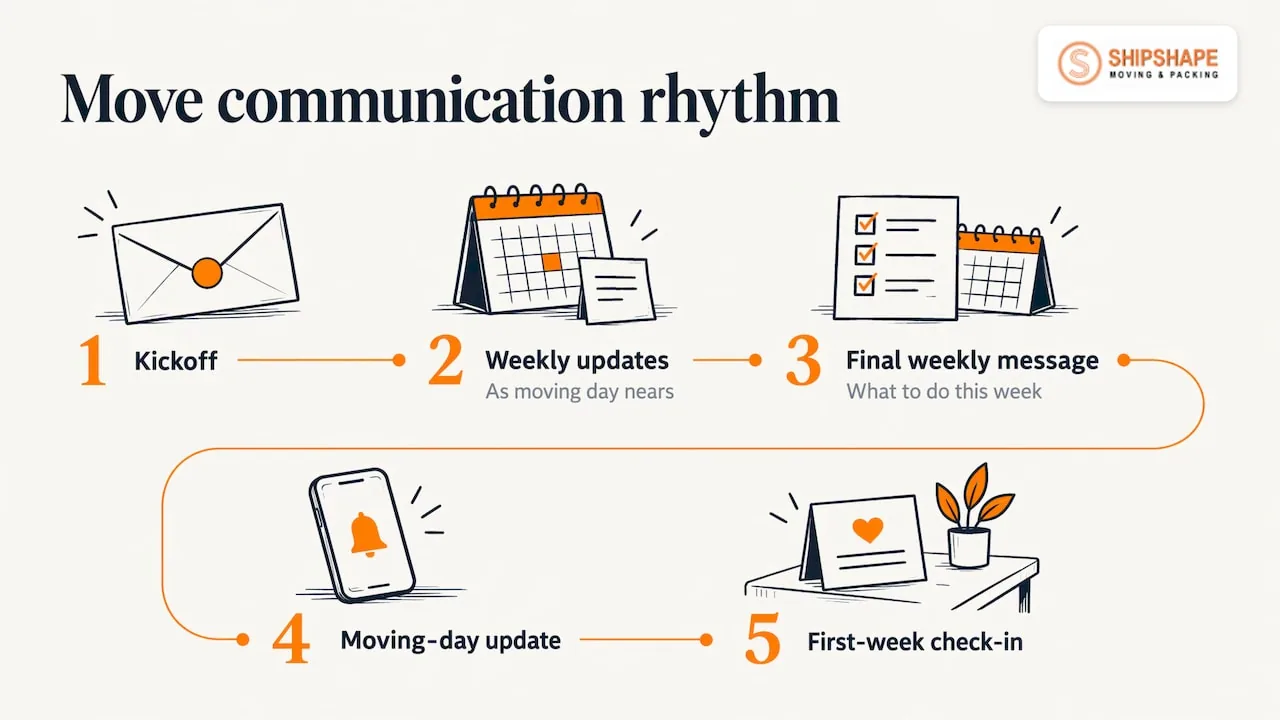
Pick a cadence and keep it: a kickoff message, short weekly updates as the move nears, a final “what to do this week” message, a moving-day update and a first-week check-in. Too little communication leaves people feeling ignored, and too much trains them to skim. Short, predictable messages avoid both.
What the first announcement should say
The kickoff message sets the tone. Cover these points, in this order:
- The reason for the move. Lead with the “why”: growth, a lease ending, a better layout or a cost decision. If the reason is cost, say so. Employees respond better to a plain explanation than to a polished one that leaves out the real reason.
- The new address and how it affects the commute. Mention transit access, parking and any change in the daily route in plain terms.
- The timeline. Give the target move window, labeled provisional or confirmed.
- What changes for each person. Seating, shared spaces, equipment and whether any team works remotely during the move.
- Where updates will appear and who to ask. Name the source of truth and the point person.
- What happens next. Promise the date of the next update, then send it on that date.
Keep it short. A kickoff email with the key dates, followed by brief bulleted updates, is easier to act on than a long memo. If you have floor plans or renderings of the new space, attach them: people relax once they can picture their desk.
Tell outside parties too
Employees are only one audience. Clients, vendors, your bank, your insurer and the Post Office all need your new address. Send the notices once the date is confirmed rather than provisional, and keep a simple list of who has been told. Your own team will be asked where to send mail and deliveries, so give them one line they can repeat.
Matching the message to the channel
Different messages belong in different places. A table helps the committee decide quickly.
| Message | Best channel | Why |
|---|---|---|
| The reason for the move and the big picture | Team meeting or town hall with Q&A | People can ask questions and hear the tone |
| Key dates and deadlines | Email, then the shared source of truth | Easy to find again |
| What each person must pack and label | Short written instructions with a labeling guide | Reduces mistakes on move day |
| Schedule changes | The source of truth, plus a direct message | One maintained version, plus a nudge |
| Remote and hybrid staff updates | High-level email or video update | Keeps them included without overload |
| Moving-day logistics | A message sent to everyone the day before | Fresh and easy to act on |
Use more than one channel for anything that matters. An email reinforced by a team meeting and a posted sign is more likely to be remembered than any single message.
Answering questions without guessing
Questions will arrive whether or not you invite them. Decide in advance who answers what: managers explain how the change affects team schedules, HR handles personal and support questions, and facilities or the office manager answers building access and parking. When a question has no answer yet, say so, say who is finding out and when you will report back. A promised update that arrives on time builds more trust than a confident guess that turns out wrong.
Hold a Q&A session with management, then follow it with a written FAQ so people who missed it get the same answers. Give managers a short guide on what they can decide themselves and what they should refer to HR.
Some employees will have personal questions about a longer commute or a changed schedule. Offer a private way to ask, such as a direct message or a short conversation with a manager. People rarely raise these in a group.
When the move affects where people live
If the new location is far enough that some employees are considering a change of home, even a temporary one, they will want to compare short-term options early. A guide to corporate housing versus monthly rentals explains the trade-offs in plain terms and gives a manager something concrete to share when the question comes up.

Moving day: communication that keeps the day on schedule
Moving day goes smoothly when the people moving your furniture, the people packing their desks and the building manager all work from the same schedule.
Before the crew arrives
- Tell employees exactly what they must do: empty desks, pack personal items, label boxes with name and new location.
- Confirm freight elevator or loading dock access with both buildings and share the timing with your movers. Our guide to loading dock scheduling for a move covers how to approach it.
- Share a floor plan so crews know where each department’s items go.
- Set up a way for the old and new sites to talk to each other during the move. Phones are usually enough.
- Tour the new space with your committee before the day so questions about layout are already answered.
During the move
Send a short message at the start of the day confirming the plan, and one when the final items have arrived. If something changes, say what changed, which space employees can use meanwhile, what to do instead and when the next decision will be published. That structure comes from the same Officedays guidance on delays.
Expect some things to change. As one federal agency CIO put it in FedTech Magazine’s report on office moves, the message should include the need to stay flexible, not only a fixed plan. The goal on the first morning back is that people know where to go and what to do, so the day feels like business as usual.
Giving your movers what they need
Your moving crew is part of this communication chain. A short brief with the address, contact person, access instructions, floor plan and department order lets them work without stopping to ask. Our office move checklist for Bay Area businesses lists what to gather, and our guide to small office move planning in Oakland walks through the steps for smaller teams.
If your move involves a licensed mover, you can confirm the company is authorized to operate in California using the license search on the Bureau of Household Goods and Services site. The bureau regulates household goods movers within the state.
After the move: keep communicating
The move is not finished when the last box arrives. Kastle’s office relocation checklist points to a few first-week priorities:
- Confirm that every employee can get into the building before the first morning.
- Check that internet, phones, printers and access readers work.
- Walk the space for damage or missing items.
- Ask employees for feedback during the first week and address small issues promptly.
Send a welcome message with the practical details people will need: where the break room and meeting rooms are, how to book a meeting room, what the emergency procedures are and which nearby spots are handy for lunch or coffee. Then close the loop. Tell people which issues you fixed, which are in progress and when you will update them again.
A thank-you message to everyone who helped is worth sending. It marks the end of the project and gives the team a shared sense of finishing something together.
How ShipShape fits into your communication plan
A clear internal plan is easier to carry out when the crew handling your belongings follows the same schedule. Our office relocation service is staffed by full-time ShipShape employees, never subcontractors, and every mover is background checked before their first job. Office and retail moves are planned around your operating hours, so your messages to employees and our schedule match.

If packing is part of your plan, we also offer packing services with labeling. For local moves, our published rates are $190/hr for 2 movers, $260/hr for 3 movers and $330/hr for 4 movers by card, and paying cash is $10/hr less than the card rate. There is a three-hour minimum and a one-time $80 truck fee. To plan your own move date and crew size, get a free quote. We are a licensed mover under California household goods permit MTR 0192323, and our USDOT number is 3549568.
Our perspective on office move communication
We are movers, so we see an office move from the loading ramp, and the lesson that applies most to communication is simple: a move runs on information as much as on trucks.
Our crews are full-time ShipShape employees. That matters for communication because the people you briefed before the move are the people who show up. Every mover is background checked before their first job, so you can tell your staff who will be handling their equipment.
We would encourage you to send your movers the same facts you send your employees: the address, the contact person, the access details, the order of departments and the floor plan. When your team knows what to pack and your crew knows where to take it, the day is calmer for everyone.
Our trucks carry moving blankets, stretch wrap, dollies, straps, floor and door-frame protection and wardrobe boxes. Your part is making sure employees have labeled and packed what is theirs. If you tell them how, ahead of time, they will do it.
Free quotes are the easiest way to begin. Tell us your move window and your building access, and we can help you build a schedule your messages can follow.
Dennis
FAQ
When should we announce an office move to employees?
Announce it as soon as the decision is final and you can explain the reason, even if some details are still provisional. Label unconfirmed dates as such and promise a date for the next update. Employees handle uncertainty better when they hear about it early than when they find out through rumor.
What should an office move announcement include?
Include the reason for the move, the new address, how it affects the commute, the timeline, what changes for each person and where future updates will appear. Name the point person for questions. Keep the first message short and follow with a Q&A session and a written FAQ.
How do we communicate with remote or hybrid employees?
Send them the same key dates and reasons as everyone else, in a shorter high-level format, and tell them whether the move changes anything for them, such as desk booking or equipment. Include them in Q&A sessions by video so they hear the same answers at the same time.
How do we handle schedule changes on moving day?
Post the change in your single source of truth and send a direct message. Say what changed, which space employees can use, what to do instead and when the next decision will be shared. Share the revised timing with your moving crew at the same time.
Who should coordinate with the movers?
One person, usually the office manager or the project lead, should be the contact for the moving company. That person shares the floor plan, access details and schedule, and relays changes between the movers and your internal team.
Sources
- Employee coping with organizational change in the face of a pandemic (Public Relations Review, 2020)
- How to Prep Your Team for an Office Move or Remodel (LERDAHL)
- Office Move Communication Plan: Timeline and Templates (Officedays, 2026)
- How DOD, NSF Managed Office Moves Without Tech Disruptions (FedTech Magazine, 2020)
- Office Relocation & Office Move Checklist Guide (Kastle)
- Monthly Rentals vs. Corporate Housing: Your Complete Relocation Guide