Small Office Move Planning: A Step-by-Step Guide for Oakland

A small office move goes well when you settle the lease, the building rules and your internet service first, then book a licensed crew, then pack by desk and label everything. Do the long-lead items early and the physical move becomes the easy part. This guide gives the order of work for Oakland and Bay Area teams.
Key Takeaways
- Start with the paperwork that takes longest: your lease end date, the new building’s move rules and your internet and phone service.
- Name one person as move coordinator, and give every employee a short, clear task list for their own desk.
- Hire a mover with a California household goods permit and a written not-to-exceed quote, and check the permit on the state’s Bureau of Household Goods and Services site.
- Back up your data, restore a test file, and carry keys, access cards and chargers yourself.
- After the move, update your business address with the state and city so notices and renewals reach you.
Table of Contents
- Why a small office move needs its own plan
- Start with the lease and the building
- Name a coordinator and set the budget
- Book internet and phone service early
- Build an inventory before you ask for quotes
- Get a written quote from a licensed mover
- Plan the move around your operating hours
- Tell your team and your customers
- Pack by desk and label by room
- Protect your data before the move
- Items to sort out before moving day
- Moving day
- After the move
- Let us handle the physical move
- Our perspective on small office moves
- FAQ
- Sources
Why a small office move needs its own plan
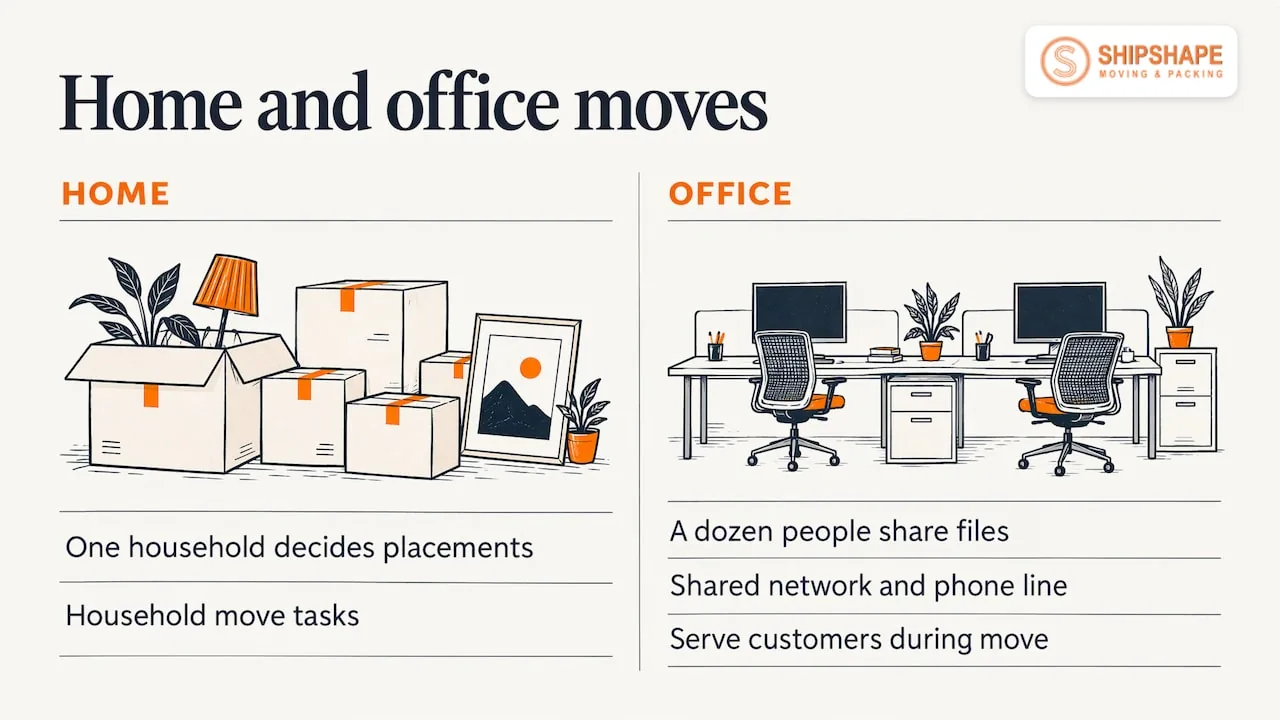
A house move and an office move look alike from the curb, but the work is different. In a home, one household decides what goes where. In an office, a dozen people share one set of files, one network and one phone line, and the business has to keep serving customers while it changes address.
A small office usually has no facilities department and no IT department. Someone on the team, often the owner or office manager, ends up running the move on top of their normal job. That is why a plan with a clear order of work matters more than a long checklist: it tells you what to do first, what can wait and what to hand off.
If you want a full task list to print, our office move checklist for Bay Area businesses covers it item by item. This article explains the planning behind that list, so you know why each step sits where it does.
Start with the lease and the building
Before you pick a mover or a date, read two documents: your current lease and the new building’s rules.
Your current lease. Find the end date, the notice you must give the landlord and what the lease says about leaving the space in its original condition. Photograph the old office before you pack, so you can show its condition when you hand back the keys.
The new building’s rules. Many Oakland office buildings, from Downtown and Jack London Square to Uptown and Temescal, manage loading through the property manager. Ask the manager in writing about:
- Which entrance, elevator and loading area movers may use
- Which hours moves are allowed
- Whether the building needs a certificate of insurance from your mover before the crew can enter
- Whether the elevator can be reserved for your move
- Where the truck can park
A building that requires a certificate of insurance expects your mover to supply it, so ask the mover about it when you request your quote. Our guide to moving company insurance explains what the term means and why buildings ask for it. For the dock and elevator side, see loading dock scheduling for a move.
Name a coordinator and set the budget
Pick one person to own the move. That person keeps the master schedule, talks to the landlord, the mover and the internet provider, and answers staff questions. Without one owner, the same question gets asked of three people and answered three ways.
Then set a budget with room for surprises. List the costs you can already see:
- Moving labor and the truck
- Packing materials, or packing labor if you hire it
- Internet, phone and cabling at the new space
- New signage, keys and access cards
- Reprinted stationery, business cards and your website address
Add a cushion for what you will miss. Most small offices find a few things after the move starts: a cabinet that needs to be taken apart, a lock that needs rekeying, a delivery that arrives early.
Book internet and phone service early
This is the step small offices most often leave too late. A new internet line is not something a provider can switch on the day you arrive. It usually needs an order, a site visit and sometimes new wiring in the building. If the line is late, you may open the new office with no way to take card payments, answer calls or reach cloud files.
So order service as soon as you have a signed lease. Ask the provider for a confirmed activation date, not an estimate, and write it into your schedule. Keep a mobile hotspot charged as a fallback, and decide in advance who works remotely if the line is not ready.
One honest limit on how we can help here: our crews move your furniture, equipment and boxes. Your internet provider or IT contact handles the line, the router and the network, so line them up separately and early.
Build an inventory before you ask for quotes
A mover can only quote what it knows about. Walk the office with a notepad or phone and list:
- Desks, chairs, tables and shelving, with rough sizes
- Filing cabinets and storage units
- Computers, monitors, printers and phones
- Boardroom or reception furniture
- Anything heavy, fragile or high-value, such as a safe, artwork or lab equipment
- Anything that will not come to the new space and should be donated, recycled or disposed of
An inventory also helps you decide what to leave behind. Moving a broken chair costs the same labor as moving a good one. Offices that clear out old files and unused furniture before the move pay for fewer hours of work.
Use the same list on delivery day to check that every item arrived. If something is missing or damaged, tell the mover in writing and follow the claim steps in your contract.
Get a written quote from a licensed mover
In California, companies that move household goods need a permit from the state’s Bureau of Household Goods and Services. You can look up a mover’s permit on the bureau’s website before you sign anything. ShipShape Moving holds California household goods permit MTR 0192323 and USDOT number 3549568.
When you compare quotes, compare the same things:
- Crew size and the number of trucks
- Whether the price is an hourly rate, a flat figure or a not-to-exceed figure
- Whether packing, furniture disassembly and floor protection are included
- Whether the mover supplies the building’s insurance certificate
- Any deposit needed to hold your date
We give written not-to-exceed quotes, and you can get a free quote for your office once you have your inventory and the new building’s rules in hand.
What the hourly rate covers
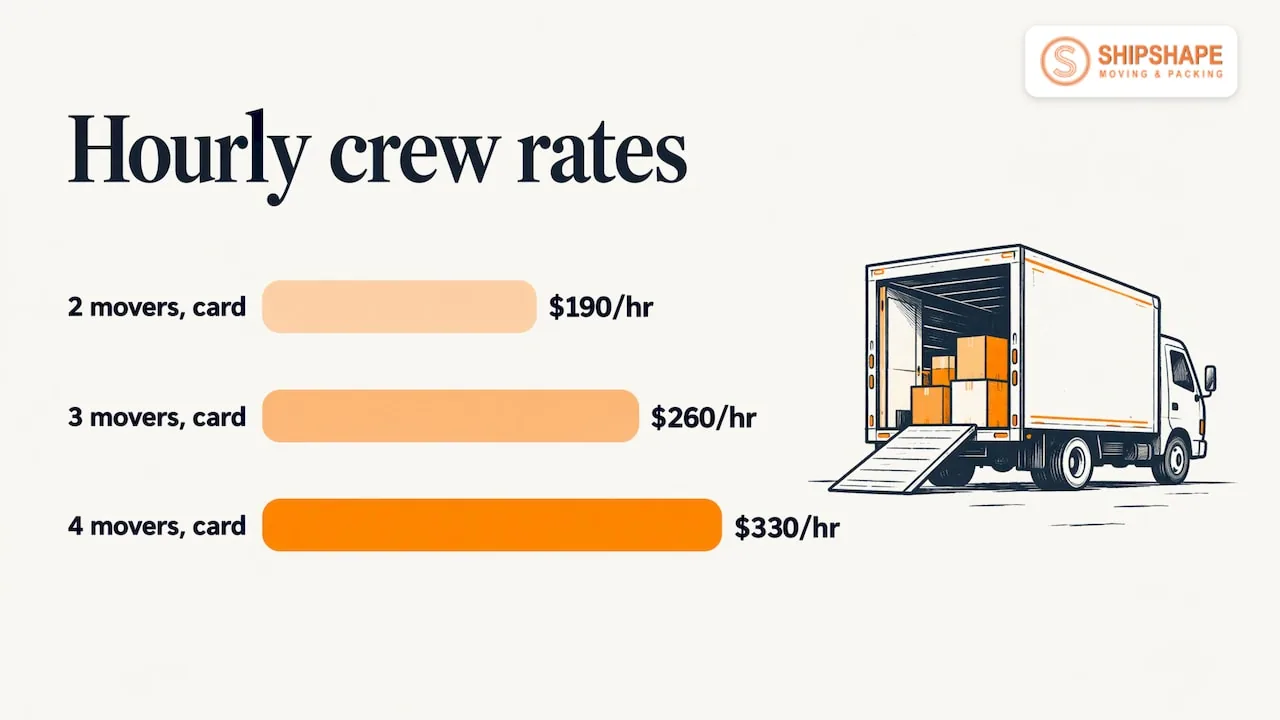
Our local moves are billed by the hour, by card, at $190 an hour for 2 movers, $260 an hour for 3 movers and $330 an hour for 4 movers. Paying cash is $10 an hour less than the card rate. There is a three-hour minimum and a one-time $80 truck fee. A small office with a handful of desks and a few filing cabinets will usually want a smaller crew, while a suite with a reception area and a conference room may justify a larger one. Your quote shows which fits.
Crew and trucks
Everyone who comes to your office is a full-time ShipShape employee, never a subcontractor, and every mover is background checked before their first job. That matters in an office, where crews pass client files, laptops and personal items on desks. Our fleet is five 26-foot box trucks, each with a loading ramp and stocked with moving blankets, stretch wrap, dollies, straps, floor and door-frame protection, wardrobe boxes and tools to take apart and reassemble furniture.
Plan the move around your operating hours
The best moving time is the one that costs your business the least. For a retail counter or a clinic, that is different from a design studio where people can work from home for a day. Decide:
- Which days your customers can live without you
- Which staff must be present when the crew arrives
- Which equipment needs to be running until the last moment, such as the phone system or point-of-sale terminal
We plan office and retail moves around your operating hours, so tell us when you can close and when you must be open. Then tell your landlord, since the building’s rules for loading hours may narrow the choice.
For other types of workplace moves, see our commercial moves page, and our office relocations page for what we handle.
Tell your team and your customers
Employees do better with a short, specific message than a long, general one. Well before the move, send a one-page note that covers:
- The move date and the first day at the new address
- When computers will be disconnected
- What each person packs, and what they leave for the crew
- How to label boxes
- Who to ask if something goes wrong
Tell customers and suppliers the new address and any day you will be closed, before you move and again after. Update your Google Business Profile, website, email signatures, invoices and any directory listings the same week you arrive.
Pack by desk and label by room
Each person packs their own desk. Nobody else knows what is in a drawer, what is private and what can be thrown out. Give people boxes and labels and ask them to:
- Label each box with the new room and the owner’s desk or name
- Never write sensitive contents on the outside, such as “payroll” or “client contracts”
- Keep valuables, personal electronics and cash with them
- Empty filing cabinets before the move, since loaded cabinets are heavy and can be a hazard to lift. Schoolcraft College’s move management process requires staff to empty storage units for this reason, and the same sense applies to a small office.
- Tape keys for any lockable furniture inside it, or leave them in the lock
If your team does not have time to pack, or you have fragile or high-value items, we offer packing services, and our packing supplies checklist lists what to gather first. For artwork, collections and equipment that needs extra care, our white glove service is built for valuables.
Protect your data before the move
Equipment can be replaced. Business data is harder to recover. In the days before the move:
- Back up every computer, shared drive and cloud account
- Restore a test file from the backup, to prove it works
- Photograph the back of each workstation, so cables go back where they came from
- Photograph existing damage to furniture and walls at both addresses
Do not rely on the message “backup complete” alone. A restored test file is the proof.
Pack an essentials box that you carry yourself, not on the truck: keys, access cards, chargers, a printed contact list, a few tools and a spare power strip.
Items to sort out before moving day
Ask your mover for the list of items it cannot transport, and ask in writing. Movers generally do not take hazardous materials such as flammable liquids, certain cleaning chemicals or compressed gas. Check the supply closet, the break room and any workshop or lab area, and plan separate disposal or transport for anything on the list.
Also decide what you will carry personally: cash, checks, important legal documents, hard drives with the only copy of company data, and anything that would be hard to replace.
Moving day
On the day, the coordinator stays on site at the old office and a second person meets the crew at the new one. Here is how a small office keeps the day calm:
- Walk the crew through the old office and point out anything fragile or off-limits
- Confirm the building contact at both ends and the elevator reservation
- Shut down equipment in order, starting with computers and ending with the network
- Supervise loading against your inventory
- Check closets, bathrooms and storage areas for leftovers before the last box goes out
- At the new office, show the crew a floor plan with room labels and let them place furniture where it belongs
Our crews bring floor and door-frame protection and tools to take apart and reassemble furniture, so desks and shelves arrive ready to use.
After the move
Before staff arrive the next working day, power up equipment, test the internet, phones, printers and shared drives, and check delivered items against your inventory. Report missing or damaged items to the mover in writing, following the time frame in your contract.
Then update the places that keep your address on file:
- The California Secretary of State: update your business address through the state’s online business filing system
- Your city: if you have a business tax certificate in Oakland, Berkeley, San Francisco or another Bay Area city, contact that city’s business tax office through its official website to update the location
- Your bank, insurer, payroll provider, landlord and licensing bodies
- Your website, Google Business Profile and printed materials
Ask for feedback from your team a few days later. Small problems like a bad Wi-Fi corner or a missing cable are easier to fix when everyone reports them early.
Let us handle the physical move
If your plan is in order and you want the lifting, loading and furniture assembly handled, our office relocation team can take it on. We move small offices, retail spaces and clinics around the Bay Area, from Oakland and Berkeley to San Francisco, San Mateo, Palo Alto and San Jose. Local moves are billed by the hour at $190 for 2 movers, $260 for 3 movers and $330 for 4 movers by card, cash is $10 an hour less, with a three-hour minimum and a one-time $80 truck fee. Request a free quote and we will put a written not-to-exceed figure in front of you.

Our perspective on small office moves
We think the hardest part of a small office move is not the lifting. It is that everyone on the team is still doing their regular job while the move happens.
That is why we encourage people to plan the order of work first: lease, building rules, internet, inventory, quote. Once those are settled, the move day itself is a matter of crews, trucks and labels.
Our crews are full-time ShipShape employees, never subcontractors, and every mover is background checked before their first job. For an office, where crews are near client files and equipment, we think that is the right way to staff a move.
We also believe in clear pricing. Our hourly rates are published, with a three-hour minimum and a one-time truck fee, and we give written not-to-exceed quotes so there is no guessing about the final bill.
If you are weighing a move, send us your inventory and your building’s rules and we will tell you how we would crew it.
Dennis
FAQ
How early should I start planning a small office move?
Start as soon as you have a signed lease or a firm decision to move. The items with the longest lead times are the internet and phone service, the building’s move approvals and your lease notice, so deal with those first. Booking your mover can follow once you know your dates.
Do my employees have to pack their own desks?
It works best when they do. Each person knows what is in their drawers and what is private. Ask them to label boxes by new room and desk, keep valuables with them and leave sensitive details off the outside. If your team is short on time, you can hire packing help.
What should I ask a mover before booking an office move?
Ask for the permit number and check it with the state’s Bureau of Household Goods and Services. Ask whether the quote is not-to-exceed, what crew and truck are included, whether the building’s insurance certificate is covered and whether there is a deposit. Ask also for the list of items the crew cannot transport.
Can the move happen without closing the office?
Often a small office can close for part of a day instead of a full one. Tell your mover when you must be open, and ask the landlord which hours loading is allowed. We plan office and retail moves around your operating hours.
Sources
- California Bureau of Household Goods and Services
- California Secretary of State, business filing system
- Schoolcraft College, Move Management Process (2025)