How to Pack Artwork for a Move in the Bay Area
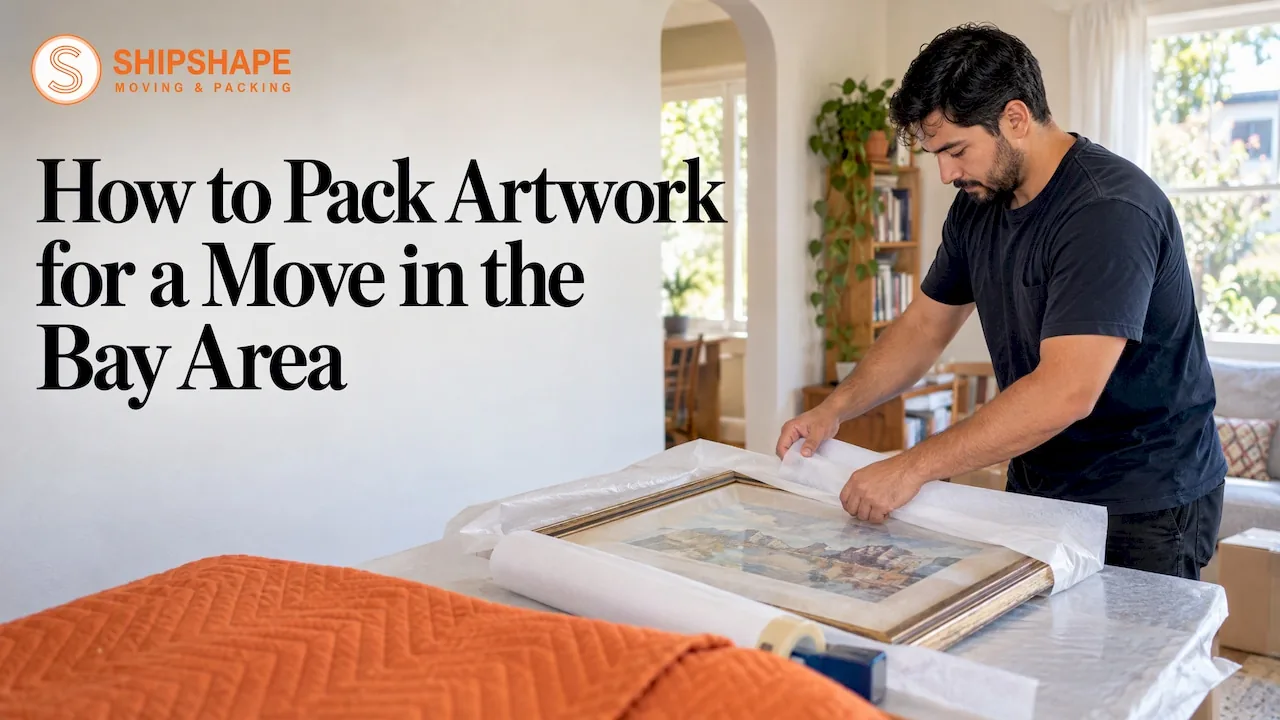
To pack artwork for a move, protect the surface first, add rigid support around the frame, cushion the corners, and make sure the piece rides upright and snug, never loose and never squeezed. Conservation institutes and art insurers agree on those basics, and they work whether you are carrying a framed print down a Temescal stairwell or sending a large canvas across the state. For valuable or oversized pieces, the safest route is a full-service crew that handles them with white glove care. Our white glove moving service is built for that kind of handling.
This guide walks you through the whole process in the order you will do it, with the Bay Area details that change how you plan: narrow stairs, hillside streets, and tight apartment buildings.
Key Takeaways
- Protect the surface first, then add rigid support, then cushioning. Order matters more than how much bubble wrap you use.
- Glass is the main hazard. Tape it, remove it where guidance allows, or replace it with a safer glazing before the move.
- Pastels, textured paintings and unframed canvases each need different wrapping, so sort your pieces before you buy supplies.
- Large, heavy or very valuable works may need a custom crate or a conservator’s advice, not a stack of boxes.
- Photograph and list every piece before packing and again on arrival, so any change in condition is documented.
Table of Contents
- Sort Your Artwork Before You Buy Supplies
- Gather the Right Materials
- Prepare the Piece
- Wrap and Pack Step by Step
- When a Custom Crate Makes Sense
- Load and Transport Artwork Safely
- Bay Area Details That Change Your Plan
- Insurance and Paperwork
- Let a Crew Handle the Pieces That Matter Most
- Our Perspective on Moving Art
- FAQ
- Sources
Sort Your Artwork Before You Buy Supplies
Not every piece in your home needs the same treatment. Spend ten minutes walking through your apartment or house and sorting each piece into a group. That tells you what to buy and where to ask for help.
| Type of piece | Main risk | What it needs |
|---|---|---|
| Framed print or poster behind glass | Broken glass scratching the image | Glass taped or removed, rigid backing, corner protection |
| Framed painting with acrylic glazing | Scratches and static | Acid-free tissue over the glazing, rigid cardboard, cushioning |
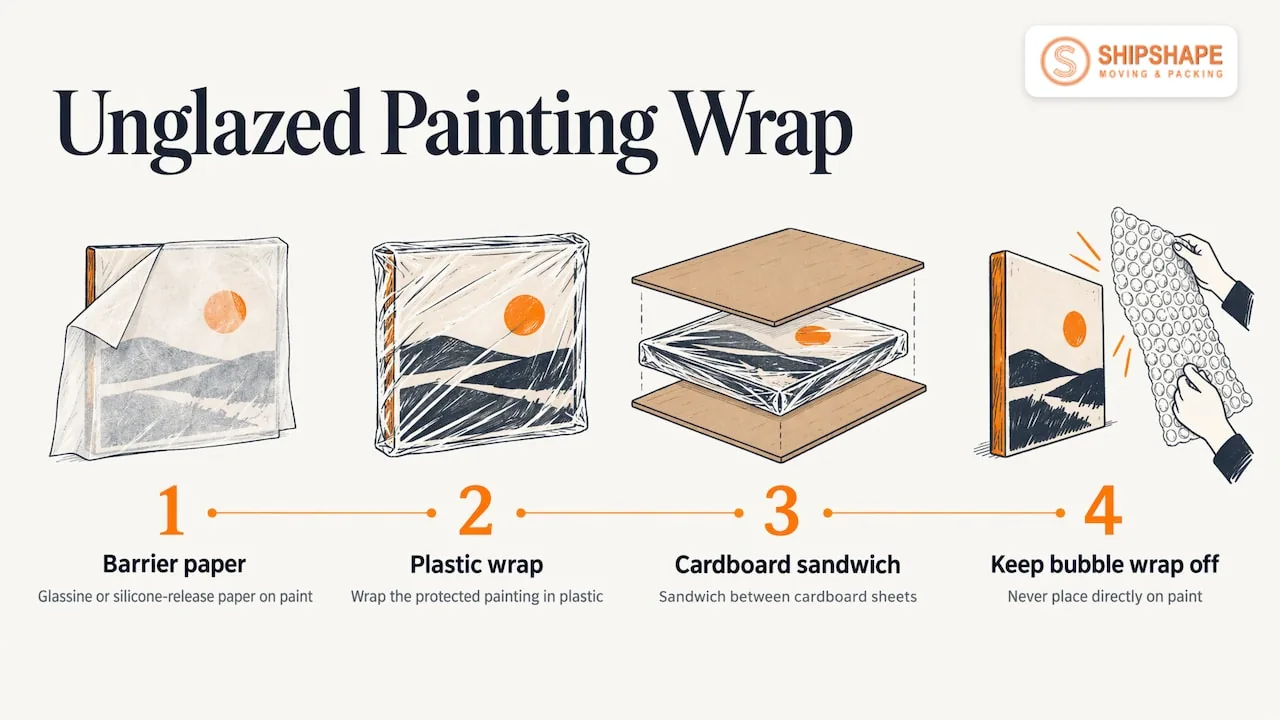
| Unglazed oil or acrylic painting | Surface abrasion and sticking | Glassine or silicone-release paper, then plastic, then cardboard |
| Pastel or charcoal work | Dust loss from vibration and static | Glass glazing rather than plastic, kept flat in transit |
| Unframed or fragile-framed canvas | Flexing and frame damage | A travel frame or rigid support |
| Large, heavy or high-value piece | Handling and structural stress | Professional handling, possibly a custom crate |
Photograph each piece front and back in good light, and write down its size and any existing damage. Insurers that cover art recommend making an inventory and noting the condition of each piece before packing and again on arrival. If you are shipping something rather than carrying it, this cushioning and drop-test guidance shows how to judge whether a package is protected well enough.
If you own a mix of antiques and art, our guide to moving antiques covers frames, gilding and furniture alongside the pieces on your walls.
Gather the Right Materials
The Canadian Conservation Institute’s note on wrapping a painting lists bubble wrap or thin closed-cell foam, clear plastic sheet, rigid cardboard, low-tack glass tape and cushioned corner covers as the core materials. Add these to your list:
- Acid-free tissue or glassine paper for the surface layer
- Rigid cardboard sheets or flat picture boxes sized to the piece
- Painter’s or glass tape that releases cleanly
- Corner protectors
- Soft gloves and a clean, flat table
- A marker and labels
Skip newspaper and ordinary packing paper against a painted surface. Ink and rough fibers do not belong near paint. For a full list of the general supplies a household move needs, see our packing supplies checklist, and our guide to moving box sizes helps with the flat and wardrobe-style boxes that work for mid-sized frames.
Prepare the Piece
Set up a flat work area clear of sharp or loose objects. National Gallery Singapore’s packing guide says to remove rings, watches and jewelry, check that the framed painting is stable, and get help if the piece is too large or heavy before you start.
Check the frame
Look for splits, warps or loose joints. The Smithsonian’s guidance on framing says frame members should not have splits, warps or delamination that make the structure unstable. A wobbly frame can fail under its own weight when lifted, so handle that piece with extra support, or treat it as a fragile-frame piece and use a travel frame.
Deal with the glass
Glass breaks in transit and the shards are what damage the artwork. You have two approaches:
- Tape the glass. National Gallery Singapore recommends glass tape on glass glazing so the shards stay together if it breaks. The Canadian Conservation Institute adds that low-tack tape on non-laminated glass can help hold shards, but it should be removed carefully after travel because it can damage coatings.
- Remove the glass. The Smithsonian repository guidance says to remove glass before packing unless it is laminated safety glass or clear plastic glazing. If you remove it, wrap the glass separately and label it with the artwork it belongs to.
For acrylic or styrene glazing, lay acid-free tissue over the surface rather than tape. Tape can mark plastic.
Handle pastels differently
Pastel and charcoal sit loosely on the paper. Chubb’s art-moving guide says pastels should be framed with glass instead of Plexiglas, because plastic’s static charge can attract pastel dust, and pastels travel more safely flat. Plan for these pieces to ride flat, not on edge among your framed prints.
Wrap and Pack Step by Step
Framed work behind glass
- Lay the piece face up on a clean surface and tape the glass if you are keeping it in place.
- Cover the front with a sheet of clean paper or tissue so nothing touches the glass directly.
- Fit corner protectors on all four corners.
- Wrap the whole piece in bubble wrap or thin foam, smooth side toward the artwork, and secure it with tape on the wrap only, never on the frame or the artwork.
- Slide it between two sheets of rigid cardboard or into a flat picture box, and seal it.
- Mark the box “Fragile, artwork” and mark the top edge so it is always carried upright.
Unglazed paintings
Oil and acrylic paintings without glass need a barrier that will not stick to the paint. The Smithsonian-based guidance relayed by National Gallery Singapore points to glassine or silicone-release paper on unglazed paintings. Chubb’s version for flat-surfaced unframed paintings is to wrap them in glassine, then plastic, and sandwich them between cardboard sheets. Never put bubble wrap directly onto paint, especially thick or textured paint, since the pattern can press into the surface.
Unframed or fragile-framed pieces
The Canadian Conservation Institute lists a travel frame for a painting that is unframed or has a fragile frame, and notes it makes the painting stronger and more rigid during handling. A canvas that flexes when you pick it up is the one most likely to crack paint. Do not roll it, and do not carry it alone.
Do not over-tighten
Snug is the goal. The University of Melbourne’s transport guidance stresses reducing vibration and movement while avoiding excessive tightness, since pressure itself can permanently damage an object. Wrap firmly enough that nothing shifts, but never cinch straps or tape across the artwork.
When a Custom Crate Makes Sense
Cardboard and foam are fine for most prints and mid-sized framed pieces. Crating enters the picture when a piece is large, heavy, fragile, very valuable or traveling far. A Canadian moving-industry tip sheet recommends a wooden crate built to the painting’s dimensions for maximum protection, and professional consultation for long-distance or multi-piece moves. The Canadian Conservation Institute says large, heavy, fragile or unstable paintings may need special preparation or support, and recommends consulting a conservator if you are unsure.
If you own a work you could not replace, such as an original, a family heirloom or a piece with a formal appraisal, talk to a conservator or the art’s insurer before moving day. Then tell us about it when you request a quote, so the move is planned around that piece from the start.
Load and Transport Artwork Safely
Packing is half the job. The other half is how the piece rides.
- Keep paintings on edge, not flat, and not under other items. Pastels are the exception: keep them flat.
- Load them last in and first out where possible, so nothing is stacked against them during the day.
- Secure them to the truck wall. Chubb advises a truck with a working lift gate, functioning locks and climate control, with pieces strapped snugly to the walls.
- Separate artwork from furniture with moving blankets and padding so a corner of a dresser never meets a frame.
- Check against your inventory on arrival, and photograph anything that looks different before it is unwrapped.
Our trucks are 26-foot box trucks, each with a loading ramp and stocked with moving blankets, stretch wrap, dollies, straps, and floor and door-frame protection. Those are the items that keep a wrapped piece from moving or scraping on the way through a doorway.
Bay Area Details That Change Your Plan
A move here has features that a generic national guide skips.
Oakland. Many older homes and apartment buildings in Temescal, Rockridge, Adams Point and around Lake Merritt have narrow stairways and tight turns. Measure your largest piece, wrapped, against every doorway and landing on the route before moving day. A wrapped frame is thicker than a bare one, and a piece that fits unwrapped may not turn a corner once padded. If it will not fit, decide ahead of time whether to move it through a window or to bring in a crew experienced in handling awkward items.
Berkeley. Many homes in the hills sit up steep steps from the street. Carry paths are longer than they look from the curb, so plan to wrap each piece fully before it leaves the house, not at the truck.
San Francisco. Parking and loading access shape the day. Our guide on how to prepare for moving day in San Francisco covers what to arrange with your building, and it applies to how long your artwork sits in a hallway or on a curb.
Moving between cities. If you are relocating into the Bay Area from elsewhere or heading out of state, long distance moving means longer time in the truck, and that is when custom crating matters most.
Insurance and Paperwork
Before moving day, find out what your homeowner’s or renter’s policy says about art, and whether a high-value piece needs separate coverage. Our guide to moving company insurance explains the terms you will see on a quote. Keep your inventory photos, receipts and any appraisals in one place you can reach during the move.
Let a Crew Handle the Pieces That Matter Most

Packing one print yourself is simple. Packing a whole house of framed art, mirrors and fragile pieces on top of everything else is where mistakes happen. We offer professional packing and labeling and white glove handling for valuables, performed by full-time ShipShape employees, never subcontractors. Every mover is background checked before their first job.
Here is how the cost works. Our local moves are billed hourly by card at $190/hr for 2 movers, $260/hr for 3 movers and $330/hr for 4 movers, and paying cash is $10/hr less than the card rate. There is a three-hour minimum and a one-time $80 truck fee. You can see the full rates on our pricing page, and we provide written not-to-exceed quotes.

When you are ready to plan, get a free quote and tell us which pieces are artwork, how large they are and where they are going. We are a licensed Berkeley company, with California household goods permit MTR 0192323 and USDOT 3549568.
Our Perspective on Moving Art
Most damage to artwork during a move comes down to handling and planning, not the wrapping material alone. A good wrap can be undone by a crowded truck, a rushed carry down a staircase, or a piece nobody noticed was fragile until it was lifted.
That is why we put the people first. Our crews are full-time ShipShape employees, not subcontractors, and each mover is background checked before their first job. They work together on every move, and that consistency matters when a frame needs two sets of hands and a clear path.
Our trucks carry blankets, stretch wrap, straps, dollies, ramps, and floor and door-frame protection, which are the basics for keeping framed work steady and surfaces protected through Bay Area doorways and stairwells. For valuables, our white glove service gives those pieces dedicated care, and our packing service takes the wrapping and labeling off your list so you are not doing it at midnight before moving day.
Tell us about your art early. It lets us plan the order of the day around it.
Dennis
FAQ
Can I pack artwork in bubble wrap alone?
Bubble wrap is only one layer. Put clean paper or tissue between it and the artwork, add rigid cardboard for support, and use corner protectors. Bubble wrap pressed straight onto paint or a pastel can leave marks.
Should I take the glass out of a framed picture?
It depends on the glazing. Guidance from the Smithsonian repository is to remove glass unless it is laminated safety glass or clear plastic. If you leave it in, tape it so any shards stay together, and wrap the front with clean paper.
How should I move a pastel or charcoal drawing?
Keep it behind glass, not plastic, and keep it flat during transit. Static from plastic can pull dust off the surface, and vibration can loosen it further.
Do I need a crate for every painting?
No. Most mid-sized framed pieces travel well in rigid cardboard with cushioning. Large, heavy, fragile or very valuable works, and long-distance moves, are where a custom crate or a conservator’s advice comes in.
Sources
- Wrapping a Painting, CCI Notes 10/16, Canadian Conservation Institute
- How to Pack a Framed Painting, National Gallery Singapore
- Smithsonian repository framing guidance
- Getting Smart About Moving Your Art, Chubb
- Getting Smart About Moving Your Art, Chubb (2023 edition)
- Consumer Tip Sheet: Artwork and Sculptures
- Packing for Transport, University of Melbourne