How to Pack Kitchen Dishes for a Move Without Breakage
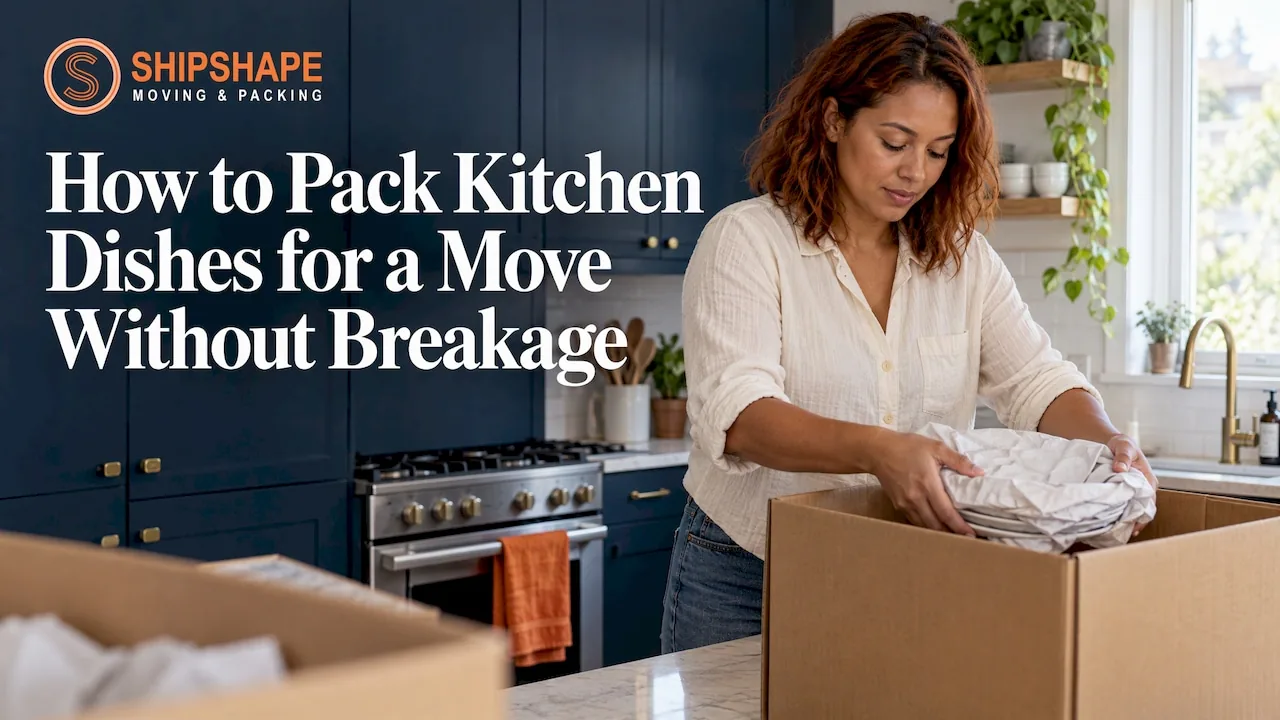
Pack kitchen dishes by wrapping every piece in plain packing paper, standing plates on their edges in a sturdy double-walled box, and filling every gap so nothing can shift. Glasses go in dividers or snug paper wraps. If you would rather hand the whole kitchen to a trained crew, our packing service does it for you.
Key Takeaways
- Wrap each dish individually in plain packing paper, and use bubble wrap or newspaper only as filler around the pieces.
- Plates are stronger on their edges, like records in a crate, so pack them vertically with paper between them.
- Empty space inside a box is what breaks dishes, so fill every gap before you tape the lid.
- Tape the bottom seam first, put heavy items low, and label every side of the box as fragile.
- Oakland, Berkeley and San Francisco moves often involve stairs, tight streets and carrying distance, so smaller, well-packed boxes make for a safer move.
Table of Contents
- Why Dishes Break in a Move
- Supplies for Packing Dishes
- Before You Wrap: Sort and Plan
- How to Pack Plates and Bowls
- How to Pack Glassware
- Packing China and Other Fragile Pieces
- Fill, Seal and Label the Box
- Packing Dishes for a Bay Area Move
- When to Let a Crew Pack the Kitchen
- Our Perspective
- FAQ
- Sources
Why Dishes Break in a Move
Dishes rarely break because of one big drop. They break because pieces rub, shift and press against each other for the length of a truck ride, on stairs, and through every hand-off. America’s Test Kitchen’s editors explain that negative space is the enemy in a box: gaps give fragile items room to move, and movement is what makes damage likely.
That idea drives every step below. A good dish box has four things: a firm container, a cushioned bottom, a snug wrap on each piece, and no loose space at the top or sides. If you get those four right, the exact wrapping style matters much less.
The second reason dishes fail is weight. A box of plates is far heavier than it looks, and a weak box bottom is where many boxes give out. Plan for small to medium boxes for heavy items, and save the larger ones for light things.
Supplies for Packing Dishes
Gather everything before you wrap the first plate. Stopping halfway to find tape is how people end up stacking unwrapped dishes in a drawer.
- Sturdy boxes. This Old House recommends medium double-walled boxes for dishes. Double-walled cardboard has two layers of corrugation, so it holds up to weight and stacking. Our moving box sizes guide shows what each size holds and which one suits heavy kitchen items.
- Plain packing paper. Use unprinted paper. Newsprint can leave ink on dishes, so keep it for filling gaps.
- Bubble wrap. Useful for stemware, heirlooms and as extra padding in the box.
- Cardboard dividers or cell inserts. These create separate compartments for glasses and mugs.
- Packing tape. Buy more than you think you need, because every seam gets reinforced.
- Markers and labels. Mark “Fragile” and “This Side Up” on more than one side of every box.
- Soft fillers. Dish towels, linens and t-shirts do double duty as padding and save you from buying extra paper.
For the full list across the whole house, see our packing supplies checklist.
Paper or bubble wrap?
Use paper against the dish and bubble wrap around it. This Old House notes that bubble wrap is hard to mold around dishes, so packing paper is the better direct wrap, while bubble wrap, newspaper or peanuts work as filler. Paper conforms to rims and handles, and it stays put. Bubble wrap can slide off a smooth plate.
Before You Wrap: Sort and Plan
Packing dishes takes longer than most people expect, so start with the kitchen’s least-used items. This Old House suggests going through each drawer, cabinet and pantry shelf first, then packing in stages, starting with nonessentials and leaving the everyday items for last.
A simple order works well:
- Sort. Set aside anything you no longer use. Chipped plates and mismatched mugs are not worth the box space or the moving time.
- Pack the occasional items first. Serving platters, holiday dishes, fancy glassware and china can go early because you will not miss them.
- Pack everyday dishes last. Keep what your household needs for the final days.
- Make an essentials box. Set aside a few plates, bowls, cups, utensils and a pot or pan for each person. This Old House recommends keeping a separate essentials box for the first days in the new home. Our unpacking checklist tells you what to open first after the truck is unloaded.
If you are working backward from a moving date, our house move checklist shows where kitchen packing fits in the schedule.
How to Pack Plates and Bowls
Plates and bowls are the heaviest and most breakable part of the kitchen, and they are also the easiest to get right once you know the method.
Build the box base
Tape the bottom seam of the box and run extra tape across it before anything goes in. Move.org’s guide makes the same point about weak box bases, and it is simple physics: dishes are heavy, and the bottom takes all the load. Then add a thick layer of crumpled packing paper on the floor of the box. America’s Test Kitchen calls this a paper bumper that absorbs shock from below.
Wrap in bundles
Martha Stewart’s guide describes a bundle method that works well for same-size plates. Wrap each plate in paper, stack a small group, then rewrap the whole stack in a fresh sheet and tape it. Keeping bundles small means you can lift them without strain and check that each one is tight.
To wrap a single plate:
- Lay a sheet of paper flat and place the plate near one corner.
- Fold the corner over the plate, then pull in the opposite sides, one at a time.
- Roll the plate toward the far corner, tucking the paper in as you go.
- Stack the next plate on top and repeat.
Bowls can nest, but put a sheet of paper between each one so the rims do not rub. Wrap a stack of nested bowls as one bundle, then add paper inside the top bowl so the bundle has no hollow space.
Stand them on edge
This Old House explains that plates are structurally stronger on their edges, like vinyl records. Packed vertically and snugly side by side with paper between them, the pressure spreads out and the chance of cracking drops. Flat stacking puts the weight of every plate on the one beneath.
Stand bundles upright on the paper layer, pack them close, and stuff the sides and top with crumpled paper. Give the box a gentle shake. If you hear or feel anything move, open it and add more paper.
Heavy items go low
The heaviest pieces, such as dinner plates and large platters, go at the bottom. Lighter bowls and saucers go above them. A box that is heavy on the bottom is more stable when stacked and less likely to crush what is inside.
How to Pack Glassware
Glasses fail at the rim and the stem, so the goal is support from the inside and the outside.
Drinking glasses and mugs
Crumple a few sheets of paper inside each glass so the walls are not left hollow. Wrap the glass in paper, then wrap it again. Cardboard dividers help because every glass sits in its own cell. Mugs can be wrapped one by one, with the handle padded with a little extra paper, because handles are the first part to snap.
Pack glasses upright if your dividers support them, or on their sides with the rim wrapped, according to the box design. What matters is that no glass touches another.
Stemware and wine glasses
This Old House gives a clear method for stemware. Crumple paper inside the bowl of the glass, lay the glass on its side across the corner of a sheet, roll the paper around it, fold the excess around the stem and bowl, and slide it snugly into a cell. Fill any open cells with bubble wrap or crumpled paper so nothing can move once the lid closes.
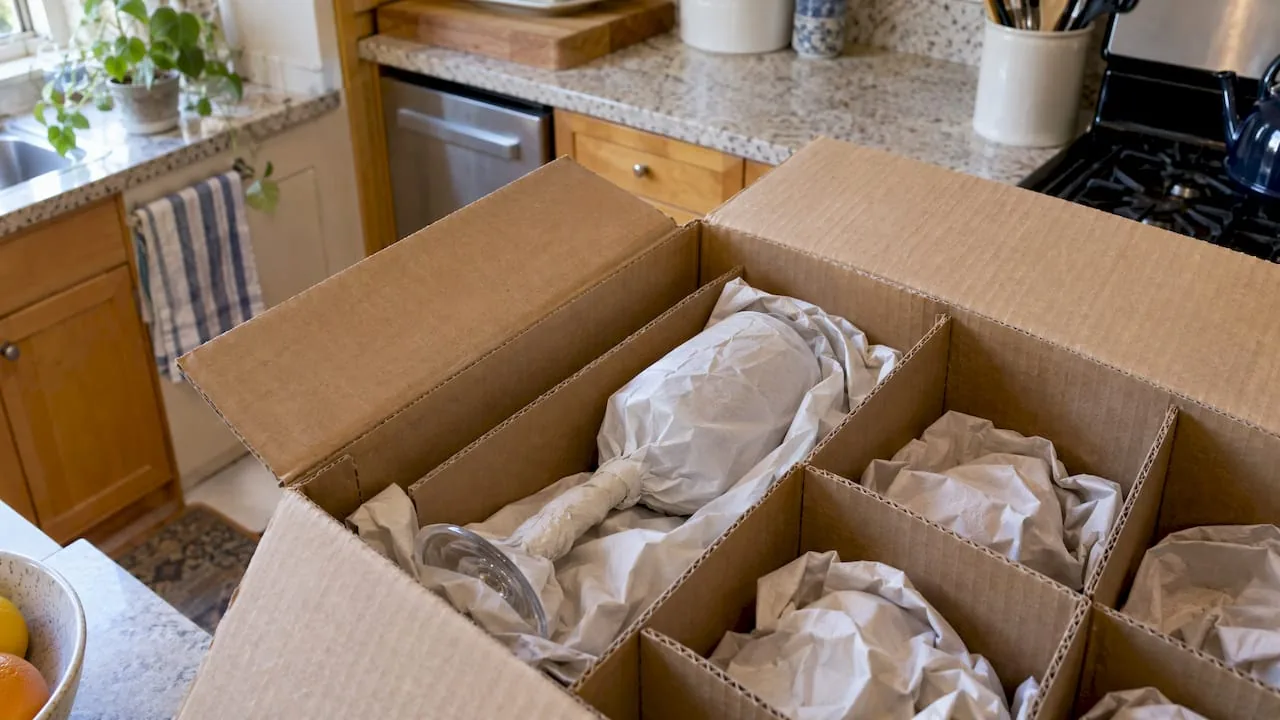
Stemware is the one place where bubble wrap earns its keep, as an outer layer over the paper. If you have a wine collection to move as well, our guide to moving wine bottles safely covers the bottles.
Packing China and Other Fragile Pieces
Family china, hand-painted pieces and heirlooms follow the same principles, with a little extra care.
- Wrap each piece alone. Put a sheet of paper between a plate and its lid or saucer.
- Use a smaller box. A box with fewer pieces is easier to carry and less likely to crush.
- Pad the rims and handles. Teacups, gravy boats and pitchers have parts that stick out and snap first.
- Add a second layer for delicate pieces. Paper next to the piece, bubble wrap around it.
- Never leave a gap. Towels, linens and soft clothing fill voids and add cushioning.
For the sharp items nearby, America’s Test Kitchen suggests wrapping knives and food-processor blades in thick towels taped in place or a knife roll, so nobody gets cut while unpacking.
For collectible, antique or high-value dishware, white glove handling is built for it. Our white glove moving service is for valuables that need extra attention. You can also browse our guides on packing and moving special items.
Fill, Seal and Label the Box
The last few minutes of packing decide whether the earlier work pays off.
- Fill the top. Add crumpled paper, a towel or a soft layer until the contents cannot move when you gently shake the box.
- Close the flaps and check them. If the lid bulges, the box is overfilled. Take something out.
- Tape every seam. Run tape along the center seam and across both edges. The “H” pattern, across the middle seam and both side seams, gives the box more strength.
- Label on several sides. Write “Fragile” and “This Side Up” on the top and at least two sides, plus the room it belongs in, such as “Kitchen: plates.” Martha Stewart’s guide recommends labeling on multiple sides so the label shows no matter how the box is stacked.
- Keep dish boxes manageable. If you cannot lift it comfortably, it is too heavy. Repack it into two smaller boxes.
Packing Dishes for a Bay Area Move
Local conditions shape how you should pack. Many Oakland homes and apartments, from older buildings near Lake Merritt to hillside houses in Rockridge and Montclair, involve stairs or a long carry from the curb. Berkeley’s hillside streets and San Francisco’s walk-ups and tight curbs add to that. Every extra flight is another chance for a heavy box to tilt.
What that means for your kitchen:
- Choose smaller boxes for plates and bowls. They are easier to carry down a staircase.
- Pack boxes tightly so they do not shift when carried at an angle.
- Keep fragile boxes together and labeled so the crew can load them last and unload them first.
- If you are moving within San Francisco, read our guide on preparing for moving day in San Francisco for parking and building access.
For more kitchen and household tips, see our moving tips and tricks page.
When to Let a Crew Pack the Kitchen
The kitchen is the slowest room to pack. It has the most small items, the most fragile ones, and the most decisions. If you are working full-time, moving with children, or relocating into the Bay Area from a distance, packing it yourself can take days you do not have.

ShipShape offers packing and labeling as part of our moving services. Our crews are full-time ShipShape employees, never subcontractors, and every mover is background checked before their first job. Our trucks are stocked with moving blankets, stretch wrap, dollies, straps and floor and door-frame protection.
If you are moving across town, our local moving service covers Oakland, Berkeley, San Francisco and the surrounding Bay Area. We also handle apartment and residential moves, large homes and moves within California.

To see how a kitchen would be handled for your move, get a free quote. Our published local rates, by card, are $190 per hour for 2 movers, $260 per hour for 3 movers and $330 per hour for 4 movers. Paying cash is $10 per hour less than the card rate. Local moves have a three-hour minimum and a one-time $80 truck fee.
Our Perspective
Dishes are the part of a move where small decisions add up. A box with a firm bottom, paper against every piece and no empty space survives almost anything. A box with one missing step often does not.
That is why we think of the kitchen as its own project, not just another room. It has the most individual items, the most variety in shape and the most things people care about. Plates, glasses, a grandparent’s serving bowl: each needs a different kind of attention.
Our crews are full-time ShipShape employees. Every mover is background checked before their first job. When the people who pack and carry your dishes work for the same company and use the same trucks and equipment, you are dealing with one team and one standard, not a patchwork.
We also think the best packing is the kind you do not have to think about. If you pack the kitchen yourself, use the method in this guide. If you would like help, our packing and labeling service is there so that you can spend moving week on the rest of your list.
Dennis
FAQ
What is the best way to pack plates for moving?
Wrap each plate in plain packing paper, bundle a small stack and rewrap it, then stand the bundles on their edges in a double-walled box. Put a thick layer of crumpled paper under them and fill all sides and the top. Plates are stronger on their edge than lying flat.
Is packing paper or bubble wrap better for dishes?
Packing paper is the better direct wrap because it molds around rims and edges. Bubble wrap works best as extra padding around stemware and delicate pieces, or as filler in the box. Use unprinted paper against dishes so ink does not transfer.
How do I pack glassware so it does not break?
Crumple paper inside each glass, wrap the outside, and place it in a divider cell or snugly in the box. For stemware, roll the glass in paper from a corner, fold the paper around the stem and bowl, and pad any open cells. Nothing should touch or move when you close the box.
What should I do with dishes I use every day?
Pack them last, and keep a small essentials box with a few plates, cups, bowls and utensils for each person. Open it first at your new place. Our unpacking checklist helps you set the kitchen up in a sensible order.
Can ShipShape pack my kitchen for me?
Yes. We offer packing and labeling as part of our moving services, along with white glove handling for valuables. Get a free quote to talk through your kitchen and your move.
Sources
- How To Pack Dishes for Moving, This Old House
- How To Pack a Kitchen, This Old House
- How to Pack Dishes and Glasses When Moving, Martha Stewart
- Moving? Follow These Expert Tips to Keep Your Kitchenware Safe, America’s Test Kitchen